AI Literacy and Seminar-Driven Career Readiness among Indonesian Secondary School Students: A Cross-Survey Analysis
DOI:
https://doi.org/10.65150/EP-gjefm/V2E6/2026-07Keywords:
AI literacy, career readiness, secondary education, Indonesia, seminar effectiveness, generative AI, educational interventionAbstract
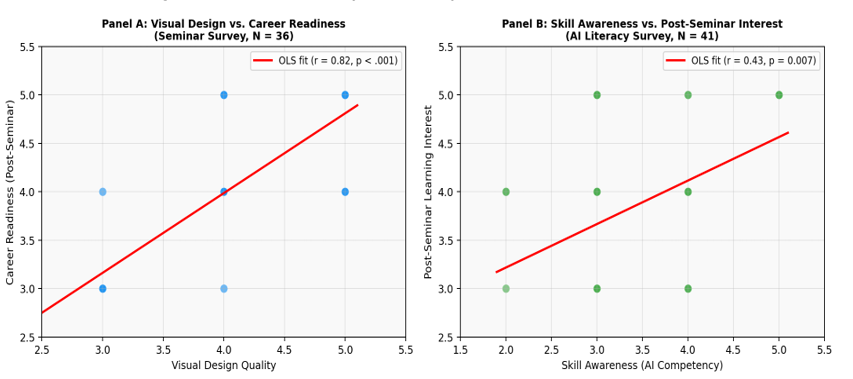
The rapid diffusion of generative artificial intelligence (AI) across professional and academic settings has heightened the urgency of building genuine AI literacy among young people, particularly in emerging economies where the gap between AI adoption and preparedness remains wide. This study examines two distinct but complementary phenomena: the effectiveness of an AI-themed educational seminar in shaping career readiness perceptions, and the baseline level of AI literacy among Indonesian secondary school students who attended the event. Using two purpose-built Likert-scale surveys administered on April 1, 2026, this study collected responses from 36 seminar participants (Seminar Evaluation Survey) and 41 students (AI Literacy Survey), primarily aged 17–19. Ordinary least squares (OLS) regression, Spearman rank correlations, and reliability analyses were employed to test three directional hypotheses. Results show that visual design quality (β = 0.485, p < .001) and data credibility (β = 0.264, p = .011) are the strongest predictors of post-seminar career readiness, together accounting for 75.1% of its variance (R² = 0.751). In the AI Literacy Survey, skill awareness is the sole significant predictor of continued learning interest (β = 0.575, p = .003), while overall AI literacy remains moderate (composite mean = 3.53 out of 5), with AI job optimism scoring lowest (M = 3.05). No statistically significant gender gap in composite AI literacy was detected (p = .239). These findings carry direct implications for educators and policymakers designing AI literacy interventions in Indonesia and comparable ASEAN contexts.
References
1) ASEAN Foundation. (2024). AI Ready ASEAN initiative: Building AI literacy across Southeast Asia. ASEAN Foundation & Google.
2) Bandura, A. (1986). Social foundations of thought and action: A social cognitive theory. Prentice-Hall.
3) Carolus, A., Koch, M. J., Straka, S., Latoschik, M. E., & Wienrich, C. (2023). MAILS – Meta AI literacy scale: Development and testing of an AI literacy questionnaire based on a comprehensive literature review. Computers in Human Behavior: Artificial Humans, 1(2), 100sheltered.
4) Carolus, A., Bauer, B., & colleagues. (2024). Meta AI literacy scale: Further validation and development of a short version. PMC (National Institutes of Health). https://pmc.ncbi.nlm.nih.gov/articles/PMC11544068/
5) Center for Digital Society, Universitas Gadjah Mada. (2025, December 17). Why literacy is a key pillar of Indonesian education in the age of artificial intelligence. https://digitalsociety.id/2025/12/17/why-literacy-is-a-key-pillar-of-indonesian-education-in-the-age-of-artificial-intelligence/20606/
6) Deci, E. L., & Ryan, R. M. (2000). The 'what' and 'why' of goal pursuits: Human needs and the self-determination of behavior. Psychological Inquiry, 11(4), 227–268. https://doi.org/10.1207/S15327965PLI1104_01
7) Dickey, E., & Bejarano, A. (2025). Evaluating the AI-Lab intervention: Impact on student perception and use of generative AI in early undergraduate computer science courses. arXiv. https://arxiv.org/pdf/2505.00100
8) Fauziddin, M., Adha, T. R., Arifiyanti, N., Indriyani, F., Rizki, L. M., Wulandary, V., & Reddy, V. S. V. (2025). The impact of AI on the future of education in Indonesia. Educative: Jurnal Ilmiah Pendidikan, 3(1), 11–16. https://doi.org/10.70437/educative.v3i1.828
9) Fošner, A. (2024). University students' attitudes and perceptions towards AI tools: Implications for sustainable educational practices. Sustainability, 16(19), 8668. https://doi.org/10.3390/su16198668
10) Hattie, J. (2009). Visible learning: A synthesis of over 800 meta-analyses relating to achievement. Routledge.
11) Khalifa, M., & Albadawy, M. (2024). Using artificial intelligence in academic writing and research: An essential guide for overcoming challenges, enhancing efficiency, and maintaining integrity. Computer Methods and Programs in Biomedicine Update, 6. https://doi.org/10.1016/j.cmpbup.2024.100145
12) Long, D., & Magerko, B. (2020). What is AI literacy? Competencies and design considerations. In Proceedings of the 2020 CHI Conference on Human Factors in Computing Systems (pp. 1–16). https://doi.org/10.1145/3313831.3376727
13) Mayer, R. E. (2009). Multimedia learning (2nd ed.). Cambridge University Press.
14) Ng, D. T. K., Leung, J. K. L., Chiu, T. K. F., & Chu, S. K. W. (2024). Design and validation of the AI literacy questionnaire: The affective, behavioural, cognitive and ethical approach. British Journal of Educational Technology, 55(3).
https://doi.org/10.1111/bjet.13411
15) Petty, R. E., & Cacioppo, J. T. (1986). The elaboration likelihood model of persuasion. Advances in Experimental Social Psychology, 19, 123–205. https://doi.org/10.1016/S0065-2601(08)60214-2
16) Setyawan, M. B., Dewi, D. A., & Hamid, M. A. (2025). Assessing students' readiness for artificial intelligence-based project learning to strengthen local wisdom values in Indonesia. Cogent Education, 12(1). https://doi.org/10.1080/2331186X.2025.2582948
17) Springer Nature. (2025). University students' perceptions of the impact of artificial intelligence in the business sector on their educational and professional development. Education and Information Technologies. https://doi.org/10.1007/s10639-025-13712-4
18) UNESCO. (2022). K-12 AI curricula: A mapping of government-endorsed AI curricula. UNESCO.
19) UNESCO. (2024). AI competency framework for students. UNESCO.
Downloads
Published
Issue
Section
License
Copyright (c) 2026 Eka Sudarmaji, Herlan, M. Rubiul Yatim, Satria Yunas, Roy Prakoso, Rika Kaniati, Octavia Tyara Ramadh, Sabrina Nurulfarah Juwanto (Author)

This work is licensed under a Creative Commons Attribution 4.0 International License.