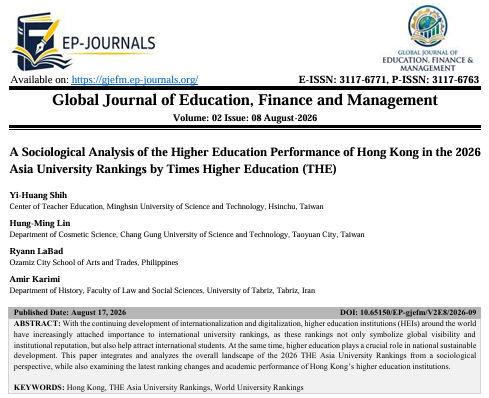
A Sociological Analysis of the Higher Education Performance of Hong Kong in the 2026 Asia University Rankings by Times Higher Education (THE)
DOI:
https://doi.org/10.65150/EP-gjefm/V2E8/2026-09Keywords:
Hong Kong, THE Asia University Rankings, World University RankingsAbstract
With the continuing development of internationalization and digitalization, higher education institutions (HEIs) around the world have increasingly attached importance to international university rankings, as these rankings not only symbolize global visibility and institutional reputation, but also help attract international students. At the same time, higher education plays a crucial role in national sustainable development. This paper integrates and analyzes the overall landscape of the 2026 THE Asia University Rankings from a sociological perspective, while also examining the latest ranking changes and academic performance of Hong Kong’s higher education institutions.
References
1) Altbach, P. G. (2012). The Globalization of College and University Rankings. Change: The Magazine of Higher Learning, 44(1), 26–31. https://doi.org/10.1080/00091383.2012.636001
2) Altbach, P. G., & Knight, J. (2007). The internationalization of higher education: Motivations and realities. Journal of Studies in International Education, 11(3–4), 290–305. https://doi.org/10.1177/1028315307303542
3) Altbach, P. G., & Salmi, J. (2011). The Road to Academic Excellence: The Making of World-Class Research Universities. Washington, DC: World Bank.
4) Bourdieu, P. (1986). The forms of capital. In J. G. Richardson (Ed.), Handbook of Theory and Research for the Sociology of Education (pp. 241–258). New York, NY: Greenwood Press.
5) Chen, M. K., & Shih, Y. H. (2025). The role of higher education in sustainable national development: Reflections from an international perspective," Edelweiss Applied Science and Technology, 9(4), 1343-1351.
6) Dill, D. D., & Soo, M. (2005). Academic quality, league tables, and public policy: A cross-national analysis of university ranking systems. High Educ 49, 495–533. https://doi.org/10.1007/s10734-004-1746-8
7) DiMaggio, P. J., & Powell, W. W. (1983). The iron cage revisited: Institutional isomorphism and collective rationality in organizational fields. American Sociological Review, 48(2), 147–160. https://doi.org/10.2307/2095101
8) Hazelkorn, E. (2015). Rankings and the Reshaping of Higher Education: The Battle for World-Class Excellence (2nd ed.). London, England: Palgrave Macmillan.
9) Jack, P. (2026). World University Rankings 2026: results announced. https://www.timeshighereducation.com/news/world-university-rankings-2026-results-announced
10) Kochetkov, D. (2024). University rankings in the context of research evaluation: A state-of-the-art review. Quantitative Science Studies, 5(3), 533-555.
11) Lin, J. C. (2026). Framing National Education in Hong Kong: A frame analysis of power dynamics in stakeholders' competing narratives. British Educational Research Journal, 00, 1–26. https://doi.org/10.1002/berj.70149
12) Lu, Q. Y. (2026). THE Asia University Rankings 2026: All eight publicly funded universities in Hong Kong enter the top 100 in Asia for the first time. https://hk.ulifestyle.com.hk/topic/detail/20095211/
13) Marginson, S. (2007a). Global University Rankings: Implications in general and for Australia. Journal of Higher Education Policy and Management, 29, 131 - 142.
14) Marginson, S. (2007b).Global Position and Position Taking:The Case of Australia. Journal of Studies in International Education,11(1),5-32.
15) Marginson, S. (2011). Higher education and public good. Higher Education Quarterly, 65(4), 411–433.
16) Marginson, S. (2014). University rankings and social science. European Journal of Education, 49(1),45–59. https://doi.org/10.1111/ejed.12061
17) Marginson, S. (2016). The worldwide trend to high participation higher education: Dynamics of social stratification in inclusive systems. Higher Education, 72, 413–434. https://doi.org/10.1007/s10734-016-0016-x
18) Mok, K. H., & Cheung, A. B. L. (2011). Global aspirations and strategising for world-class status: new form of politics in higher education governance in Hong Kong. Journal of Higher Education Policy and Management, 33(3),231–251.
https://doi.org/10.1080/1360080X.2011.564998
19) Mok, K. H. (2015). Higher education transformations for global competitiveness: Policy responses, social consequences and impact on the academic profession in Asia. Higher Education Policy, 28, 1–15.
20) Salmi, J. (2009). The challenge of establishing world-class universities. World Bank Group.
21) Shih, Y. H. (2024) Higher education for sustainable development in Taiwan: an analysis of universities listed in the top 500 of the QS World University Rankings 2024. Front. Educ. 9:1421813. doi: 10.3389/feduc.2024.1421813
22) Shih, Y. H., Hsu, M. C., & Chang, C. L. (2025). Sustainability Transformations in Higher Education: Global Perspectives on The Challenges and Solutions. International Journal of Education and Humanities, 5(1), 126–139. https://doi.org/10.58557/(ijeh).v5i1.290
23) Shih, Y. H., & Wang, R. J. (2022). Incorporating gender issues into the classroom: Study on the teaching of gender-related courses in the general curriculum of Taiwan’s universities. Policy Futures in Education, 20(1), 44-55.
24) Shin, J.C., & Toutkoushian, R.K. (2011). The Past, Present, and Future of University Rankings. In: Shin, J., Toutkoushian, R., Teichler, U. (eds) University Rankings. The Changing Academy – The Changing Academic Profession in International Comparative Perspective, vol 3. Springer, Dordrecht. https://doi.org/10.1007/978-94-007-1116-7_1
25) Wu, C. S. (2026). Chasing university rankings without losing the essence of education and distinctive institutional development. Taiwan Educational Review Monthly, 15(1), 20–25.
26) Wang, R. J. (2026). Chasing university rankings without losing the essence of education and distinctive institutional development. Taiwan Educational Review Monthly, 15(1), 20–25.
27) Wang, R. J., & Shih, Y. H. (2023). What are universities pursuing? A review of the Quacquarelli Symonds world university rankings of Taiwanese universities (2021–2023). Front. Educ. 8:1185817. doi: 10.3389/feduc.2023.1185817
28) World Bank. (2020). The changing nature of higher education financing: Implications for higher education policy. World Bank Group.
29) Ye, Y., & Shih, Y. H. (2021). Development of John Dewey’s educational philosophy and its implications for children’s education. Policy Futures in Education, 19(8), 877-890. https://doi.org/10.1177/1478210320987678 (Original work published 2021)
Downloads
Published
Issue
Section
License
Copyright (c) 2026 Yi-Huang Shih, Hung-Ming Lin, Ryann LaBad, Amir Karimi (Author)

This work is licensed under a Creative Commons Attribution 4.0 International License.