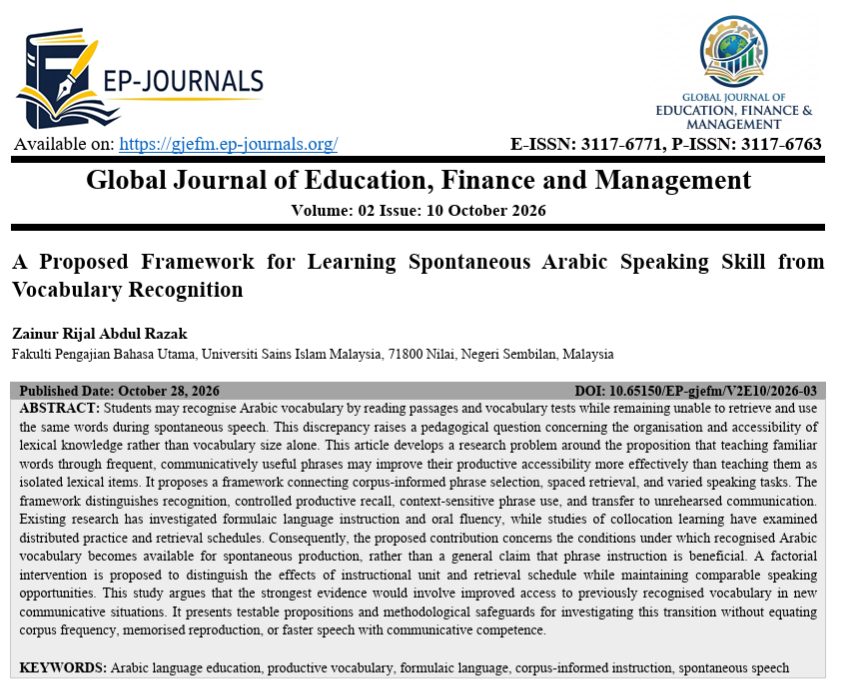
A Proposed Framework for Learning Spontaneous Arabic Speaking Skill from Vocabulary Recognition
DOI:
https://doi.org/10.65150/EP-gjefm/V2E10/2026-03Keywords:
Arabic language education, productive vocabulary, formulaic language, corpus-informed instruction, spontaneous speechAbstract
Students may recognise Arabic vocabulary by reading passages and vocabulary tests while remaining unable to retrieve and use the same words during spontaneous speech. This discrepancy raises a pedagogical question concerning the organisation and accessibility of lexical knowledge rather than vocabulary size alone. This article develops a research problem around the proposition that teaching familiar words through frequent, communicatively useful phrases may improve their productive accessibility more effectively than teaching them as isolated lexical items. It proposes a framework connecting corpus-informed phrase selection, spaced retrieval, and varied speaking tasks. The framework distinguishes recognition, controlled productive recall, context-sensitive phrase use, and transfer to unrehearsed communication. Existing research has investigated formulaic language instruction and oral fluency, while studies of collocation learning have examined distributed practice and retrieval schedules. Consequently, the proposed contribution concerns the conditions under which recognised Arabic vocabulary becomes available for spontaneous production, rather than a general claim that phrase instruction is beneficial. A factorial intervention is proposed to distinguish the effects of instructional unit and retrieval schedule while maintaining comparable speaking opportunities. This study argues that the strongest evidence would involve improved access to previously recognised vocabulary in new communicative situations. It presents testable propositions and methodological safeguards for investigating this transition without equating corpus frequency, memorised reproduction, or faster speech with communicative competence.
References
1) Asbulah, L. H., Aladdin, A., Lubis, M. A., & Sahrim, M. (2019). Strategi pembelajaran kolokasi bahasa Arab dalam kalangan pelajar universiti awam Malaysia. GEMA Online Journal of Language Studies, 19(2), 139–159. https://doi.org/10.17576/gema-2019-1902-09
2) Boulton, A., & Cobb, T. (2017). Corpus use in language learning: A meta-analysis. Language Learning, 67(2),348–393.
https://doi.org/10.1111/lang.12224
3) Cepeda, N. J., Pashler, H., Vul, E., Wixted, J. T., & Rohrer, D. (2006). Distributed practice in verbal recall tasks: A review and quantitative synthesis. Psychological Bulletin, 132(3), 354–380. https://doi.org/10.1037/0033-2909.132.3.354
4) Conklin, K., & Schmitt, N. (2012). The processing of formulaic language. Annual Review of Applied Linguistics, 32, 45–61. https://doi.org/10.1017/S0267190512000074
5) Ellis, N. C. (2012). Formulaic language and second language acquisition: Zipf and the phrasal teddy bear. Annual Review of Applied Linguistics, 32, 17–44. https://doi.org/10.1017/S0267190512000025
6) Fang, N., Elgort, I., & Chen, Z. (2024). Effects of retrieval schedules on the acquisition of explicit, automatized-explicit, and implicit knowledge of L2 collocations. Studies in Second Language Acquisition, 46(3), 663–685. https://doi.org/10.1017/S0272263124000184
7) Gablasova, D., Brezina, V., & McEnery, T. (2017). Collocations in corpus-based language learning research: Identifying, comparing, and interpreting the evidence. Language Learning, 67(S1), 155–179. https://doi.org/10.1111/lang.12225
8) Karpicke, J. D., & Roediger, H. L., III. (2008). The critical importance of retrieval for learning. Science,319(5865), 966–968. https://doi.org/10.1126/science.1152408
9) Lambert, C., Kormos, J., & Minn, D. (2017). Task repetition and second language speech processing. Studies in Second Language Acquisition, 39(1), 167–196. https://doi.org/10.1017/S0272263116000085
10) McGuire, M., & Larson-Hall, J. (2017). Teaching formulaic sequences in the classroom: Effects on spoken fluency. TESL Canada Journal, 34(3), 1–25. https://doi.org/10.18806/tesl.v34i3.1271
11) Nation, I. S. P. (2013). Learning vocabulary in another language (2nd ed.). Cambridge University Press.
12) Nergis, A. (2021). Can explicit instruction of formulaic sequences enhance L2 oral fluency? Lingua, 255, Article 103072. https://doi.org/10.1016/j.lingua.2021.103072
13) Suzuki, S., Kormos, J., & Uchihara, T. (2021). The relationship between utterance and perceived fluency: A meta-analysis of correlational studies. The Modern Language Journal, 105(2), 435–463. https://doi.org/10.1111/modl.12706
14) Tavakoli, P., & Uchihara, T. (2020). To what extent are multiword sequences associated with oral fluency? Language Learning, 70(2), 506–547. https://doi.org/10.1111/lang.12384
15) Thomson, H. (2017). Building speaking fluency with multiword expressions. TESL Canada Journal, 34(3), 26–53.
https://doi.org/10.18806/tesl.v34i3.1272
16) Webb, S. (2008). Receptive and productive vocabulary sizes of L2 learners. Studies in Second Language Acquisition, 30(1), 79–95. https://doi.org/10.1017/S0272263108080042
17) Yamagata, S., Nakata, T., & Rogers, J. (2023). Effects of distributed practice on the acquisition of verb–noun collocations. Studies in Second Language Acquisition, 45(2), 291–317. https://doi.org/10.1017/S0272263122000225
18) Zaki, M. (2017). Corpus-based teaching in the Arabic classroom: Theoretical and practical perspectives. International Journal of Applied Linguistics, 27(2), 514–541. https://doi.org/10.1111/ijal.12159
Downloads
Published
Issue
Section
License
Copyright (c) 2026 Zainur Rijal Abdul Razak (Author)

This work is licensed under a Creative Commons Attribution 4.0 International License.