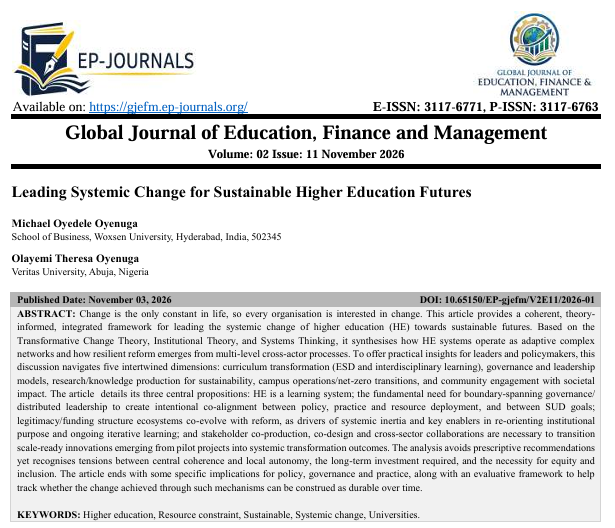
Leading Systemic Change for Sustainable Higher Education Futures
DOI:
https://doi.org/10.65150/EP-gjefm/V2E11/2026-01Keywords:
Higher education, Resource constraint, Sustainable, Systemic change, Universities.Abstract
Change is the only constant in life, so every organisation is interested in change. This article provides a coherent, theory-informed, integrated framework for leading the systemic change of higher education (HE) towards sustainable futures. Based on the Transformative Change Theory, Institutional Theory, and Systems Thinking, it synthesises how HE systems operate as adaptive complex networks and how resilient reform emerges from multi-level cross-actor processes. To offer practical insights for leaders and policymakers, this discussion navigates five intertwined dimensions: curriculum transformation (ESD and interdisciplinary learning), governance and leadership models, research/knowledge production for sustainability, campus operations/net-zero transitions, and community engagement with societal impact. The article details its three central propositions: HE is a learning system; the fundamental need for boundary-spanning governance/ distributed leadership to create intentional co-alignment between policy, practice and resource deployment, and between SUD goals; legitimacy/funding structure ecosystems co-evolve with reform, as drivers of systemic inertia and key enablers in re-orienting institutional purpose and ongoing iterative learning; and stakeholder co-production, co-design and cross-sector collaborations are necessary to transition scale-ready innovations emerging from pilot projects into systemic transformation outcomes. The analysis avoids prescriptive recommendations yet recognises tensions between central coherence and local autonomy, the long-term investment required, and the necessity for equity and inclusion. The article ends with some specific implications for policy, governance and practice, along with an evaluative framework to help track whether the change achieved through such mechanisms can be construed as durable over time.
References
1) Abdelgaffar, H. (2021). A review of responsible management education: practices, outcomes and challenges. The Journal of Management Development, 40(9/10), 613-638. https://doi.org/10.1108/jmd-03-2020-0087
2) Alberdi, G. & Zubillaga, M. (2021). The Promotion of Sustainable Diets in the Healthcare System and Implications for Health Professionals: A Scoping Review. Nutrients, 13(3), 747. https://doi.org/10.3390/nu13030747
3) Alava, J., Kola-Torvinen, P., & Risku, M. (2023). Educational Policy, Governance, and Leadership., 11-39. https://doi.org/10.1007/978-3-031-37604-7_2
4) Alberdi, G. & Zubillaga, M. (2021). The Promotion of Sustainable Diets in the Healthcare System and Implications for Health Professionals: A Scoping Review. Nutrients, 13(3), 747. https://doi.org/10.3390/nu13030747
5) Apata A.O & Oyedele M. O. (2025). Undergraduates' Application of ChatGPT in Academic Writing: Perceptions, Problems and Prospects. International Journal of Social Sciences and Management Review 8(3), 201-218 https://doi.org/10.37602/IJSSMR.2025.8312
6) Aver, B., Fošner, A., & Alfirević, N. (2021). Higher Education Challenges: Developing Skills to Address Contemporary Economic and Sustainability Issues. Sustainability, 13(22), 12567. https://doi.org/10.3390/su132212567
7) Azizi, L. (2022). Which leadership processes encourage sustainable transitions within universities?. International Journal of Sustainability in Higher Education, 24(1), 46-68. https://doi.org/10.1108/ijshe-12-2021-0510
8) Basheer, N., Ahmed, V., Bahroun, Z., et al. (2024). Exploring sustainability assessment practices in higher education: A comprehensive review. Sustainability.
9) Boocock, A. (2017). Meeting the needs of local communities and businesses: From transactional to eco-leadership in the English further education sector. Educational Management Administration & Leadership, 47(3), 349-368. https://doi.org/10.1177/1741143217739364
10) Caro-Barek, V. and Støckert, R. (2024). Road works ahead: the journey of an innovative cross-campus hybrid learning space navigating higher education institutions’ organizational setbacks. Frontiers in Education, 9. https://doi.org/10.3389/feduc.2024.1330804
11) Cebrián, G. (2019). University and the 2030 Agenda for Sustainable Development: processes and prospects. Universitas Tarraconensis Revista De Ciències De L Educació, 78-94. https://doi.org/10.17345/ute.2019.1.2629
12) Christine W., Gustav O., Jeroen J. & Liane S.(2024). Revolutionising sustainability leadership and education: addressing the human dimension to support flourishing, culture and system transformation, Climatic Change, Springer, vol. 177(1), pages 1-23,https://doi.org/10.1007/s10584-023-03636-8
13) Clair, M. & Chiang, L. (2016). Chapter 2. The University as a Living Laboratory for Climate Solutions. Collabra, 2(1).https://doi.org/10.1525/collabra.61
14) Edwards, M., Benn, S., & Starik, M. (2017). Business cases for sustainability-integrated management education.https://doi.org/10.4337/9781785361241.00010
15) Eichberg, E. & Charles, A. (2024). The Role of the Civic University in Facilitating Inclusive and Transformative Pedagogical Approaches to the Sustainable Development Goals: A Systematic Literature Review. Sustainability, 16(7), 2752. https://doi.org/10.3390/su16072752
16) Evans, N., Inwood, H., Christie, B., & Ärlemalm–Hagsér, E. (2021). Comparing education for sustainable development in initial teacher education across four countries. International Journal of Sustainability in Higher Education, 22(6), 1351-1372.https://doi.org/10.1108/ijshe-07-2020-0254
17) Farinha, C., Caeiro, S., & Azeiteiro, U. (2020). Universities speak up regarding the implementation of sustainable development challenges. International Journal of Sustainability in Higher Education, 21(3), 465-506. https://doi.org/10.1108/ijshe-08-2019-0250
18) Filho, W. L., Eustachio, J. H. P. P., Ávila, L. V., Dinis, M. A. P., Hernandez-Diaz, P. M., Batista, K., Borsari, B., & Abubakar, I. R. (2025). Enhancing the contribution of higher education institutions to sustainable development research: A focus on post-2015 SDGs. Sustainable Development, 33(2), 1745–1757. https://doi.org/10.1002/sd.3184
19) Flori, M., Raulea, E.-C., & Raulea, C. (2025). Innovative leadership and sustainability in higher education management. Cleaner and Responsible Consumption. https://doi.org/10.1016/j.caeo.2025.100272
20) Gawande, A., & Kumar, A., (2022). Fostering Resilient Business Ecosystems and Economic Growth: Towards the Next Normal. Research and Publication Cell, Dr. D. Y. Patil B-School, Pune, India. DOI: https://doi.org/10.5281/zenodo.6773034
21) Gedifew, M. and Muluneh, G. (2020). Building a change adaptive university: A system of composite indicators to measure and facilitate pervasive changes. Higher Education Quarterly, 75(2), 227-246. https://doi.org/10.1111/hequ.12279
22) Geels, F. W. (2002). Technological transitions as evolutionary reconfiguration processes: A multi-level perspective. Research Policy, 31(8–9), 1257–1274.
23) Goins, M., Sluder, C., Madgett, M., Touton, L., & Stephenson, S. (2023). Oak Ridge National Laboratory FY 2023 Site Sustainability Plan with FY 2023 Performance Data.. https://doi.org/10.2172/2217700
24) Haniff, N. & Daya, P. (2023). Distributed leadership: A model for student leadership engagement. South African Journal of Higher Education. https://doi.org/10.20853/37-4-5078
25) Harris, A. (2020). Leading school and system improvement: Why context matters. European Journal of Education, 55(2), 143-145.https://doi.org/10.1111/ejed.12393
26) Hazelkorn, E. (2015). Rankings and the reshaping of higher education (2nd ed.). Palgrave Macmillan.
27) Hua, H. H., Le, T. T., Phuong, H. Y., & Pham, T. T. (2025). Sustainable leadership in higher education: a case study exploring the emergent strategies of four Vietnamese leaders’ strategies. Cogent Social Sciences, 11(1). https://doi.org/10.1080/23311886.2025.2516076
28) Jafar, S.H., Oyedele, O.M., Nawaah, D. & Bolanle, A.S. (2025). Exploring Leadership Challenges for Adoption of Digital Innovation and Sustainability, Singh, R., Corvello, V., Coniglio, I.M. and Khan, S. (Ed.) Innovation Ecosystems and Sustainable Technologies (Emerald Studies in Sustainable Innovation Management), Emerald Publishing Limited, Leeds, pp. 253-269. https://doi.org/10.1108/978-1-83662-368-720251012
29) Jameson, J. (2012). Leadership Values, Trust and Negative Capability: Managing the Uncertainties of Future English Higher Education. Higher Education Quarterly, 66(4), 391-414. https://doi.org/10.1111/j.1468-2273.2012.00533.x
30) Kaseke, N. (2022). Internationalisation and governance issues in higher education., 109-130. https://doi.org/10.4102/aosis.2022.bk297.06
31) Kılanç, B. (2012). Operationalization of Diversity in Turkish Higher Education System. Yuksekogretim Dergisi, 2(1), 38-51. https://doi.org/10.2399/yod.12.010
32) Kourgiozou, V., Commin, A., Dowson, M., Rovas, D., & Mumovic, D. (2021). Scalable pathways to net zero carbon in the UK higher education sector: A systematic review of smart energy systems in university campuses. Renewable and Sustainable Energy Reviews, 147, 111234. https://doi.org/10.1016/j.rser.2021.111234
33) Kurowski, A. (2020). The language of dissent – how school leaders adjust to policy change. Educational Role of Language Journal, 2020-1(3), 43-61. https://doi.org/10.36534/erlj.2020.01.04
34) Levesque, V. & Wake, C. (2021). Organizational change for sustainability education: a case study of one university’s efforts to create and implement institution-wide sustainability competencies. International Journal of Sustainability in Higher Education, 22(3), 497-515. https://doi.org/10.1108/ijshe-09-2019-0285
35) Lūsēna-Ezera, I. and Siliņa-Jasjukeviča, G. (2024). What is the implementation practice of schools as learning organisations from the perspective of local governments?. Acta Paedagogica Vilnensia, 51, 118-131. https://doi.org/10.15388/actpaed.2023.51.7
36) Lomas, D. & Bond, S. (2024). Responding to climate change in Aotearoa New Zealand: Universities, neoliberalism and narratives of change. New Zealand Geographer, 80(1), 30-43. https://doi.org/10.1111/nzg.12385
37) Lottu, O., Ehiaguina, V., Ayodeji, S., Ndiwe, T., & Izuka, U. (2023). GLOBAL REVIEW OF SOLAR POWER IN EDUCATION: INITIATIVES, CHALLENGES, AND BENEFITS. Engineering Science & Technology Journal, 4(4), 209-221.https://doi.org/10.51594/estj.v4i4.583
38) Marginson, S. (2016). The worldwide trend to high participation higher education. Higher Education, 72(4), 413–434.
39) Meadows, D. H. (2008). Thinking in systems: A primer. Chelsea Green Publishing.
40) Melles, G. (2019). Views on education for sustainable development (ESD) among lecturers in UK MSc taught courses. International Journal of Sustainability in Higher Education, 20(1), 115-138. https://doi.org/10.1108/ijshe-02-2018-0032
41) Menon, S. & Suresh, M. (2020). Synergizing education, research, campus operations, and community engagements towards sustainability in higher education: a literature review. International Journal of Sustainability in Higher Education, 21(5), 1015-1051. https://doi.org/10.1108/ijshe-03-2020-0089
42) Middlehurst, R. (2013). Changing Internal Governance: Are Leadership Roles and Management Structures in United Kingdom Universities Fit for the Future?. Higher Education Quarterly, 67(3), 275-294. https://doi.org/10.1111/hequ.12018
43) Miller, A., Reyes, J., Wyttenbach, M., & Ezeugwu, G. (2022). The limits of the “system of schools” approach: Superintendent perspectives on change efforts in U.S. Catholic school systems. Journal of Educational Change, 24(4), 943-970. https://doi.org/10.1007/s10833-022-09475-1
44) Moon, C., Walmsley, A., & Apostolopoulos, N. (2018). Governance implications of the UN higher education sustainability initiative. Corporate Governance, 18(4), 624-634. https://doi.org/10.1108/cg-01-2018-0020
45) Mugano, G. (2022). Accountability in higher education., 89-108. https://doi.org/10.4102/aosis.2022.bk297.05
46) Mutanga, S., Mantlana, B., Mudavanhu, S., Muthige, M., Skhosana, F., Lumsden, T., … & John, J. (2024). Implementation of water energy food-health nexus in a climate constrained world: a review for South Africa. Frontiers in Environmental Science, 12. https://doi.org/10.3389/fenvs.2024.1307972
47) Nduji R., Oyenuga M.O , Bazza M., & Oriaku C.(2023) Application of Transactional Leadership Style for Managers in Adopting the Organization’s Cultural Intelligence: A Study of Coscharis Group of Companies, Nnewi, Nigeria ASRIC Journal on Social Sciences and Humanities Vol 4(1) (2023) 299-316 www.asric.africa
48) Ogbolu, G., Hague, S., Adelaja, A., Ohanagorom, M., Amala, M., & Adedeji, O. (2026). Sustainability in Higher Education: A Systematic Review and Conceptual Framework of Institutional Maturity (SHE-IMM). Trends in Higher Education, 5(1), 26. https://doi.org/10.3390/higheredu5010026
49) Oyenuga, M.O., Jeresa, S. (2025). Adaptation and Resilience: Private, Public, and Individual Change Makers. In: Singh, R., Filho, W.L. (eds) Climate Neutrality Through Smart Eco-Innovation and Environmental Sustainability. Climate Change Management. Springer, Cham. https://doi.org/10.1007/978-3-031-83250-5_2
50) Oyenuga, M.O., Singh, R., Apata, S.B., Khan, S., Kumar, V. (2025). Strengthening Legal and Institutional Frameworks for Net Zero Economy. In: Smart Technologies for Climate Change and Net Zero Policies: Practical Approaches Towards Sustainability. Climate Change Management. Springer, Cham. https://doi.org/10.1007/978-3-031-92221-3_16
51) Oyenuga, M. O. & Apata, S. B. (2026). The Future of Sustainable Education in Higher Education. In A. Omotosho, S. Apata, & M. Akintolu (Eds.), Interdisciplinary Perspectives on Transnational Education for Sustainable Development (pp. 231-262). IGI Global Scientific Publishing. https://doi.org/10.4018/979-8-3373-4357-0.ch008
52) Oyenuga, M. O. (2026). Case Studies: Sustainability in Higher Education in the Global South. In A. Omotosho, S. Apata, & M. Akintolu (Eds.), Interdisciplinary Perspectives on Transnational Education for Sustainable Development (pp. 119-156). IGI Global Scientific Publishing. https://doi.org/10.4018/979-8-3373-4357-0.ch005
53) Oyenuga, M. O. (2026). Leadership 4.0: AI and the Reimagining of Higher Education Institutions. In D. Roache (Ed.), Institutional Perspectives on AI Implementation in Higher Education (pp. 339-372). IGI Global Scientific Publishing. https://doi.org/10.4018/979-8-2600-3673-0.ch012
54) Polin, K., Yiğitcanlar, T., Washington, T., & Limb, M. (2024). Unpacking Smart Campus Assessment: Developing a Framework via Narrative Literature Review. Sustainability, 16(6), 2494. https://doi.org/10.3390/su16062494
55) Popowska, M. and Sady, M. (2023). Universities’ journey towards sustainability- systematic literature review. International Journal of Sustainability in Higher Education, 25(3), 596-615. https://doi.org/10.1108/ijshe-08-2022-0280
56) Robinson, J., Alhakim, A., Grace, X., Alam, M., Brando, F., Braune, M., … & Wiek, A. (2023). Odd couples: reconciling academic and operational cultures for whole-institution sustainability governance at universities. International Journal of Sustainability in Higher Education, 24(8), 1949-1969. https://doi.org/10.1108/ijshe-07-2022-0244
57) Sharma, R. (2021). Sustainable Political Leadership Based on System Thinking in Rural Development Practices of Nepal. Research Nepal Journal of Development Studies, 4(2), 93-105. https://doi.org/10.3126/rnjds.v4i2.42689
58) Sharp, L. (2002). Green campuses: the road from little victories to systemic transformation. International Journal of Sustainability in Higher Education, 3(2), 128-145. https://doi.org/10.1108/14676370210422357
59) Shostak, R., Alessandro, M., Dia¬mond, P., Mosqueira, E., & Lafuente, M. (2023). The Center of Government, Revisited: A Decade of Global Reforms.. https://doi.org/10.18235/0004994
60) Siliņa-Jasjukeviča, G., Lastovska, A., Surikova, S., Kaulēns, O., Linde, I., & Lūsēna-Ezera, I. (2023). Education Policy Institutions’ Comprehension of the School as a Learning Organisation Approach: A Case Study of Latvia. Education Sciences, 13(9), 907. https://doi.org/10.3390/educsci13090907
61) Spulber, D. (2022). Reflections on globalisation, leadership and pedagogy: Competence-based didactics and Objective based Training.. Geopolitical Social Security and Freedom Journal, 5(2), 63-77. https://doi.org/10.2478/gssfj-2022-0014
62) Sterling, S. (2011). Transformative learning and sustainability. Learning and Teaching in Higher Education, 5, 17–33.
63) Sun, Y., Cui, H., Han, Y., & Tong, X. (2023). Current Status and Implications of International Higher Education Governance Research., 706-712. https://doi.org/10.2991/978-94-6463-058-9_111
64) Sylvestre, P., Wright, T., & Sherren, K. (2013). Exploring Faculty Conceptualizations of Sustainability in Higher Education: Cultural Barriers to Organizational Change and Potential Resolutions. Journal of Education for Sustainable Development, 7(2), 223-244. https://doi.org/10.1177/0973408214526491
65) Torres, A. (2023). Causal Stories and Problem Definitions: How Policymakers and Superintendents Frame School Turnaround. Aera Open, 9. https://doi.org/10.1177/23328584231186425
66) Uljens, M. & Elo, J. (2024). Grounding Higher Education Leadership Research in Non-affirmative Education Theory., 1-44. https://doi.org/10.1007/978-3-031-55116-1_1
67) UNESCO. (2021). Reimagining our futures together: A new social contract for education. UNESCO Publishing.
68) Vargas, V., Paucar‐Caceres, A., & Haley, D. (2021). The Role of Higher Education Stakeholder Networks for Sustainable Development: A Systems Perspective., 123-139. https://doi.org/10.1007/978-3-030-63399-8_9
69) Veidemane, A., Crăciun, D., & Meulen, B. (2024). Critical sustainability events and perceived roles of academic leaders at a leading university in sustainability: CIT case study.. https://doi.org/10.21203/rs.3.rs-4977416/v1
70) Wals, A. E. J., & Blewitt, J. (2010). Sustainability in higher education. International Journal of Sustainability in Higher Education, 11(2), 132–146.
71) Weiss, M., Barth, M., & Wehrden, H. (2021). The patterns of curriculum change processes that embed sustainability in higher education institutions. Sustainability Science, 16(5), 1579-1593. https://doi.org/10.1007/s11625-021-00984-1
72) Whittaker, J. & Montgomery, B. (2022). Advancing a cultural change agenda in higher education: issues and values related to reimagining academic leadership. Discover Sustainability, 3(1). https://doi.org/10.1007/s43621-022-00079-6
73) Woods, P., Jarvis, J., Roberts, A., & Culshaw, S. (2020). School Leadership Preparation and Development in England.. https://doi.org/10.1093/acrefore/9780190264093.013.720
Downloads
Published
Issue
Section
License
Copyright (c) 2026 Michael Oyedele Oyenuga, Olayemi Theresa Oyenuga (Author)

This work is licensed under a Creative Commons Attribution 4.0 International License.