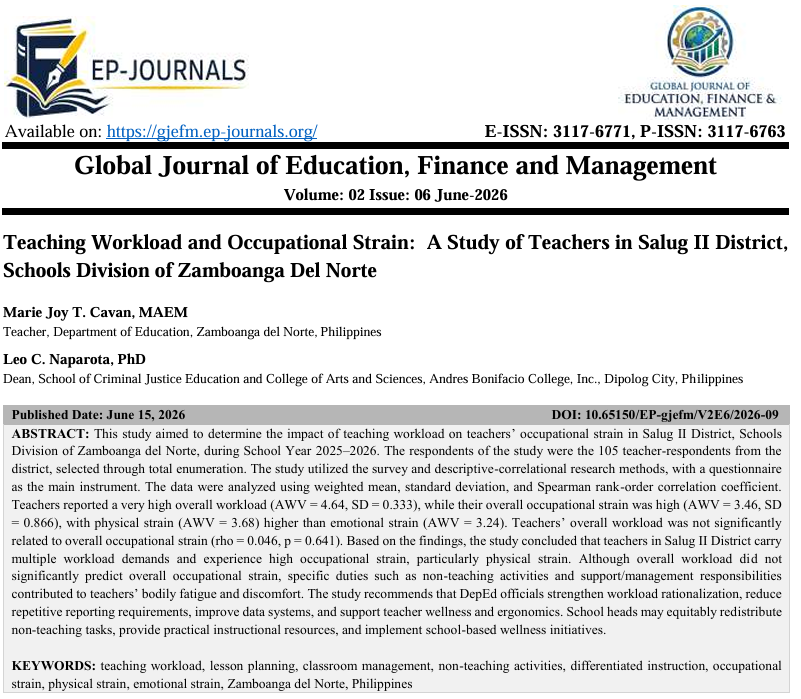
Teaching Workload and Occupational Strain: A Study of Teachers in Salug II District, Schools Division of Zamboanga Del Norte
DOI:
https://doi.org/10.65150/EP-gjefm/V2E6/2026-09Keywords:
teaching workload, lesson planning, classroom management, non-teaching activities, differentiated instruction, occupational strain, physical strain, emotional strain, Zamboanga del Norte, PhilippinesAbstract
This study aimed to determine the impact of teaching workload on teachers’ occupational strain in Salug II District, Schools Division of Zamboanga del Norte, during School Year 2025–2026. The respondents of the study were the 105 teacher-respondents from the district, selected through total enumeration. The study utilized the survey and descriptive-correlational research methods, with a questionnaire as the main instrument. The data were analyzed using weighted mean, standard deviation, and Spearman rank-order correlation coefficient. Teachers reported a very high overall workload (AWV = 4.64, SD = 0.333), while their overall occupational strain was high (AWV = 3.46, SD = 0.866), with physical strain (AWV = 3.68) higher than emotional strain (AWV = 3.24). Teachers’ overall workload was not significantly related to overall occupational strain (rho = 0.046, p = 0.641). Based on the findings, the study concluded that teachers in Salug II District carry multiple workload demands and experience high occupational strain, particularly physical strain. Although overall workload did not significantly predict overall occupational strain, specific duties such as non-teaching activities and support/management responsibilities contributed to teachers’ bodily fatigue and discomfort. The study recommends that DepEd officials strengthen workload rationalization, reduce repetitive reporting requirements, improve data systems, and support teacher wellness and ergonomics. School heads may equitably redistribute non-teaching tasks, provide practical instructional resources, and implement school-based wellness initiatives.
References
1) Agyapong, B., Obuobi-Donkor, G., Burback, L., & Wei, Y. (2022). Stress, burnout, anxiety and depression among teachers: A scoping review. International Journal of Environmental Research and Public Health, 19(17), 10706. https://doi.org/10.3390/ijerph191710706
2) Aldabbagh, R., Glazebrook, C., Sayal, K., & Daley, D. (2024). Systematic review and meta-analysis of the effectiveness of teacher delivered interventions for externalizing behaviors. Journal of Behavioral Education, 33(2), 233–274.
https://doi.org/10.1007/s10864-022-09491-4
3) Aldrup, K., Klusmann, U., Lüdtke, O., Göllner, R., & Trautwein, U. (2018). Student misbehavior and teacher well-being: Testing the mediating role of the teacher–student relationship. Learning and Instruction, 58, 126–136.
https://doi.org/10.1016/j.learninstruc.2018.05.006
4) Avanzi, L., Fraccaroli, F., Castelli, L., Marcionetti, J., Crescentini, A., Balducci, C., & van Dick, R. (2018). How to mobilize social support against workload and burnout: The role of organizational identification. Teaching and Teacher Education, 69, 154–167. https://doi.org/10.1016/j.tate.2017.10.001
5) Baghban, K., Golmohamadi, G., & Asadollahpour, F. (2025). The worldwide prevalence of voice disorders among schoolteachers: A systematic review and meta-analysis. Journal of Voice. Advance online publication. https://doi.org/10.1016/j.jvoice.2025.04.018
6) Creagh, S., Thompson, G., Mockler, N., Stacey, M., & Hogan, A. (2025). Workload, work intensification and time poverty for teachers and school leaders: A systematic research synthesis. Educational Review, 77(2), 661–680.
https://doi.org/10.1080/00131911.2023.2196607
7) Department of Education. (2024). Rationalization of teachers’ workload in public schools and payment of teaching overload (DepEd Order No. 005, s. 2024). https://www.deped.gov.ph/wp-content/uploads/DO_s2024_005.pdf
8) Department of Education. (2025). Guidelines on the streamlining of school forms and reports accomplished by teachers (DepEd Order No. 006, s. 2025). https://www.deped.gov.ph/wp- content/uploads/DO_s2025_006.pdf
9) Donker, M. H., van Gog, T., & van Merriënboer, J. J. G. (2020). Teachers’ emotional exhaustion: Associations with their typical use of and implicit attitudes toward emotion regulation strategies. Frontiers in Psychology, 11, 867. https://doi.org/10.3389/fpsyg.2020.00867
10) Farrow, R., Iniesto, F., Weller, M., & Pitt, R. (2020). Surveys & questionnaires. In Research methods handbook. The Open University / GO-GN. https://open.library.okstate.edu/gognresearchmethods/chapter/surveys-questionnaires/
11) Gibbs, K. (2023). Voices in practice: Challenges to implementing differentiated instruction by teachers and school leaders in an Australian mainstream secondary school. The Australian Educational Researcher. https://doi.org/10.1007/s13384-022-00551-2
12) Hettinger, K., Lazarides, R., Rubach, C., & Schiefele, U. (2021). Teacher classroom management self-efficacy: Longitudinal relations to perceived teaching behaviors and student enjoyment. Teaching and Teacher Education, 103, 103349.
https://doi.org/10.1016/j.tate.2021.103349
13) Jellis, C., Williamson, J., & Suto, I. (2021). How well do we understand wellbeing? Teachers’ experiences in an extraordinary educational era. Research Matters: A Cambridge University Press & Assessment Publication, 32, 45–66.
14) Jerrim, J., & Sims, S. (2021). When is high workload bad for teacher wellbeing? Accounting for the non-linear contribution of specific teaching tasks. Teaching and Teacher Education, 105, 103395. https://doi.org/10.1016/j.tate.2021.103395
15) Kariou, A., Koutsimani, P., Montgomery, A., & Lainidi, O. (2021). Emotional labor and burnout among teachers: A systematic review. International Journal of Environmental Research and Public Health, 18(23), 12760. https://doi.org/10.3390/ijerph182312760
16) Maas, J., Schoch, S., Scholz, U., Rackow, P., Schüler, J., Wegner, M., & Keller, R. (2021). Teachers’ perceived time pressure, emotional exhaustion and the role of social support from the school principal. Social Psychology of Education, 24(2), 441–464.
https://doi.org/10.1007/s11218-020-09605-8
17) Madigan, D. J., Kim, L. E., Glandorf, H. L., & Kavanagh, O. (2023). Teacher burnout and physical health: A systematic review.
International Journal of Educational Research, 119, 102173. https://doi.org/10.1016/j.ijer.2023.102173
18) Nordgren, K., Kristiansson, M., Liljekvist, Y., & Bergh, D. (2021). Collegial collaboration when planning and preparing lessons: A large-scale study exploring the conditions and infrastructure for teachers’ professional development. Teaching and Teacher Education, 105, 103513. https://doi.org/10.1016/j.tate.2021.103513
19) Organisation for Economic Co-operation and Development. (2020). TALIS 2018 results (volume II): Teachers and school leaders as valued professionals. OECD Publishing. https://doi.org/10.1787/19cf08df-en
20) Ramírez-García, C. O., Lluguay-Quispillo, D. J., Inga-Lafebre, J. D., Cuenca-Lozano, M. F., Ojeda-Zambrano, R. M., & Cárdenas-Baque, C. C. (2023). Musculoskeletal disorders in primary school teachers. Sustainability, 15(23), 16222.
https://doi.org/10.3390/su152316222
21) Shen, Z., Lan, R., Su, X., Lian, R., & Zhang, Y. (2025). The relationship between extra- administrative workload, emotional
exhaustion, and work engagement of primary and secondary school teachers: Based on multilevel linear model analysis. Behavioral Sciences, 15(10), 1405. https://doi.org/10.3390/bs15101405
22) Smale-Jacobse, A. E., Meijer, A., Helms-Lorenz, M., & Maulana, R. (2019). Differentiated instruction in secondary education: A systematic review of research evidence. Frontiers in Psychology, 10, 2366. https://doi.org/10.3389/fpsyg.2019.02366
23) Symbaluk, D. (2024). Surveys. In Research methods: Exploring the social world in Canadian contexts (3rd ed.). MacEwan Open Books. https://openbooks.macewan.ca/researchmethods/chapter/chapter-7-surveys/
24) Tahernejad, S., Hejazi, A., Rezaei, E., Makki, F., Sahebi, A., & Zangiabadi, Z. (2024). Musculoskeletal disorders among teachers: A systematic review and meta-analysis. Frontiers in Public Health, 12, 1399552. https://doi.org/10.3389/fpubh.2024.1399552
25) UNESCO. (2024). Global report on teachers: Addressing teacher shortages and transforming the profession.UNESCO. https://unesdoc.unesco.org/ark:/48223/pf0000388832
26) Yang, H., Jeon, H., & Choi, S. (2025). Associations between time spent communicating with parents, teacher self-efficacy, and stress: The role of professional development. International Journal of Educational Research Open, 9, 100500.
https://doi.org/10.1016/j.ijedro.2025.100500
27) Zhai, L., & Guo, C. (2025). Teachers’ emotional labor in parent–teacher interactions: Key elements and theoretical logic from a grounded theory approach. Frontiers in Psychology, 16, 1639197. https://doi.org/10.3389/fpsyg.2025.1639197
Downloads
Published
Issue
Section
License
Copyright (c) 2026 Marie Joy T. Cavan, MAEM, Leo C. Naparota, PhD (Author)

This work is licensed under a Creative Commons Attribution 4.0 International License.