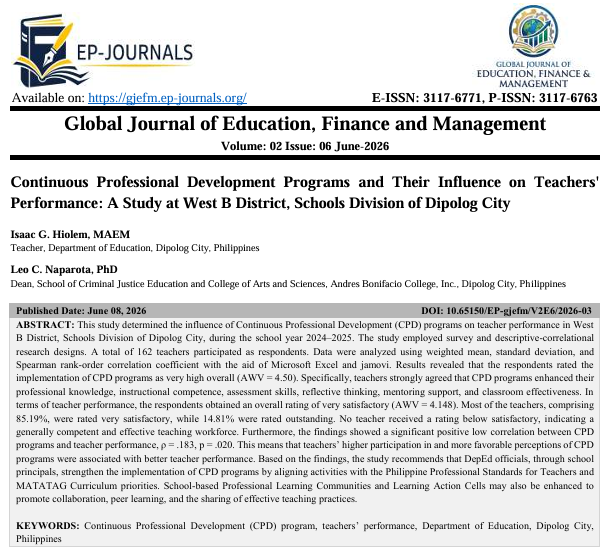
Continuous Professional Development Programs and Their Influence on Teachers' Performance: A Study at West B District, Schools Division of Dipolog City
DOI:
https://doi.org/10.65150/EP-gjefm/V2E6/2026-03Keywords:
Continuous Professional Development (CPD) program, teachers’ performance, Department of Education, Dipolog City, PhilippinesAbstract
This study determined the influence of Continuous Professional Development (CPD) programs on teacher performance in West B District, Schools Division of Dipolog City, during the school year 2024–2025. The study employed survey and descriptive-correlational research designs. A total of 162 teachers participated as respondents. Data were analyzed using weighted mean, standard deviation, and Spearman rank-order correlation coefficient with the aid of Microsoft Excel and jamovi. Results revealed that the respondents rated the implementation of CPD programs as very high overall (AWV = 4.50). Specifically, teachers strongly agreed that CPD programs enhanced their professional knowledge, instructional competence, assessment skills, reflective thinking, mentoring support, and classroom effectiveness. In terms of teacher performance, the respondents obtained an overall rating of very satisfactory (AWV = 4.148). Most of the teachers, comprising 85.19%, were rated very satisfactory, while 14.81% were rated outstanding. No teacher received a rating below satisfactory, indicating a generally competent and effective teaching workforce. Furthermore, the findings showed a significant positive low correlation between CPD programs and teacher performance, ρ = .183, p = .020. This means that teachers’ higher participation in and more favorable perceptions of CPD programs were associated with better teacher performance. Based on the findings, the study recommends that DepEd officials, through school principals, strengthen the implementation of CPD programs by aligning activities with the Philippine Professional Standards for Teachers and MATATAG Curriculum priorities. School-based Professional Learning Communities and Learning Action Cells may also be enhanced to promote collaboration, peer learning, and the sharing of effective teaching practices.
References
1) Aiken, L. S., & Susane, G. (2001). West multiple progression. Sage Publishing, Inc.
2) Anderson, A., & Cayambe, J. (2024). Teacher performance evaluation and teaching effectiveness.
3) Bacus, R. C. (2024). Predictors of beginning teachers’ teaching performance. Frontiers in Education, 9, Article 1375726. https://doi.org/10.3389/feduc.2024.1375726
4) Cohen, L., Manion, L., & Morrison, K. (2014). Research methods in education (7th ed.). Routledge.
5) Creswell, J. W., & Guetterman, T. C. (2019). Educational research: Planning, conducting, and evaluating quantitative and qualitative research (6th ed.). Pearson.
6) Dacholfany, M. I., & Antoni, R. (2024). The effectiveness of teacher professional development program on classroom and behaviour management: A systematic review. Journal of Education Culture and Society.
7) Darling-Hammond, L., Hyler, M. E., & Gardner, M. (2017). Effective teacher professional development. Learning Policy Institute. https://doi.org/10.54300/122.311
8) DeCarlo, M. (2021). Scientific inquiry in social work. Open Social Work Education.
9) Delos Reyes, R., et al. (2023). Mentoring, professional learning communities, and teaching performance in Philippine public schools.
10) Department of Education. (2015). DepEd Order No. 2, s. 2015: Guidelines on the establishment and implementation of the Results-Based Performance Management System in the Department of Education. Department of Education.
11) Department of Education. (2016). DepEd Order No. 35, s. 2016: The Learning Action Cell as a K to 12 Basic Education Program school-based continuing professional development strategy for the improvement of teaching and learning. Department of Education.
12) Department of Education. (2017). DepEd Order No. 42, s. 2017: National adoption and implementationof the Philippine Professional Standards for Teachers. Department of Education.
13) Department of Education. (2024). Training on the MATATAG Curriculum for Kindergarten, Grade 1, 4, and 7 school leaders and teachers. Department of Education.
14) Department of Education. (2023). DepEd Memorandum No. 008, s. 2023:Multi-year guidelines on the Results-Based Performance
Management System–Philippine Professional Standards for Teachers. Department of Education.
15) Engida, M. A. (2024). Impact of teaching quality on student achievement: Student evidence. Frontiers in Education, 9, Article 1367317. https://doi.org/10.3389/feduc.2024.1367317
16) Garcia, J. A. S., Prudente, M. S., Mistades, V. M., Roleda, L. S., & Talaue, F. T. (2024). Systematic review of professional development programs for teachers in the Philippines. Second Congressional Commission on Education.
17) Garcia, M., & Mendoza, R. (2024). Continuous professional development and teaching effectiveness among public school teachers.
18) Garcia, M., & Ramos, L. (2024). Continuous professional development and teachers’ performance in Philippine public schools.
19) Gore, J., Lloyd, A., Smith, M., Bowe, J., Ellis, H., & Lubans, D. (2017). Effects of professional development on the quality of teaching: Results from a randomised controlled trial of Quality Teaching Rounds. Teaching and Teacher Education, 68, 99–113. https://doi.org/10.1016/j.tate.2017.08.007
20) Jones, K. (2024). Teacher professional learning and professional development day practices.
21) Kurteshi, V., & Rrustemi, J. (2025). Exploring the impact of continuous professional development on teacher performance: Insights from students and teachers. Educational Process: International Journal, 16, Article e2025228. https://doi.org/10.22521/edupij.2025.16.228
22) Luong, G.-Y. (2025). The effectiveness of mentoring, coaching, and induction practices for early career teachers: A scoping review. Teaching and Teacher Education, 163, Article 105065. https://doi.org/10.1016/j.tate.2025.105065
23) McCombes, S. (2025, January 14). Survey research: Definition, examples and methods. Scribbr. Original work published 2019.
24) Mendoza, R., & Arellano, P. (2023). Teachers’ performance under the Results-Based Performance Management System in Philippine public schools.
25) Mgaiwa, S. J., & Milinga, J. R. (2024). Teacher preparation and continuous professional development: A review of “missing links.” Social Sciences & Humanities Open, 10, Article 100990. https://doi.org/10.1016/j.ssaho.2024.100990
26) Navarro, J. (2024). Sustaining outstanding teacher performance through coaching, workload management, and professional support.
27) Olvido, M., et al. (2024). Continuous professional development, instructional confidence, and curriculum adaptation among Filipino teachers.
28) Oplas, R. (2024). Professional learning communities and collaborative teacher development in Philippine schools.
29) Philippine Institute for Development Studies. (2025). Teacher effectiveness, school environment, workload, and professional development in Philippine basic education. Philippine Institute for Development Studies.
30) Refugio, C. N., Galleto, P. G., & Torres, R. (2019). Competence landscape of Grade 9 mathematics teachers: Basis for an enhancement program. Cypriot Journal of Educational Sciences, 14(2), 241–256. https://doi.org/10.18844/cjes.v14i2.4125
31) Rincón, Y. R., Munárriz, A., & Magreñán Ruiz, A. (2024). A new approach to continuous assessment: Moving from a stressful sum of grades to meaningful learning through self-reflection. The International Journal of Management Education, 22(3), Article 101072. https://doi.org/10.1016/j.ijme.2024.101072
32) Saleem, A., Gul, R., & Dogar, A. A. (2021). Effectiveness of continuous professional development program as perceived by primary level teachers. Elementary Education Online, 20(3), 53–72. https://doi.org/10.17051/ilkonline.2021.03.06
33) Santos, A., et al. (2025). Philippine Professional Standards for Teachers-aligned CPD programs and teacher performance.
34) Teacher Education Council. (2025). Teacher professional development and Philippine Professional Standards for Teachers implementation report. Teacher Education Council.
35) UNESCO. (2017). Continuous assessment for improved teaching and learning. UNESCO.
36) Ventista, O. M., & Brown, C. (2023). Teachers’ professional learning and its impact on students’ learning outcomes: Findings from a systematic review. Social Sciences & Humanities Open, 8(1), Article 100565. https://doi.org/10.1016/j.ssaho.2023.100565
Downloads
Published
Issue
Section
License
Copyright (c) 2026 Isaac G. Hiolem, MAEM, Leo C. Naparota, PhD (Author)

This work is licensed under a Creative Commons Attribution 4.0 International License.