Influence of School Principals’ Digital Leadership on Teacher Performance in the East District, Schools Division of Dipolog City
DOI:
https://doi.org/10.65150/EP-gjefm/V2E6/2026-08Keywords:
school principal, digital leadership, teachers’ performance, Dipolog City, PhilippinesAbstract
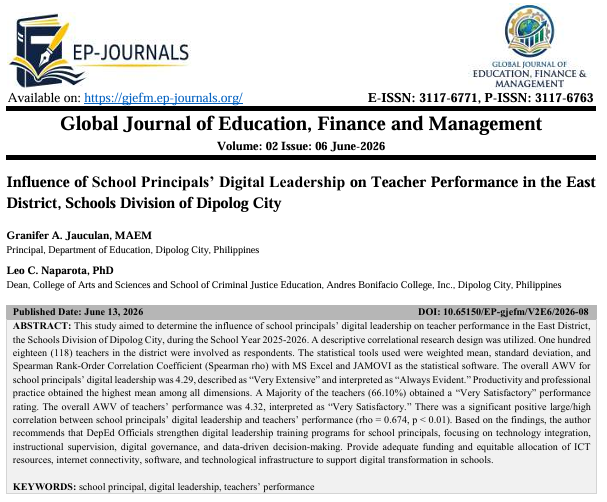
This study aimed to determine the influence of school principals’ digital leadership on teacher performance in the East District, the Schools Division of Dipolog City, during the School Year 2025-2026. A descriptive correlational research design was utilized. One hundred eighteen (118) teachers in the district were involved as respondents. The statistical tools used were weighted mean, standard deviation, and Spearman Rank-Order Correlation Coefficient (Spearman rho) with MS Excel and JAMOVI as the statistical software. The overall AWV for school principals’ digital leadership was 4.29, described as “Very Extensive” and interpreted as “Always Evident.” Productivity and professional practice obtained the highest mean among all dimensions. A Majority of the teachers (66.10%) obtained a “Very Satisfactory” performance rating. The overall AWV of teachers’ performance was 4.32, interpreted as “Very Satisfactory.” There was a significant positive large/high correlation between school principals’ digital leadership and teachers’ performance (rho = 0.674, p < 0.01). Based on the findings, the author recommends that DepEd Officials strengthen digital leadership training programs for school principals, focusing on technology integration, instructional supervision, digital governance, and data-driven decision-making. Provide adequate funding and equitable allocation of ICT resources, internet connectivity, software, and technological infrastructure to support digital transformation in schools.
References
Acebuche, A. (2023). Digital leadership towards effective school management: A systematic review. Psychology and Education: A Multidisciplinary Journal.
AlAjmi, M. K. (2022). The impact of digital leadership on teachers’ technology integration during the COVID-19 pandemic in Kuwait. International Journal of Educational Research, 112, 101928. doi:10.1016/j.ijer.2022.101928
Barangai, [Initials]. (2024). Transformational leadership practices of school heads and teachers’ morale and performance.
Cadag, [Initials]. (2024). Individual Performance Commitment and Review Form as an evaluation tool for teacher productivity, accountability, and professional growth.
Calo, [Initials]. (2025). Digital leadership and ICT engagement toward instructional productivity and innovation among educators.
Capinpuyan, [Initials]., & Prado, [Initials]. (2024). Digital leadership and teacher performance through strategic technology implementation.
Creswell, J. W., & Guetterman, T. C. (2019). Educational research: Planning, conducting, and evaluating quantitative and qualitative research (6th ed.). Pearson.
Damasco, [Initials]., & Villocino, [Initials]. (2024). Instructional leadership practices, ICT competence of school administrators, and teachers’ work performance
Dasruth, [Initials]., [Additional authors if any]. (2024). Principals’ leadership practices and digital leadership preparation in schools.
DeCarlo, M. (2021). Scientific inquiry in social work. Open Social Work Education.
Dela Rosa, [Initials]. (2022). Digital leadership and teachers’ performance in public secondary schools in Marikina City
Department of Education. (2015). DepEd Order No. 2, s. 2015: Guidelines on the establishment and implementation of the Results-Based Performance Management System in the Department of Education.
Department of Education. (2025). DepEd Memorandum No. 017, s. 2025: Interim guidelines for the Department of Education Performance Management and Evaluation System for Teachers in the School Year 2024–2025.
Espinosa, J. P. M. (2024). Character strength, resilience, and teacher performance: Their relationships. AIDE Interdisciplinary Research Journal, 9(1), 1–11. https://doi.org/10.56648/aide-irj.v9i1.122
Esogon, S. G., Gumban, J. L., & Guitche, M. Q. (2024). Practice of transformational leadership of school heads and work performance of teachers in public elementary schools. Journal of Interdisciplinary Perspectives, 2(9), 63–74. https://doi.org/10.69569/jip.2024.0342
Hamzah, N. H., Nasir, M. K. M., & Wahab, J. A. (2021). The effects of principals’ digital leadership on teachers’ digital teaching during the COVID-19 pandemic in Malaysia. Journal of Education and E-Learning Research, 8(2), 216–221. doi:10.20448/journal.509.2021.82.216.221
International Society for Technology in Education. (2021). ISTE standards for education leaders. ISTE.
Karakose, T., Polat, H., & Papadakis, S. (2021). Examining teachers’ perspectives on school principals’ digital leadership roles and technology capabilities during the COVID-19 pandemic. Sustainability, 13(23), 13448. doi:10.3390/su132313448
Mahinay, A. E. D. (2024). Leader-member exchange relationship, school culture, and job satisfaction: Their implication to senior high school teachers’ work performance. European Journal of Theoretical and Applied Sciences, 2(3). https://doi.org/10.59324/ejtas.2024.2(3).72
McCombes, S. (2019/2025). Survey research: Definition, examples and methods. Scribbr.
Miao, F., & Holmes, W. (2023). Guidance for generative AI in education and research. UNESCO.
Organisation for Economic Co-operation and Development. (2025). Education and digital technology/technology in education report. OECD.
Porcincula, A. C., & Madarang, A. S. (2024). School head leadership styles and performance of teachers: Basis for an intervention. International Journal of Research Publication, 159(1), 178–189. https://www.ijrp.org/paper- detail/7245
Sampiano, [Initials]., & Alum, [Initials]. (2025). Teachers’ performance and experiences in IPCRF compliance.
Tapia, M. (2024). Digital leadership of school heads and teachers’ technological proficiency on school outcomes, Schools Division Office of Laguna. International Journal of Research Publications, 148(1). https://doi.org/10.47119/IJRP1001481520246419
Tømte, C. E. (2024). Conceptualisation of professional digital competence for school leaders in schools with 1:1 coverage of digital devices. Computers & Education, 222, 105151. doi:10.1016/j.compedu.2024.105151
UNESCO. (2023). Guidance for generative AI in education and research. UNESCO.
Uy, M. R. (2024). School heads’ leadership styles and teachers’ performance. Psychology and Education: A Multidisciplinary Journal, 17(1), 33–38. https://doi.org/10.5281/zenodo.10647343
Zeng, M., Cheah, K. S. L., & Abdullah, Z. (2025). The influence of school principals’ digital leadership on teachers’ competency in integrating artificial intelligence: A systematic thematic review. Frontiers in Education, 10, 1655967. https://doi.org/10.3389/feduc.2025.1655967
Downloads
Published
Issue
Section
License
Copyright (c) 2026 Leo C. Naparota, PhD, Granifer A. Jauculan, MAEM (Author)

This work is licensed under a Creative Commons Attribution 4.0 International License.