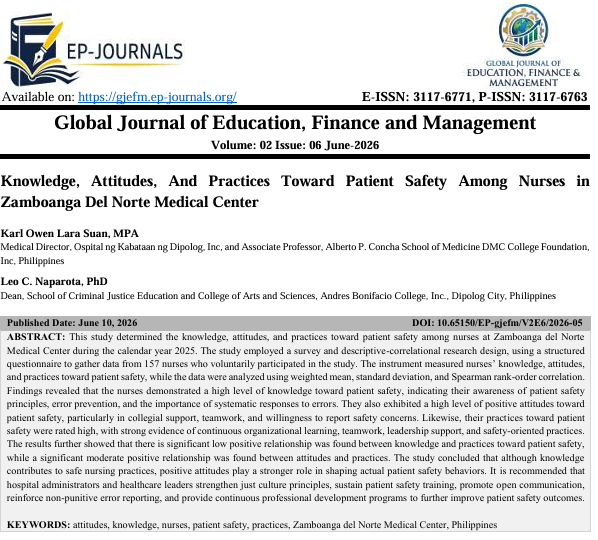
Knowledge, Attitudes, And Practices Toward Patient Safety Among Nurses in Zamboanga Del Norte Medical Center
DOI:
https://doi.org/10.65150/EP-gjefm/V2E6/2026-05Keywords:
attitudes, knowledge, nurses, patient safety, practices, Zamboanga del Norte Medical Center, PhilippinesAbstract
This study determined the knowledge, attitudes, and practices toward patient safety among nurses at Zamboanga del Norte Medical Center during the calendar year 2025. The study employed a survey and descriptive-correlational research design, using a structured questionnaire to gather data from 157 nurses who voluntarily participated in the study. The instrument measured nurses’ knowledge, attitudes, and practices toward patient safety, while the data were analyzed using weighted mean, standard deviation, and Spearman rank-order correlation. Findings revealed that the nurses demonstrated a high level of knowledge toward patient safety, indicating their awareness of patient safety principles, error prevention, and the importance of systematic responses to errors. They also exhibited a high level of positive attitudes toward patient safety, particularly in collegial support, teamwork, and willingness to report safety concerns. Likewise, their practices toward patient safety were rated high, with strong evidence of continuous organizational learning, teamwork, leadership support, and safety-oriented practices. The results further showed that there is significant low positive relationship was found between knowledge and practices toward patient safety, while a significant moderate positive relationship was found between attitudes and practices. The study concluded that although knowledge contributes to safe nursing practices, positive attitudes play a stronger role in shaping actual patient safety behaviors. It is recommended that hospital administrators and healthcare leaders strengthen just culture principles, sustain patient safety training, promote open communication, reinforce non-punitive error reporting, and provide continuous professional development programs to further improve patient safety outcomes.
References
1) Agency for Healthcare Research and Quality. (2022). Surveys on patient safety culture: SOPS hospital survey 2.0: 2022 user database report. Agency for Healthcare Research and Quality.
2) Alandajani, A., Khalid, B., Ng, Y. G., & Banakhar, M. (2022). Knowledge and attitudes regarding medication errors among nurses: A cross-sectional study in major Jeddah hospitals. Nursing Reports, 12(4), 1023–1039.
3) Alshammari, F., Pasay-an, E., Alboliteeh, M., & Cruz, J. P. (2019). Nurses’ perceptions of patient safety culture in Saudi Arabian hospitals: A cross-sectional study. Nursing Open, 6(3), 1067–1074.
4) Ayyad, A., Abu Baker, N., Oweidat, I., Al-Mugheed, K., Alsenany, S. A., & Abdelaliem, S. M. F. (2024a). Knowledge, attitudes, and practices toward patient safety among nurses in health centers. BMC Nursing, 23, 171.
5) Ayyad, A., Mahmoud, S., & Ali, H. (2024b). Knowledge, attitudes, and practices toward patient safety among nurses: The role of continuing education. Journal of Nursing Management, 32(1), 45–55.
6) Berdida, D. J. E., & Alhudaib, K. A. (2025). Linking patient safety, caring behaviours and professional self-efficacy with missed nursing care among Filipino emergency room nurses: A structural equation model study. Journal of Clinical Nursing, 34(6), 2181–2193.
7) Bhat, A. (2019). Correlational research: What it is with examples. QuestionPro. https://www.questionpro.com/blog/correlational-research/
8) Chen, X., Pan, H., Li, F., & Gong, G. (2025). Nurses’ perceptions of patient safety culture in intensive care units: A systematic review and meta-analysis. Nursing in Critical Care, 30(5), e70138.
9) Cho, D. B., Lee, W., Kim, S. Y., & Choi, S. (2022). Effect of online education on the knowledge on, attitudes towards, and skills in patient safety for nursing students in Korea: A mixed-methods study. Journal of Educational Evaluation for Health Professions, 19.
10) Fowler, F. J. (2014). Survey research methods (5th ed.). SAGE Publications.
11) Hammoudi, B. M., Ismaile, S., & Abu Yahya, O. (2018). Factors associated with medication administration errors and knowledge of nurses in Saudi Arabia. Saudi Pharmaceutical Journal, 26(3), 401–407.
12) Han, Y., Kim, J. S., & Seo, Y. (2020). Cross-sectional study on patient safety culture, patient safety competency, and adverse events. Western Journal of Nursing Research, 42(1), 32–40.
13) Hesgrove, B., Zebrak, K., Yount, N., Sorra, J., & Ginsberg, C. (2024). Associations between patient safety culture and workplace safety culture in hospital settings. BMC Health Services Research, 24(1), 568.
14) Hughes, A. M., Gregory, M. E., Joseph, D. L., Sonesh, S. C., Marlow, S. L., Lacerenza, C. N., & Salas, E. (2016). Saving lives: A meta-analysis of team training in healthcare. Journal of Applied Psychology, 101(9), 1266.
15) Kakemam, E., Albelbeisi, A. H., Rouzbahani, M., Gharakhani, M., Zahedi, H., & Navvabi, S. (2024). Nurses’ perceptions of patient safety competency: A cross-sectional study of relationships with occurrence and reporting of adverse events. PLOS ONE, 19(1), e0297185.
16) Khater, W. A., Akhu-Zaheya, L. M., Al-Mahasneh, S. I., & Khater, R. (2015). Nurses’ perceptions of patient safety culture in
Jordanian hospitals. International Nursing Review, 62(1), 82–91.
17) Kim, Y. M., Yoon, Y. S., Hong, H. C., & Min, A. (2019). Effects of a patient safety course using a flipped classroom approach among undergraduate nursing students: A quasi-experimental study. Nurse Education Today, 79, 180–187. https://doi.org/10.1016/j.nedt.2019.05.033
18) Labrague, L. J. (2025). How does nurse compassion competence influence patient safety incidents? Exploring the mediating role of safety standards adherence. Worldviews on Evidence-Based Nursing, 22(5), e70071.
19) Lee, S. E., & Dahinten, V. S. (2021). Psychological safety as a mediator of the relationship between inclusive leadership and nurse voice behaviors and error reporting. Journal of Nursing Scholarship, 53(6), 737–745. https://doi.org/10.1111/jnu.12689
20) Li, L. Z., Yang, P., Singer, S. J., Pfeffer, J., Mathur, M. B., & Shanafelt, T. (2024). Nurse burnout and patient safety, satisfaction, and quality of care: A systematic review and meta-analysis. JAMA Network Open, 7(11), e2443059.
21) Makary, M. A., & Daniel, M. (2016). Medical error—the third leading cause of death in the US. BMJ, 353, i2139.
22) Malak, M. Z., Salouk, J., Al-Shawawreh, R., Al-Kamiseh, H., & Ayed, A. (2022). Perceptions of patient safety culture among emergency room nurses in Jordanian accredited hospitals. Journal of Nursing Management, 30(7), 3131–3138.
23) Oweidat, I., Abu Baker, N., Ayyad, A., Al-Motlaq, M., & Albataineh, R. (2023). Awareness of reporting practices and barriers to incident reporting among nurses: A cross-sectional study. BMC Nursing, 22, 183.
24) Padrogane, K. G. B. (2025). Perceived leadership and safety culture of health care professionals in a government hospital in Cebu City, Philippines [Master’s thesis, University of the Philippines Open University]. UPOU Repository.
25) Park, H. Y., & Yeom, I. (2025). Effects of patient safety education programs on nursing students’ knowledge, attitude, and competency with patient safety: A systematic review, meta-analysis, and meta-regression. Nurse Education Today, 150, 106675.
26) Ramos, R. R., & Calidgid, C. C. (2018). Patient safety culture among nurses at a tertiary government hospital in the Philippines. Applied Nursing Research, 44, 67–75.
27) Tamondong-Lachica, D. R., Panganiban, L. C. R., Roberto, G. D., Calacday, C. R. D., & Mejia, A. D. (2024). Description of core performance measures and indicators of patient safety used by select government and private hospitals in the Philippines. Acta Medica Philippina, 58(1), 15.
28) Tenza, I. S., Blignaut, A. J., Ellis, S. M., & Coetzee, S. K. (2024). Nurse perceptions of practice environment, quality of care and patient safety across four hospital levels within the public health sector of South Africa. BMC Nursing, 23(1), 324.
29) Torkaman, M., Sabzi, A., & Farokhzadian, J. (2022). The effect of patient safety education on undergraduate nursing students’ patient safety competencies. Community Health Equity Research & Policy, 42(2), 219–224.
30) Tubayan, P. A. T. (2025). Development and acceptability of the E-Nurse patient safety system towards technology management. International Journal of Research and Scientific Innovation, 12(8), 581–596.
31) Verano, F. R. (2025). Enhancing patient safety culture in healthcare organization through training and leadership. Asia Pacific Journal of Allied Health Sciences, 8(2), 25–33.
32) Vikan, M., Aase, K., & de Gaal, S. (2023). The association between patient safety culture and adverse events: A scoping review. BMC Health Services Research, 23, 932.
33) Wake, A. D., Tuji, T. S., Gonfa, B. K., Waldekidan, E. T., Beshaw, E. D., Mohamed, M. A., & Geressu, S. T. (2021). Knowledge, attitude, practice and associated factors towards patient safety among nurses: A cross-sectional study. PLOS ONE, 16(7), e0254122.
34) World Health Organization. (2021). Global patient safety action plan 2021–2030: Towards eliminating avoidable harm in health care. World Health Organization.
35) Yoon, S., Kim, I., & Lee, S. (2022). Factors influencing military nurses’ reporting of patient safety events: Roles of just culture,
authentic leadership, safety climate, and safety motivation. Asian Nursing Research, 16(3), 151–158.
36) Zhang, N., Xu, Y., Lu, Q. D., Wang, Y., Zhu, L. Y., An, R. X., & Wang, X. J. (2025). Nurses’ knowledge, attitude, and practice in peripherally inserted central catheter-related thrombosis prophylactic practices: A multicentric cross-sectional study. Medicine, 104(17), e42005.
Downloads
Published
Issue
Section
License
Copyright (c) 2026 Karl Owen Lara Suan, MPA, Leo C. Naparota, PhD (Author)

This work is licensed under a Creative Commons Attribution 4.0 International License.