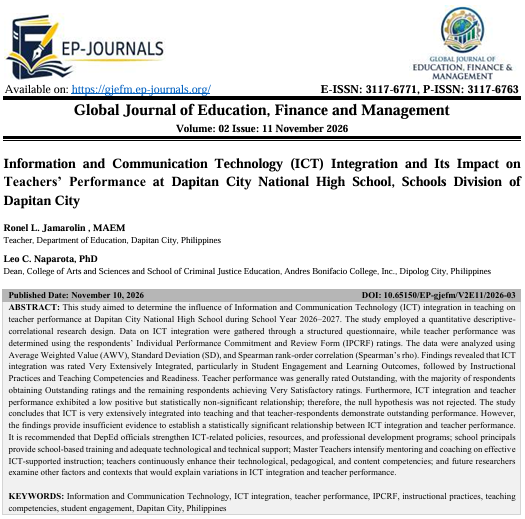
Information and Communication Technology (ICT) Integration and Its Impact on Teachers’ Performance at Dapitan City National High School, Schools Division of Dapitan City
DOI:
https://doi.org/10.65150/EP-gjefm/V2E11/2026-03Keywords:
Information and Communication Technology, ICT integration, teacher performance, IPCRF, instructional practices, teaching competencies, student engagement, Dapitan City, PhilippinesAbstract
This study aimed to determine the influence of Information and Communication Technology (ICT) integration in teaching on teacher performance at Dapitan City National High School during School Year 2026–2027. The study employed a quantitative descriptive-correlational research design. Data on ICT integration were gathered through a structured questionnaire, while teacher performance was determined using the respondents’ Individual Performance Commitment and Review Form (IPCRF) ratings. The data were analyzed using Average Weighted Value (AWV), Standard Deviation (SD), and Spearman rank-order correlation (Spearman’s rho). Findings revealed that ICT integration was rated Very Extensively Integrated, particularly in Student Engagement and Learning Outcomes, followed by Instructional Practices and Teaching Competencies and Readiness. Teacher performance was generally rated Outstanding, with the majority of respondents obtaining Outstanding ratings and the remaining respondents achieving Very Satisfactory ratings. Furthermore, ICT integration and teacher performance exhibited a low positive but statistically non-significant relationship; therefore, the null hypothesis was not rejected. The study concludes that ICT is very extensively integrated into teaching and that teacher-respondents demonstrate outstanding performance. However, the findings provide insufficient evidence to establish a statistically significant relationship between ICT integration and teacher performance. It is recommended that DepEd officials strengthen ICT-related policies, resources, and professional development programs; school principals provide school-based training and adequate technological and technical support; Master Teachers intensify mentoring and coaching on effective ICT-supported instruction; teachers continuously enhance their technological, pedagogical, and content competencies; and future researchers examine other factors and contexts that would explain variations in ICT integration and teacher performance.
References
1) Aiken, L. S., & Susane, G. (2001). West multiple progression. Sage Publishing, Inc.
2) Asmawil, P. D., & Asiri, M. S. (2026). The integration of information communication technology (ICT) in teaching among public elementary school teachers at Talipao District, Division of Sulu. Journal of Education and Academic Settings, 3(1), 1–11.https://doi.org/10.62596/wdxp4366
3) Bedenlier, S., Bond, M., Buntins, K., Zawacki-Richter, O., & Kerres, M. (2020). Facilitating student engagement through educational technology in higher education: A systematic review in the field of arts and humanities. Australasian Journal of Educational Technology, 36(4), 126–150. https://doi.org/10.14742/ajet.5477
4) Cohen, J. (1988). Statistical power analysis for the behavioral sciences (2nd ed.). Lawrence Erlbaum Associates.
5) Creswell, J. W., & Guetterman, T. C. (2019). Educational research: Planning, conducting, and evaluating quantitative and qualitative research (6th ed.). Pearson.
6) Department of Education. (2015). Guidelines on the establishment and implementation of the Results-Based Performance Management System in the Department of Education (DepEd Order No. 2, s. 2015).
7) Department of Education. (2017). Implementing guidelines on the release and utilization of Maintenance and Other Operating Expenses allocations for Senior High Schools (DepEd Order No. 22, s. 2017).
8) Department of Education. (2017). DepEd Order No. 42, s. 2017: National adoption and implementation of the Philippine Professional Standards for Teachers.
9) Department of Education. (2010). Guidelines on the implementation of the DepEd Computerization Program (DCP) (DepEd Order No. 78, s. 2010).
10) Department of Education. (2023). Revised guidelines on the implementation of the Department of Education Computerization Program (DepEd Order No. 16, s. 2023).
11) Dimakuta, N. H. A., & Guilenna, J. B. (2024). Perceptions and practices on ICT integration: Its impact to teaching performance. Psychology and Education: A Multidisciplinary Journal, 18(8), 724–734. https://doi.org/10.5281/zenodo.10949522
12) Espinosa, C. P., & Pañares, N. C. (2023). Teachers’ characteristics and their ICT competence in West II District, Cagayan de Oro City. International Journal of Research Publications, 125(1), 243–257.
https://doi.org/10.47119/IJRP1001251520234899
13) Falloon, G. (2020). From digital literacy to digital competence: The teacher digital competency framework. Educational Technology Research and Development, 68(5), 2449–2472. https://doi.org/10.1007/s11423-020-09767-4
14) Hillmayr, D., Ziernwald, L., Reinhold, F., Hofer, S. I., & Reiss, K. M. (2020). The potential of digital tools to enhance mathematics and science learning in secondary schools: A context-specific meta-analysis. Computers & Education, 153, Article 103897.https://doi.org/10.1016/j.compedu.2020.103897
15) Hizam, S. M., Akter, H., Sentosa, I., & Ahmed, W. (2021). Digital competency of educators in the virtual learning environment: A structural equation modeling analysis. IOP Conference Series: Earth and Environmental Science, 704, Article 012023.https://doi.org/10.1088/1755-1315/704/1/012023
16) König, J., Heine, S., Jäger-Biela, D. J., & Rothland, M. (2024). ICT integration in teachers’ lesson plans: A scoping review of empirical studies. European Journal of Teacher Education, 47(4), 821–849. https://doi.org/10.1080/02619768.2022.2138323
17) Lawrence, J. E., & Tar, U. A. (2018). Factors that influence teachers’ adoption and integration of ICT in teaching/learning process. Educational Media International, 55(1), 79–105. https://doi.org/10.1080/09523987.2018.1439712
18) Macayanan, M., & Abalos, A. (2023). Relationship of secondary teachers’ instructional skills, competencies and teaching performance. Wesleyan Scientific Review, 2(2). https://doi.org/10.54788/wsr.v2i2.27
19) Magtoltol, R. C., & Oropa, J. C. (2025). ICT landscape and digital literacy skills of basic education teachers. Journal of Interdisciplinary Perspectives, 3(6), 145–153. https://doi.org/10.69569/jip.2025.173
20) Piquero, L. Z. (2024). Teachers’ core competencies and performance in a DepEd high school. Psychology and Education: A Multidisciplinary Journal, 16(2), 220–227. https://doi.org/10.5281/zenodo.10457689
21) Refugio, C. N., Galleto, P. G., & Torres, R. (2019). Competence landscape of grade 9 mathematics teachers: Basis for an enhancement program. Cypriot Journal of Educational Sciences, 14(2), 241–256. https://doi.org/10.18844/cjes.v14i2.4125
22) Ruel, E. (2018). 100 questions (and answers) about survey research. SAGE Publications.
23) Sangcad, N. M., & Abarquez, C. A. (2024). Teachers’ self-efficacy and their performance. Psychology and Education: A Multidisciplinary Journal, 21(6), 686–700. https://doi.org/10.5281/zenodo.12633818
24) Saunders, M., Lewis, P., & Thornhill, A. (2019). Research methods for business students (8th ed.). Pearson.
25) Sasota, R. S., Cristobal, R. R., Sario, I. S., Biyo, J. T., & Magadia, J. C. (2021). Will–skill–tool (WST) model of technology integration in teaching science and mathematics in the Philippines. Journal of Computers in Education, 8(3), 443–464.
https://doi.org/10.1007/s40692-021-00185-w
26) Schindler, L. A., Burkholder, G. J., Morad, O. A., & Marsh, C. (2017). Computer-based technology and student engagement: A critical review of the literature. International Journal of Educational Technology in Higher Education, 14, Article 25.https://doi.org/10.1186/s41239-017-0063-0
27) Smestad, B., Hatlevik, O. E., Johannesen, M., & Øgrim, L. (2023). Examining dimensions of teachers’ digital competence: A systematic review pre- and during COVID-19. Heliyon, 9(6), Article e16677. https://doi.org/10.1016/j.heliyon.2023.e16677
28) Suárez-Rodríguez, J., Almerich, G., Orellana, N., & Díaz-García, I. (2018). A basic model of integration of ICT by teachers: Competence and use. Educational Technology Research and Development, 66(5), 1165–1187. https://doi.org/10.1007/s11423-018-9591-0
29) Tondeur, J., van Braak, J., Ertmer, P. A., & Ottenbreit-Leftwich, A. (2017). Understanding the relationship between teachers’ pedagogical beliefs and technology use in education: A systematic review of qualitative evidence. Educational Technology Research and Development, 65(3), 555–575. https://doi.org/10.1007/s11423-016-9481-2
Downloads
Published
Issue
Section
License
Copyright (c) 2026 Ronel L. Jamarolin , MAEM, Leo C. Naparota, PhD (Author)

This work is licensed under a Creative Commons Attribution 4.0 International License.