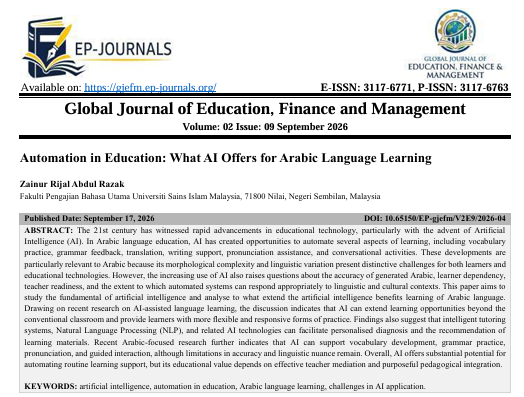
Automation in Education: What AI Offers for Arabic Language Learning
DOI:
https://doi.org/10.65150/EP-gjefm/V2E9/2026-04Keywords:
artificial intelligence, automation in education, Arabic language learning, challenges in AI applicationAbstract
The 21st century has witnessed rapid advancements in educational technology, particularly with the advent of Artificial Intelligence (AI). In Arabic language education, AI has created opportunities to automate several aspects of learning, including vocabulary practice, grammar feedback, translation, writing support, pronunciation assistance, and conversational activities. These developments are particularly relevant to Arabic because its morphological complexity and linguistic variation present distinctive challenges for both learners and educational technologies. However, the increasing use of AI also raises questions about the accuracy of generated Arabic, learner dependency, teacher readiness, and the extent to which automated systems can respond appropriately to linguistic and cultural contexts. This paper aims to study the fundamental of artificial intelligence and analyse to what extend the artificial intelligence benefits learning of Arabic language. Drawing on recent research on AI-assisted language learning, the discussion indicates that AI can extend learning opportunities beyond the conventional classroom and provide learners with more flexible and responsive forms of practice. Findings also suggest that intelligent tutoring systems, Natural Language Processing (NLP), and related AI technologies can facilitate personalised diagnosis and the recommendation of learning materials. Recent Arabic-focused research further indicates that AI can support vocabulary development, grammar practice, pronunciation, and guided interaction, although limitations in accuracy and linguistic nuance remain. Overall, AI offers substantial potential for automating routine learning support, but its educational value depends on effective teacher mediation and purposeful pedagogical integration.
References
1) Alam, A. (2021). Possibilities and Apprehensions in the landscape of artificial intelligence in education. Proceeding of the International Conference Computational.
2) Alhusaiyan, E. (2025). A systematic review of current trends in artificial intelligence in foreign language learning. Saudi Journal of Language Learning, 5(1), 1-16. doi.10.1108/sjls-07-2024-0039.
3) Al-Mahdi, M. (2021). Al-Ta’lim wa tahaddiyat al-mustaqbal fi dhauie falsafat al-zaka al-istina’ie. Journal of Technology for Teaching and Learning, 2(5), 97-140.
4) Al-Sa’id, M, Raghib, M. & Abd Al-Ghani, N. (2019). Al-‘Arabiyah wa al-zaka al-istina’ie. Riyadh: Markaz al-Malik Abdullah.
5) Altowayti, W.A.H. (2022). The role of conventional methods and artificial intelligence in the wastewater treatment: A comprehensive review. Processes, 10. https://doi.org/10.3390/pr10091832.
6) Anjum, Farheen, Bareq Raad Raheem & Zanyar Nathir Ghafar. (2025). The impact of ChatGPT on enhancing students’ motivation and learning engagement in second language education: Insights from students. Journal of E-Learning Research, 3(2), 1-11.
7) Ayah, S. A. (2023). Mustaqbal al-lughah al-Arabiyah fi ‘asri al-zaka al-istina’ie. Proceeding of ICON-POSSTAL Conference 2023. Universits Negeri Malang.
8) Dignum, V. (2021). The role and challenges of education for responsible AI. London Review of Education, 19(1), 1-11.
9) European Comission. (2020). White paper on artificial intelligence. A European approach to excellence and trust. Accessed on 13th Mei 2024 from hrome-extension://efaidnbmnnnibpcajpcglclefindmkaj/https://eurlex.europa.eu/legalcontent/EN/TXT/PDF/?uri=CELEX:52020DC0065
10) Guellil, I., Saâdane, H., Azouaou, F., Gueni, B., & Nouvel, D. (2021). Arabic natural language processing: An overview. Journal of King Saud University—Computer and Information Sciences, 33(5), 497–507. https://doi.org/10.1016/j.jksuci.2019.02.006
11) Gao, Y. (2023). A potential of adaptive learning system to enhance learning outcome: A meta-analysis. (PhD unpublished thesis).
12) Jahanzaib Shabbir & Tarique Anwer. (2015). Artificial Intelligence and its role in near future. Journal of Latex Class Files, 14(8), 1-11.
13) Kazi Bushra Orpy, Shakere Juyana & Antura Akter. (2026). Artificial intelligence tools in personalized language learning: A systematic thematic review. JOLLT Journal of Languages and Language Teaching, 14(2), 497-510. https://doi.org/10.33394/jollt.v14i2.18187
14) Khalati, Muhammad M. & Al-Romany, Tahseen A. H. (2020). Artificial intelligence development and challenges: Arabic language as a model. International Journal of Innovation, Creativity And Change, 13(5): 916-926.
15) Khazri Osman, Al Dairi Salha Juma Mohamed, Marhamah Ulfa, Dayang Sakini Mohd Kadri & Mohamad Yazid Abdul Majid. (2025). Integrasi AI dalam Komunikasi Pengajaran Bahasa Arab: Tinjauan Kritis dari Perspektif Guru. Al-Qalam International Journal of Arabic Studies, 7, 80-92.
16) Khondaker, M. T. I., Waheed, A., Nagoudi, E. M. B., & Abdul-Mageed, M. (2023). GPTAraEval: A comprehensive evaluation of ChatGPT on Arabic NLP. In Proceedings of the 2023 Conference on Empirical Methods in Natural Language Processing (pp. 220–247). Association for Computational Linguistics. https://doi.org/10.18653/v1/2023.emnlp-main.16
17) Kong, L. (2013) An Improved Information-Security Risk Assessment Algorithm for a Hybrid Model. International Journal of Advanced Computer Technology, 5.
18) Luckin, R., Holmes, W., Griffiths, M., & Forcier, L. B. (2016). Intelligence unleashed: An argument for AI in education. Pearson.
19) Luis, C., Pinto, R. & Goncalves, G. (2025). AI-powered learning analytics dashboards: A systematic review of application, techniques and research gaps. Discover Education, 4, 1-27. https://doi.org/10.1007/s44217-025-00964-y.
20) Ibrahim Badr, Rabih Bhib & James Glass. (2008). Segmentation for English-to-Arabic statistical machines translation. Proceedings of ACL-08: HLT, Short Papers: 153-156.
21) Mahendra Kumar & Anil Babu. (2026). A systematic review and meta-analysis on the use of artificial intelligence in education: Trends, impacts and future direction. Innovare Journal of Education, 14(4), 18-23.
22) Mohd Hazli Yah@Alias, Maimun Aqsa Lubis Abdin Lubis & Mahani Mohamad. (2019). Kemahiran membaca teks Arab sebagai bahasa kedua: Penelitian dari perspektif teori dan kurikulum. INSANIAH: Online Journal of Language, Communication and Humanities, 2(1), 22-44.
23) Muhamad Najib Abdul Ghafar. (1999). Penyelidikan pendidikan. Skudai: UTM
24) Muhammad Rehan Anwar & Herdi Aziz Ahyarudin. (2022). AI-powered Arabic language education in the era of society 5.0. Journal of IAIC Transactions on Sustainable Digital Innovation, 5(1), 50-57.
25) Nadwah Daud & Nadhilah Abdul Pisal. (2014). Permasalahan Pertuturan Dalam Bahasa Arab Sebagai Bahasa Kedua. GEMA Online Journal of Language Studies, 14(1), 117-133.
26) Neisser, G. Boodoo, T. J. Bouchard, A. W. Boykin, N. Brody, S. J. Ceci, D. F. Halpern, J. C. Loehlin, R. Perloff, R. J. Sternberg. (1996). Intelligence: Knowns and unknowns. American psychologist, 51(2), 77.
27) Nik Mohd Rahimi, Zahriah Hussin & Wan Normeza. (2014). Pembelajaran Kosa Kata Bahasa Arab Secara Aturan Kluster Semantik dan Aturan Kluster Bebas. Jurnal Teknologi. 67(1), 33-38.
28) Norazlin Mohd Rusdin & Siti Rahaimah Ali. (2019). Amalan dan Cabaran Perlaksanaan Pembelajaran Abad Ke-21. Proceedings of the International Conferenfe on Islamic Civilization and Technology Management. 23-24 November.ISBN: 978-967-2231-26-4
29) Nur Zafirah Mat Zuki. (2011). Macrifah al-Ficl al-Mazid fi Surah al-Muzammil lada Talabah Kulliyyah al-Quran wa al-Sunnah. Projek Ilmiah. Nilai: USIM.
30) Putri Astawa, Ni Luh Putu Ning Septyarini & Hady Permana, Putu Trisna. (2020). Media pembelajaran dengan kecerdasan buatan dalam pembelajaran bahasa Inggeris generasi-Z. Jurnal Sains Sosio Humaniora, 4(2), 756-767.
31) Rachel Gugu Mkhasibe & Oluwatoyin Ayodele Ajani. (2024) Investigating how AI can support self-directed learning for student teacher in African rural universities: Prospects, challenges and futures. International Journal of Innovative Technologies in Social Science, 4(44), 1-12. https://doi.org/10.31435/ijitss.4(44).2024.3117
32) Rasool, M., Ismail, N.A., Al-Dhaqm, A., Yafooz, W.M.S. and Alsaeedi, A. (2023) A Novel Approach for Classifying Brain Tumours Combining a SqueezeNet Model with SVM and Fine-Tuning. Electronics, 12, Article No. 149.
https://doi.org/10.3390/electronics12010149
33) Salbihana binti Samsudin, Ph D, Syed Syahrul Zarizi bin Syed Abdullah, PhD, Halif bin Md Saleh, PhD, Ahmad Shukri bin Ahmad. (2023). Pengetahuan bakal guru tentang Ai dalam pendidikan. Kolokium Penyelidikan, Pengurusan Dan Kepimpinan & Pertandingan Inovasi 2023.
34) UNESCO. (2023). Guidance for generative AI in education and research. UNESCO. https://doi.org/10.54675/EWZM9535
35) Wong, T.Y & and Bressler, N.M. (2016). Artificial intelligence with deep learning technology looks into diabetic retinopathy screening, Jama, 316(22): 2366–2367.
36) Yeo, M. A. (2023). Academic integrity in the age of Artificial Intelligence (AI) authoring apps. TESOL Journal, 14(3), e716. https://doi.org/10.1002/tesj.716
Downloads
Published
Issue
Section
License
Copyright (c) 2026 Zainur Rijal Abdul Razak (Author)

This work is licensed under a Creative Commons Attribution 4.0 International License.