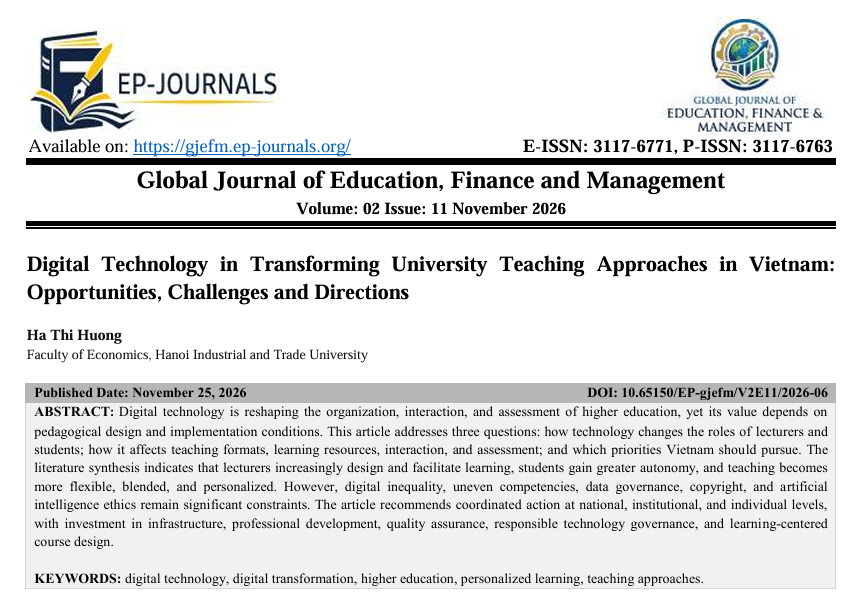
Digital Technology in Transforming University Teaching Approaches in Vietnam: Opportunities, Challenges and Directions
DOI:
https://doi.org/10.65150/EP-gjefm/V2E11/2026-06Keywords:
digital technology, digital transformation, higher education, personalized learning, teaching approachesAbstract
Digital technology is reshaping the organization, interaction, and assessment of higher education, yet its value depends on pedagogical design and implementation conditions. This article addresses three questions: how technology changes the roles of lecturers and students; how it affects teaching formats, learning resources, interaction, and assessment; and which priorities Vietnam should pursue. The literature synthesis indicates that lecturers increasingly design and facilitate learning, students gain greater autonomy, and teaching becomes more flexible, blended, and personalized. However, digital inequality, uneven competencies, data governance, copyright, and artificial intelligence ethics remain significant constraints. The article recommends coordinated action at national, institutional, and individual levels, with investment in infrastructure, professional development, quality assurance, responsible technology governance, and learning-centered course design.
References
1) Anderson, T. (Ed.). (2008). The theory and practice of online learning (2nd ed.). AU Press. https://doi.org/10.15215/aupress/9781897425084.01
2) Broadbent, J., & Poon, W. L. (2015). Self-regulated learning strategies and academic achievement in online higher education learning environments: A systematic review. The Internet and Higher Education, 27, 1–13. https://doi.org/10.1016/j.iheduc.2015.04.007
3) Hrastinski, S. (2019). What do we mean by blended learning? TechTrends, 63, 564–569. https://doi.org/10.1007/s11528-019-00375-5
4) Miao, F., & Holmes, W. (2023). Guidance for generative AI in education and research. UNESCO. https://doi.org/10.54675/EWZM9535
5) OECD. (2023). OECD digital education outlook 2023: Towards an effective digital education ecosystem. OECD Publishing. https://doi.org/10.1787/c74f03de-en
6) Radianti, J., Majchrzak, T. A., Fromm, J., & Wohlgenannt, I. (2020). A systematic review of immersive virtual reality applications for higher education: Design elements, lessons learned, and research agenda. Computers & Education, 147, Article 103778. https://doi.org/10.1016/j.compedu.2019.103778
7) Redecker, C. (2017). European framework for the digital competence of educators: DigCompEdu (Y. Punie, Ed.). Publications Office of the European Union. https://doi.org/10.2760/159770
8) Prime Minister of Vietnam. (2022). Decision No. 131/QD-TTg dated January 25, 2022, approving the project “Strengthening the application of information technology and digital transformation in education and training for 2022–2025, with orientations toward 2030.” https://vanban.chinhphu.vn/default.aspx?docid=205236&pageid=27160
9) UNESCO. (2021). Reimagining our futures together: A new social contract for education. UNESCO.
https://unesdoc.unesco.org/ark:/48223/pf0000379707
10) UNESCO. (2023). Global education monitoring report 2023: Technology in education—A tool on whose terms?
Downloads
Published
Issue
Section
License
Copyright (c) 2026 Ha Thi Huong (Author)

This work is licensed under a Creative Commons Attribution 4.0 International License.