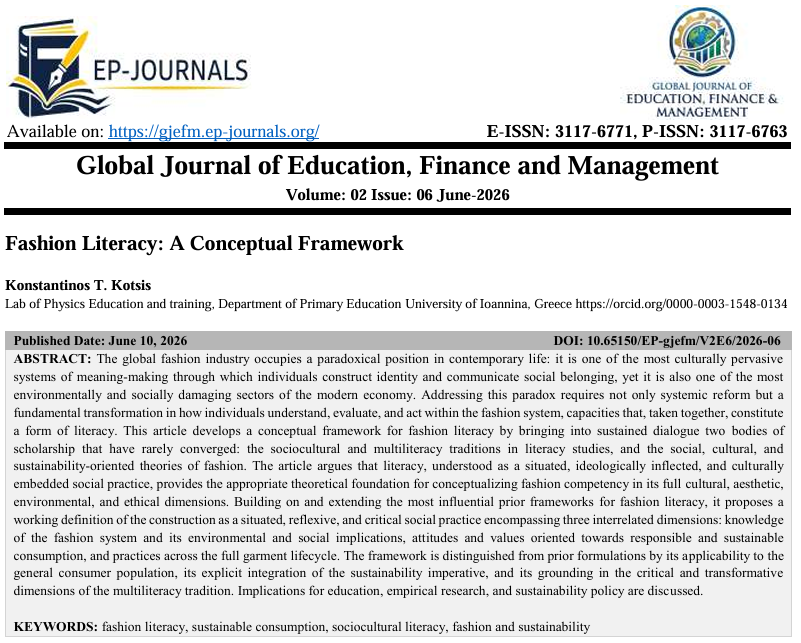
Fashion Literacy: A Conceptual Framework
DOI:
https://doi.org/10.65150/EP-gjefm/V2E6/2026-06Keywords:
fashion literacy, sustainable consumption, sociocultural literacy, fashion and sustainabilityAbstract
The global fashion industry occupies a paradoxical position in contemporary life: it is one of the most culturally pervasive systems of meaning-making through which individuals construct identity and communicate social belonging, yet it is also one of the most environmentally and socially damaging sectors of the modern economy. Addressing this paradox requires not only systemic reform but a fundamental transformation in how individuals understand, evaluate, and act within the fashion system, capacities that, taken together, constitute a form of literacy. This article develops a conceptual framework for fashion literacy by bringing into sustained dialogue two bodies of scholarship that have rarely converged: the sociocultural and multiliteracy traditions in literacy studies, and the social, cultural, and sustainability-oriented theories of fashion. The article argues that literacy, understood as a situated, ideologically inflected, and culturally embedded social practice, provides the appropriate theoretical foundation for conceptualizing fashion competency in its full cultural, aesthetic, environmental, and ethical dimensions. Building on and extending the most influential prior frameworks for fashion literacy, it proposes a working definition of the construction as a situated, reflexive, and critical social practice encompassing three interrelated dimensions: knowledge of the fashion system and its environmental and social implications, attitudes and values oriented towards responsible and sustainable consumption, and practices across the full garment lifecycle. The framework is distinguished from prior formulations by its applicability to the general consumer population, its explicit integration of the sustainability imperative, and its grounding in the critical and transformative dimensions of the multiliteracy tradition. Implications for education, empirical research, and sustainability policy are discussed.
References
1) Barry, B., & Christel, D. A. (Eds.). (2023). Fashion education: The systemic revolution. Intellect Books.
2) Barthes, R. (1985). The fashion system. Jonathan Cape. (Original work published 1967)
3) Barton, D., & Hamilton, M. (1998). Local literacies: Reading and writing in one community. Routledge.
4) Baynham, M. (1995). Literacy practices: Investigating literacy in social contexts. Longman.
5) Breivik, P. S., & Gee, E. G. (1989). Information literacy: Revolution in the library. American Council on Education.
6) Busalim, A., Fox, G., & Lynn, T. (2022). Consumer behavior in sustainable fashion: A systematic literature review and future research agenda. International Journal of Consumer Studies, 46(5), 1804–1828. https://doi.org/10.1111/ijcs.12794
7) Chang, Y. F. (1997). Citizens’ literacy and education in the information age. http://www.sinica.edu.tw/~cdp/project/0148.htm
8) Chiu, S. P., Tu, J. C., Chu, W. C., & Chuang, L. W. (2014). The levels of fashion literacy for fashion design-related departments students in Taiwan. International Journal of Affective Engineering, 13(3), 205–215.
9) Cope, B., & Kalantzis, M. (2000). Multiliteracies: Literacy learning and the design of social futures. Routledge.
10) Cope, B., & Kalantzis, M. (2009). “Multiliteracies”: New literacies, new learning. Pedagogies: An International Journal, 4(3), 164–195
https://doi.org/10.1080/15544800903076044
11) Daukantienė, N. (2023). Sustainability in fashion design education: Challenges and prospects. International Journal of Fashion Design, Technology and Education, 16(1), 1–12. https://doi.org/10.1080/17543266.2022.2093137
12) Davetas, D. (2008). Moda kai monterna techni [Fashion and modern art]. Evrasia.
13) Davis, F. (1994). Fashion, culture, and identity. University of Chicago Press.
14) Elsasser, N., & John-Steiner, V. (1977). An interactionist approach to advancing literacy. Harvard Educational Review, 47(3), 355–369.
https://doi.org/10.17763/haer.47.3.y17p7521p7r82427
15) Entwistle, J. (2000). The fashioned body: Fashion, dress and modern social theory. Polity Press.
16) Entwistle, J. (2023). The fashioned body: Fashion, dress and modern social theory (3rd ed.). Polity Press.
17) Faludi, J. (2025). Sustainable fashion, circularity and consumer behavior: Systematic review and a social marketing research and policy agenda. Social Marketing Quarterly, 31(1), 35–59. https://doi.org/10.1177/15245004241309660
18) Finkelstein, J. L. (1996). After a fashion. Melbourne University Press.
19) Geneva Environment Network. (2023). Environmental sustainability in the fashion industry.
https://www.genevaenvironmentnetwork.org/resources/updates/sustainable-fashion/
20) Gjoni, A. (2025). The influence of fashion on identity and aesthetics: A sociocultural perspective within the framework of Sustainable Development Goal. Journal of Lifestyle and SDGs Review, 5(4), e06116. https://doi.org/10.47172/2965-730X.SDGsReview.v5.n04.pe06116
21) Glasser, H., Calder, W., & Fadeeva, Z. (2005). Definition: Research in higher education for sustainability [Document prepared for the Halifax Consultation]. Halifax, Nova Scotia.
22) Goody, J. (1968). Literacy in traditional societies. Cambridge University Press.
23) Heath, S. B. (1983). Ways with words: Language, life and work in communities and classrooms. Cambridge University Press.
24) Hong, Y., Al Mamun, A., Yang, Q., & Masukujjaman, M. (2024). Predicting sustainable fashion consumption intentions and practices. Scientific Reports, 14(1), 1706. https://doi.org/10.1038/s41598-024-52215-z
25) Houghton, S., Garvey, J., Conor, L., Wilmsen, B., Dehm, J., Gamble, R., Habib, B., Holmes, K., Millner, J., & Strickland, K. M. (2024).
Towards an interdisciplinary agenda for teaching in the climate crisis: Reflections from the humanities and social sciences. Environmental Education Research, 30(11), 2007–2019. https://doi.org/10.1080/13504622.2023.2273791
26) Kalantzis, M., & Cope, B. (2023). Multiliteracies: Life of an idea. International Journal of Literacies, 30(2), 17–89.https://doi.org/10.18848/2327-0136/CGP/v30i02/17-89
27) Kotsis, K. T. (2024a). The impact of scientific literacy on politicians’ approach to the issue of climate change. EIKI Journal of Effective Teaching Methods, 2(3), 9–14. https://doi.org/10.59652/jetm.v2i3.187
28) Kotsis, K. T. (2024b). Scientific literacy is a valuable tool for modern politicians: A comprehensive analysis. Journal on Political Sciences & International Relations, 2(1), 1–5. https://doi.org/10.47363/JPSIR/2024(2)104
29) Kotsis, K. T. (2026a). Fashion literacy education and the SDGs: Curricular and policy recommendations. European Journal of Contemporary Education and E-Learning, 4(2), 336–355. https://doi.org/10.59324/ejceel.2026.4(2).25
30) Kotsis, K. T. (2026b). The fashion industry and the UN Sustainable Development Goals. European Journal of Innovative Studies and Sustainability, 2(2), 217–237. https://doi.org/10.59324/ejiss.2026.2(2).15
31) Kotsis, K. T. (2026c). Epistemology, pedagogy, and inquiry-based learning in science education: Linking theory, practice, and policy. International Journal of Advanced Multidisciplinary Research and Studies, 6(2), 963–968. https://doi.org/10.62225/2583049X.2026.6.2.6056
32) Kouba, V. L., Champagne, A. B., & Pischitelli, M. (1998). Literacy in the national science and mathematics standards. Educational Resources Information Center.
33) Kress, G. (1994). Learning to write. Routledge.
34) Li, C., & Sindhuphak, A. (2024). Establishing sustainable education for fashion and textile design according to the SDGs. Journal of Lifestyle and SDGs Review, 4(2), e01637. https://doi.org/10.47172/2965-730X.SDGsReview.v4.n02.pe01637
35) Molazadeh, M. (2023). Fashion semiology based on Roland Barthes’ theory of layered semiotics. Interdisciplinary Studies of Literature, Arts and Humanities, 2(2), 271–298. https://doi.org/10.22077/islah.2023.5829.1180
36) New London Group. (1996). A pedagogy of multiliteracies: Designing social futures. Harvard Educational Review, 66(1), 60–92.
37) Niinimäki, K., Peters, G., Dahlbo, H., Perry, P., Rissanen, T., & Gwilt, A. (2020). The environmental price of fast fashion. Nature Reviews Earth & Environment, 1, 189–200. https://doi.org/10.1038/s43017-020-0039-9
38) Ong, W. J. (1987). Orality and literacy: The technologizing of the word. Methuen.
39) Papen, U. (2023). The (New) Literacy Studies: The evolving concept of literacy as social practice and its relevance for work with deaf students. Cultura & Psyché. https://doi.org/10.1007/s43638-023-00067-1
40) Schiaroli, V., Bartoloni, L., & Nicoletti, G. M. (2025). Mapping sustainable options in the fashion industry: A systematic literature review and a future research agenda. Sustainable Development, 33(1), 215–230. https://doi.org/10.1002/sd.3129
41) Schor, J. (2002). Cleaning the closet: Towards a new fashion ethic. In J. Schor & B. Taylor (Eds.), Sustainable planet: Solutions for the twenty-first century (pp. 45–59). Beacon Press.
42) Simmel, G. (1957). Fashion. American Journal of Sociology, 62(6), 541–558.
43) Street, B. V. (1984). Literacy in theory and practice. Cambridge University Press.
44) Street, B. V. (2003). Autonomous and ideological models of literacy: Approaches from New Literacy Studies.Current Issues in Comparative Education, 5(2),1–15.
45) Stylos, G., Gavrilakis, C., Goulgouti, A., & Kotsis, K. T. (2023). Investigating energy literacy of pre-service primary school teachers in Greece. Interdisciplinary Journal of Environmental and Science Education, 19(4), Article e2318. https://doi.org/10.29333/ijese/13725
46) UNECE. (2018). Fashion and the SDGs: What role for the UN?
47) Vladimirova, K., Hanlon, M., Iran, S., McCormick, H., & Zhou, S. (2023). Exploring the influence of social media on sustainable fashion consumption: A systematic literature review and future research agenda. Journal of Global Fashion Marketing. https://doi.org/10.1080/20932685.2023.2237978
48) Wilbourn, K., Kim, H. M., & Yang, K. (2024). Goal-framed attitude and sustainability literacy in shaping circular consumption intention in fast fashion. Journal of Marketing Development and Competitiveness, 18(4). https://doi.org/10.33423/jmdc.v18i4.7417
49) Wilson, E. (2001). The contradictions of culture: Cities, culture, women. Sage.
50) Wood, J., Redfern, J., & Verran, J. (2023). Developing textile sustainability education in the curriculum: Pedagogical approaches to material innovation in fashion. International Journal of Fashion Design, Technology and Education, 16(2), 141–151. https://doi.org/10.1080/17543266.2022.2131913
51) Yeomans, D. K. (1991). A chronological history of observation, science, myth, and folklore. Wiley.
52) Zabidi, N. A., & Jamaludin, K. A. (2024). Pedagogical approaches for sustainable fashion design curriculum: A systematic literature review. International Journal of Academic Research in Progressive Education and Development, 13(1), 1719–1738. https://doi.org/10.6007/IJARPED/v13-i1/20898
Downloads
Published
Issue
Section
License
Copyright (c) 2026 Konstantinos T. Kotsis (Author)

This work is licensed under a Creative Commons Attribution 4.0 International License.