From Upward Career-Development Signals to Employee Loyalty: The Mediating Roles of Promotion Opportunity Fairness and Organisational Support Under Resource Concentration in Chinese Private Firms
DOI:
https://doi.org/10.65150/EP-gjefm/V2E7/2026-04Keywords:
private enterprises, upward career-development signals, employee loyalty, fairness of promotion opportunities, perceived resource concentration, structural equation modellingAbstract
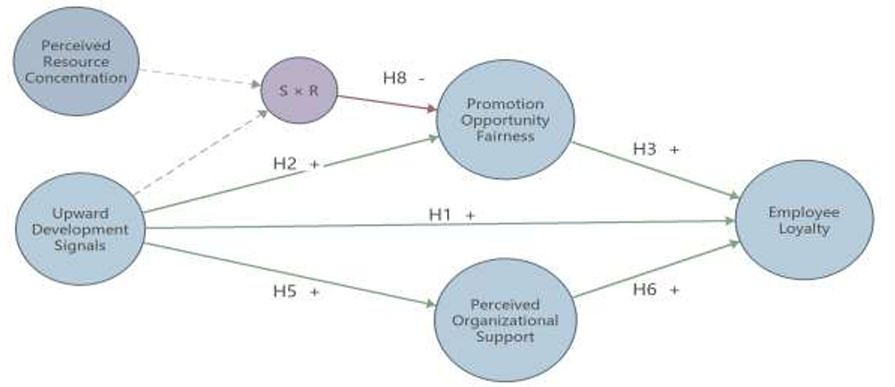
This study examines why employee loyalty declines among rank-and-file employees in Chinese private firms when promotion opportunities are unequally distributed and critical organisational resources are concentrated. Drawing on signalling theory, organisational justice theory and organisational support theory, it develops a PLS-SEM model of the effect of upward career-development signalling strength on employee loyalty and analyses 486 valid questionnaires using SmartPLS 4. The results show that upward career-development signals have a positive effect on loyalty (β = 0.118, p = 0.008) and significantly strengthen perceived fairness of promotion opportunities (β = 0.462) and perceived organisational support (β = 0.418). The two indirect effects are 0.148 and 0.119, together accounting for 69.4% of the total effect. Perceived resource concentration weakens the effect of signalling on opportunity fairness (β = -0.146), reducing the conditional indirect effect from 0.176 to 0.120. The model explains 49.2% of the variance in loyalty and demonstrates out-of-sample predictive capability. These findings suggest that loyalty in private firms is strengthened not by repeating promotion-related slogans, but by making development signals credible through transparent criteria, genuinely contestable opportunities, process feedback and a demonstrable record of honouring commitments, while using procedural safeguards to limit the discounting effect of resource concentration.
References
1) Cao, H., & Gan, W. (2026a). Employer brand attractiveness and private-enterprise employment intentions among Chinese university graduates: A moderated serial mediation analysis. Journal of Educational Theory and Practice, 3(2). https://doi.org/10.62177/jetp.v3i2.1499
2) Cao, H., & Gan, W. (2026b). The internationalisation challenges of Chinese SMEs: Formation mechanisms and governance pathways. Asia Pacific Economic and Management Review, 3(3). https://doi.org/10.62177/apemr.v3i3.1485
3) Cohen-Charash, Y., & Spector, P. E. (2001). The role of justice in organizations: A meta-analysis. Organizational Behavior and Human Decision Processes, 86(2), 278-321. https://doi.org/10.1006/obhd.2001.2958
4) Colquitt, J. A. (2001). On the dimensionality of organizational justice: A construct validation of a measure. Journal of Applied Psychology, 86(3), 386-400. https://doi.org/10.1037/0021-9010.86.3.386
5) Connelly, B. L., Certo, S. T., Ireland, R. D., & Reutzel, C. R. (2011). Signaling theory: A review and assessment. Journal of Management, 37(1), 39-67. https://doi.org/10.1177/0149206310388419
6) Cropanzano, R., & Mitchell, M. S. (2005). Social exchange theory: An interdisciplinary review. Journal of Management, 31(6), 874-900.https://doi.org/10.1177/0149206305279602
7) Eisenberger, R., Huntington, R., Hutchison, S., & Sowa, D. (1986). Perceived organizational support. Journal of Applied Psychology, 71(3), 500-507. https://doi.org/10.1037/0021-9010.71.3.500
8) Farh, J. L., Hackett, R. D., & Liang, J. (2007). Individual-level cultural values as moderators of perceived organizational support-employee outcome relationships in China: Comparing the effects of power distance and traditionality. Academy of Management Journal, 50(3), 715-729. https://doi.org/10.5465/amj.2007.25530866
9) Gan, W., Xiao, M., Zhang, N., Zhang, Y., & Mohammed, T. A. (2026). Why do graduates turn away from private firms? Examining the roles of perceived job security, perceived management compliance, perceived humanistic care, and organisational attractiveness in the Chinese context. Asia Pacific Economic and Management Review, 3(2). https://doi.org/10.62177/apemr.v3i2.1193
10) Hair, J. F., Hult, G. T. M., Ringle, C. M., & Sarstedt, M. (2022). A primer on partial least squares structural equation modeling (PLS-SEM) (3rd ed.). SAGE Publications.
11) Hair, J. F., Risher, J. J., Sarstedt, M., & Ringle, C. M. (2019). When to use and how to report the results of PLS-SEM. European Business Review, 31(1), 2-24. https://doi.org/10.1108/EBR-11-2018-0203
12) Henseler, J., Ringle, C. M., & Sarstedt, M. (2015). A new criterion for assessing discriminant validity in variance-based structural equation modeling. Journal of the Academy of Marketing Science, 43(1), 115-135. https://doi.org/10.1007/s11747-014-0403-8
13) Henseler, J., Ringle, C. M., & Sarstedt, M. (2016). Testing measurement invariance of composites using partial least squares. International Marketing Review, 33(3), 405-431. https://doi.org/10.1108/IMR-09-2014-0304
14) Kraimer, M. L., Seibert, S. E., Wayne, S. J., Liden, R. C., & Bravo, J. (2011). Antecedents and outcomes of organizational support for development: The critical role of career opportunities. Journal of Applied Psychology, 96(3), 485-500. https://doi.org/10.1037/a0021452
15) Kurtessis, J. N., Eisenberger, R., Ford, M. T., Buffardi, L. C., Stewart, K. A., & Adis, C. S. (2017). Perceived organizational support: A meta-analytic evaluation of organizational support theory. Journal of Management, 43(6), 1854-1884. https://doi.org/10.1177/0149206315575554
16) Meyer, J. P., & Allen, N. J. (1991). A three-component conceptualization of organizational commitment. Human Resource Management Review, 1(1), 61-89. https://doi.org/10.1016/1053-4822(91)90011-Z
17) Meyer, J. P., Stanley, D. J., Herscovitch, L., & Topolnytsky, L. (2002). Affective, continuance, and normative commitment to the organization: A meta-analysis of antecedents, correlates, and consequences. Journal of Vocational Behavior, 61(1), 20-52. https://doi.org/10.1006/jvbe.2001.1842
18) Mowday, R. T., Steers, R. M., & Porter, L. W. (1979). The measurement of organizational commitment. Journal of Vocational Behavior, 14(2), 224-247. https://doi.org/10.1016/0001-8791(79)90072-1
19) Podsakoff, P. M., MacKenzie, S. B., Lee, J.-Y., & Podsakoff, N. P. (2003). Common method biases in behavioral research: A critical review of the literature and recommended remedies. Journal of Applied Psychology, 88(5), 879-903. https://doi.org/10.1037/0021-9010.88.5.879
20) Rhoades, L., & Eisenberger, R. (2002). Perceived organizational support: A review of the literature. Journal of Applied Psychology, 87(4), 698-714. https://doi.org/10.1037/0021-9010.87.4.698
21) Ringle, C. M., Wende, S., & Becker, J.-M. (2024). SmartPLS 4 [Computer software]. SmartPLS. https://www.smartpls.com
22) Sarstedt, M., Henseler, J., & Ringle, C. M. (2011). Multigroup analysis in partial least squares (PLS) path modeling: Alternative methods and empirical results. In M. Sarstedt, M. Schwaiger, & C. R. Taylor (Eds.), Measurement and research methods in international marketing (Advances in International Marketing, Vol. 22, pp. 195-218). Emerald Group Publishing. https://doi.org/10.1108/S1474-7979(2011)0000022012
23) Sharma, P. N., Liengaard, B., Hair, J. F., Sarstedt, M., & Ringle, C. M. (2023). Predictive model assessment and selection in composite-based modeling using PLS-SEM: Extensions and guidelines for using CVPAT. European Journal of Marketing, 57(6), 1662-1677. https://doi.org/10.1108/EJM-08-2020-0636
24) Shmueli, G., Sarstedt, M., Hair, J. F., Cheah, J. H., Ting, H., Vaithilingam, S., & Ringle, C. M. (2019). Predictive model assessment in PLS-SEM: Guidelines for using PLSpredict. European Journal of Marketing, 53(11), 2322-2347. https://doi.org/10.1108/EJM-02-2019-0189
25) Spence, M. (1973). Job market signaling. The Quarterly Journal of Economics, 87(3), 355-374. https://doi.org/10.2307/1882010
26) Sturges, J., Guest, D., Conway, N., & Davey, K. M. (2002). A longitudinal study of the relationship between career management and organizational commitment among graduates in the first ten years at work. Journal of Organizational Behavior, 23(6), 731-748. https://doi.org/10.1002/job.164
27) Weng, Q., McElroy, J. C., Morrow, P. C., & Liu, R. (2010). The relationship between career growth and organizational commitment. Journal of Vocational Behavior, 77(3), 391-400. https://doi.org/10.1016/j.jvb.2010.05.003
Downloads
Published
Issue
Section
License
Copyright (c) 2026 Dr. Gan Weixiang, Liu Qiaoran, Dr. Xiao Mengfei (Author)

This work is licensed under a Creative Commons Attribution 4.0 International License.