A Context-Specific Digital Competence Framework for Physical Education Lecturers at Vietnamese Universities: An Integration of the Digcompedu and TPACK Models
DOI:
https://doi.org/10.65150/EP-gjefm/V2E10/2026-02Keywords:
Digital competence framework, physical education, DigCompEdu, TPACK, educational digital transformation, higher education lecturersAbstract
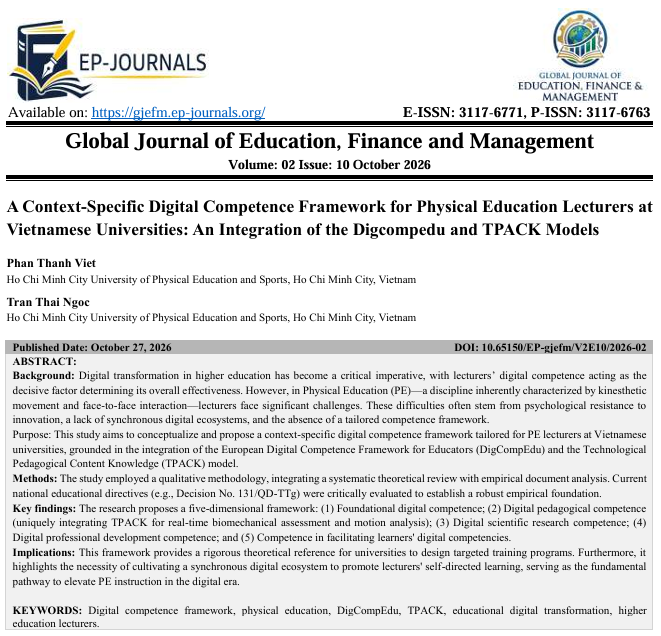
Background: Digital transformation in higher education has become a critical imperative, with lecturers’ digital competence acting as the decisive factor determining its overall effectiveness. However, in Physical Education (PE)—a discipline inherently characterized by kinesthetic movement and face-to-face interaction—lecturers face significant challenges. These difficulties often stem from psychological resistance to innovation, a lack of synchronous digital ecosystems, and the absence of a tailored competence framework.
Purpose: This study aims to conceptualize and propose a context-specific digital competence framework tailored for PE lecturers at Vietnamese universities, grounded in the integration of the European Digital Competence Framework for Educators (DigCompEdu) and the Technological Pedagogical Content Knowledge (TPACK) model.
Methods: The study employed a qualitative methodology, integrating a systematic theoretical review with empirical document analysis. Current national educational directives (e.g., Decision No. 131/QD-TTg) were critically evaluated to establish a robust empirical foundation.
Key findings: The research proposes a five-dimensional framework: (1) Foundational digital competence; (2) Digital pedagogical competence (uniquely integrating TPACK for real-time biomechanical assessment and motion analysis); (3) Digital scientific research competence; (4) Digital professional development competence; and (5) Competence in facilitating learners' digital competencies.
Implications: This framework provides a rigorous theoretical reference for universities to design targeted training programs. Furthermore, it highlights the necessity of cultivating a synchronous digital ecosystem to promote lecturers' self-directed learning, serving as the fundamental pathway to elevate PE instruction in the digital era.
References
1) Bui, T. H. (2024). Đề xuất khung năng lực số của giảng viên đại học Việt Nam trong bối cảnh Cách mạng công nghiệp 4.0 [Proposing a digital competence framework for Vietnamese university lecturers in the context of the Industrial Revolution 4.0]. Tạp chí Giáo dục [Journal of Education], 24(24), 8–13. https://tcgd.tapchigiaoduc.edu.vn/index.php/tapchi/article/view/2674
2) Central Executive Committee. (2024). Nghị quyết số 57-NQ/TW ngày 22/12/2024 của Bộ Chính trị về đột phá phát triển khoa học, công nghệ, đổi mới sáng tạo và chuyển đổi số quốc gia [Resolution No. 57-NQ/TW dated December 22, 2024 of the Politburo on breakthroughs in the development of science, technology, innovation, and national digital transformation]. Communist Party of Vietnam.
3) Central Executive Committee. (2025). Nghị quyết số 71-NQ/TW ngày 22/8/2025 của Bộ Chính trị về đột phá phát triển giáo dục và đào tạo [Resolution No. 71-NQ/TW dated August 22, 2025 of the Politburo on breakthroughs in the development of education and training]. Communist Party of Vietnam.
4) Communist Party of Vietnam. (2026). Văn kiện Đại hội Đại biểu toàn quốc lần thứ XIV (Tập 1) [Documents of the 14th National Party Congress (Vol. 1)]. National Political Publishing House.
5) Cui, H., Dong, H., & Ulanbek, M. (2026). Digital literacy development of vocational college teachers: An industry-integrated TPACK framework and intervention study. Australasian Journal of Educational Technology, 42(3), 1–21. https://doi.org/10.14742/ajet.10462
6) Do, M. P. T., & Nguyen, H. M. (2025). Digital competence of English lecturers in Vietnam. Vietnam Journal of Education, 9(2), 238–252.
https://doi.org/10.52296/vje.2025.473
7) Falloon, G. (2020). From digital literacy to digital competence: The teacher digital competency (TDC) framework. Educational Technology Research and Development, 68(5), 2449–2472. https://doi.org/10.1007/s11423-020-09767-4
8) Ferrari, A. (2013). DIGCOMP: A framework for developing and understanding digital competence in Europe. Publications Office of the European Union. https://dx.doi.org/10.2788/52966
9) Gutiérrez Porlán, I. (2014). Spanish university teacher profile in terms of skills in information and communication technology. Pixel-Bit: Journal of Media and Education, 44, 51–65. https://doi.org/10.12795/pixelbit.2014.i44.04
10) Hoang, P. (Ed.). (2003). Từ điển Tiếng Việt [Vietnamese Dictionary]. Da Nang Publishing House.
11) Killen, C. (2018). Collaboration and coaching: Powerful strategies for developing digital capabilities. In Digital literacy unpacked (pp. 29–44). Facet Publishing. https://doi.org/10.29085/9781783301997.005
12) Koehler, M. J., & Mishra, P. (2009). What is technological pedagogical content knowledge (TPACK)? Contemporary Issues in Technology and Teacher Education, 9(1), 60–70.
13) Lahn, L. C., & Berntsen, S. K. (2023). Frameworking vocational teachers’ digital competences. Nordic Journal of Comparative and International Education, 7(1). https://doi.org/10.7577/njcie.5322
14) Le, V. T., & Pham, Q. T. (2023). Chuyển đổi số trong hoạt động đào tạo ở trường đại học [Digital transformation in university training activities]. Tạp chí Khoa học Giáo dục Việt Nam [Vietnam Journal of Educational Sciences], 19(10), 1–6.
15) Ministry of Education and Training. (2025). Thông tư số 02/2025/TT-BGDĐT ngày 24/01/2025 quy định Khung năng lực số cho người học [Circular No. 02/2025/TT-BGDDT dated January 24, 2025, regulating the digital competence framework for learners]. Government of Vietnam.
16) Ministry of Education and Training. (2026a). Thông tư số 18/2026/TT-BGDĐT ngày 27/3/2026 ban hành Khung năng lực số đối với giáo viên, cán bộ quản lý cơ sở giáo dục mầm non, phổ thông và giáo dục thường xuyên [Circular No. 18/2026/TT-BGDDT dated March 27, 2026, promulgating the digital competence framework for teachers and administrators]. Government of Vietnam.
17) Ministry of Education and Training. (2026b). Thông tư số 43/2026/TT-BGDĐT ngày 9/6/2026 quy định tiêu chuẩn người dạy nghề [Circular No. 43/2026/TT-BGDDT dated June 9, 2026, regulating the standards for vocational teachers]. Government of Vietnam.
18) Ministry of Labour, Invalids and Social Affairs. (2024). Thông tư số 05/2024/TT-BLĐTBXH ngày 10/5/2024 quy định chuẩn chuyên môn, nghiệp vụ của nhà giáo giáo dục nghề nghiệp [Circular No. 05/2024/TT-BLDTBXH dated May 10, 2024, regulating professional standards for vocational education teachers]. Government of Vietnam.
19) Mishra, P., & Koehler, M. J. (2006). Technological Pedagogical Content Knowledge: A Framework for Teacher Knowledge. Teachers College Record: The Voice of Scholarship in Education, 108(6), 1017–1054. https://doi.org/10.1111/j.1467-9620.2006.00684.x
20) Nghiem, T. T., Nguyen, T. M. L., Duong, T. H. Y., Nguyen, P. H., Mai, T. K., & Le, T. T. H.. (2026). Đề xuất bộ tiêu chuẩn năng lực số dành cho giảng viên các trường đại học có đào tạo giáo viên tại Việt Nam [Set of digital competence standards for lecturers at teacher education universities in Vietnam]. Tạp chí Giáo dục [Journal of Education], 26(16), 1–11.
https://tcgd.tapchigiaoduc.edu.vn/index.php/tapchi/article/view/6452
21) Nguyen, A. T., & Bui, T. H. (2022). Một số giải pháp để phát triển năng lực số của giảng viên đại học Việt Nam [Recommendations to Develop Lecturers’ Digital Competence Framework in Vietnam]. Tạp chí Khoa học Đại học Quốc gia Hà Nội: Nghiên cứu Chính sách và Quản lý [VNU Journal of Science: Policy and Management Studies], 38(3), 83–94. https://doi.org/10.25073/2588-1116/vnupam.4407
22) Nguyen, L. P., & Le, T. T. H. (2024). Phát triển năng lực số cho giảng viên đại học trong bối cảnh hội nhập: Nghiên cứu trường hợp tại Trường Đại học Nguyễn Tất Thành [Developing digital competence for university lecturers in the context of integration]. Tạp chí Giáo dục [Journal of Education], 24(9), 7–12. https://tcgd.tapchigiaoduc.edu.vn/index.php/tapchi/article/view/1755
23) Nguyen, P. Q. (2025). Phát triển khung năng lực số cho giáo viên trong kỉ nguyên trí tuệ nhân tạo [Developing a digital competence framework for teachers in the artificial intelligence era]. In Kỉ yếu Hội thảo khoa học quốc gia: Phát triển năng lực giáo viên trong bối cảnh chuyển đổi số (pp. 254–261). National University Publishing House.
24) Nguyen, T. H. (2024). Chuyển đổi số trong giáo dục đại học - Những thách thức [Digital transformation in higher education - Challenges]. Tạp chí Khoa học Giáo dục Việt Nam [Vietnam Journal of Educational Sciences], 20(6), 1–7.
25) Oberländer, M., Beinicke, A., & Bipp, T. (2020). Digital competencies: A review of the literature and applications in the workplace. Computers & Education, 146, Article 103752. https://doi.org/10.1016/j.compedu.2019.103752
26) Pham, T. T. L. (2023). Chuyển đổi số trong giáo dục đại học: Một nghiên cứu tổng quan và các hàm ý cho các trường đại học Việt Nam [Digital transformation in higher education: An overview and implications for Vietnamese universities]. Tạp chí Khoa học, Trường Đại học Đồng Tháp [Dong Thap University Journal of Science], 12(7), 3–11. https://doi.org/10.52714/dthu.12.7.2023.1134
27) Prime Minister. (2020). Quyết định số 749/QĐ-TTg ngày 03/6/2020 phê duyệt Chương trình Chuyển đổi số quốc gia đến năm 2025, định hướng đến năm 2030 [Decision No. 749/QD-TTg dated June 3, 2020, approving the National Digital Transformation Program to 2025, oriented to 2030]. Government of Vietnam.
28) Prime Minister. (2021). Quyết định số 2222/QĐ-TTg phê duyệt Chương trình chuyển đổi số trong giáo dục nghề nghiệp đến năm 2025, định hướng đến năm 2030 [Decision No. 2222/QD-TTg approving the digital transformation program in vocational education to 2025, oriented to 2030]. Government of Vietnam.
29) Prime Minister. (2022). Quyết định số 131/QĐ-TTg ngày 25/01/2022 phê duyệt Đề án “Tăng cường ứng dụng công nghệ thông tin và chuyển đổi số trong giáo dục và đào tạo” [Decision No. 131/QD-TTg dated January 25, 2022, approving the Scheme "Enhancing the application of information technology and digital transformation in education and training"]. Government of Vietnam.
30) Rakisheva, A., & Witt, A. (2023). Digital competence frameworks in teacher education. Issues and Trends in Learning Technologies, 11(1), 29–42. https://doi.org/10.2458/itlt.5205
31) Redecker, C. (2017). European framework for the digital competence of educators: DigCompEdu (Y. Punie, Ed.). Publications Office of the European Union. https://dx.doi.org/10.2760/178382
32) Tran, H. T., Tran, X. P., & Tran, D. H. (2026). Bồi dưỡng năng lực số cho giảng viên các học viện, trường sĩ quan quân đội đáp ứng yêu cầu chuyển đổi số trong giáo dục, đào tạo [Developing digital competencies for lecturers at military academies and officer schools to meet the requirements of digital transformation in education and training]. Tạp chí Khoa học Giáo dục Việt Nam [Vietnam Journal of Educational Sciences], 22(8), 18–25.
33) Uerz, D., van Zanten, M., van der Neut, I., Tondeur, J., Kral, M., Gorissen, P., & Howard, S. (2021). A digital competences framework for lecturers in higher education. Acceleration plan Educational innovation with IT. https://acc.ixperium.nl/wp-content/uploads/2022/10/A-framework-for-digital-competences-of-lecturers.pdf
34) UNESCO. (2018a). A global framework of reference on digital literacy skills for indicator 4.4.2. UNESCO Institute for Statistics. https://unesdoc.unesco.org/ark:/48223/pf0000265403.locale=en
35) UNESCO. (2018b). UNESCO’s ICT competency framework for teachers (Version 3). UNESCO Publishing. https://www.unesco.org/en/digital-competencies-skills/ict-cft
36) Vuorikari, R., Kluzer, S., & Punie, Y. (2022). DigComp 2.2: The digital competence framework for citizens. Publications Office of the European Union. https://publications.jrc.ec.europa.eu/repository/handle/JRC128415
Downloads
Published
Issue
Section
License
Copyright (c) 2026 Phan Thanh Viet, Tran Thai Ngoc (Author)

This work is licensed under a Creative Commons Attribution 4.0 International License.