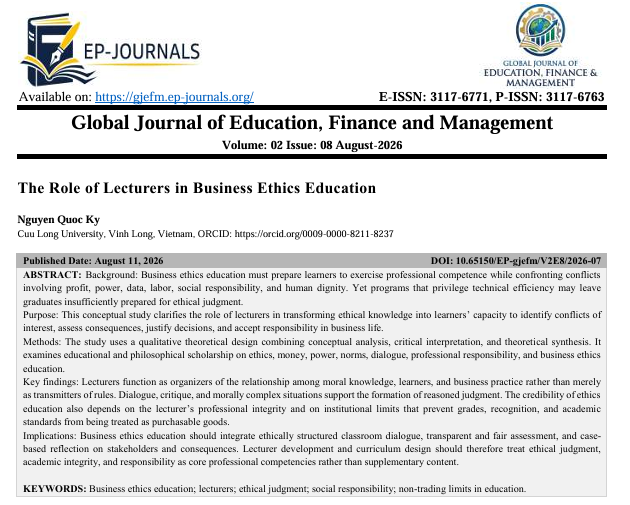
The Role of Lecturers in Business Ethics Education
DOI:
https://doi.org/10.65150/EP-gjefm/V2E8/2026-07Keywords:
Business ethics education, lecturers, ethical judgment, social responsibility, non-trading limits in educationAbstract
Background: Business ethics education must prepare learners to exercise professional competence while confronting conflicts involving profit, power, data, labor, social responsibility, and human dignity. Yet programs that privilege technical efficiency may leave graduates insufficiently prepared for ethical judgment.
Purpose: This conceptual study clarifies the role of lecturers in transforming ethical knowledge into learners’ capacity to identify conflicts of interest, assess consequences, justify decisions, and accept responsibility in business life.
Methods: The study uses a qualitative theoretical design combining conceptual analysis, critical interpretation, and theoretical synthesis. It examines educational and philosophical scholarship on ethics, money, power, norms, dialogue, professional responsibility, and business ethics education.
Key findings: Lecturers function as organizers of the relationship among moral knowledge, learners, and business practice rather than merely as transmitters of rules. Dialogue, critique, and morally complex situations support the formation of reasoned judgment. The credibility of ethics education also depends on the lecturer’s professional integrity and on institutional limits that prevent grades, recognition, and academic standards from being treated as purchasable goods.
Implications: Business ethics education should integrate ethically structured classroom dialogue, transparent and fair assessment, and case-based reflection on stakeholders and consequences. Lecturer development and curriculum design should therefore treat ethical judgment, academic integrity, and responsibility as core professional competencies rather than supplementary content.
References
1) Alberts, B., Nurse, P., & Schier, A. F. (2025). Science, education, leadership, and politics: An interview with Bruce Alberts and Paul Nurse. Annual Review of Cell and Developmental Biology, 41, 1–14. https://doi.org/10.1146/annurev-cellbio-101323-034601
2) Arendt, H. (2018). The human condition (2nd ed., enlarged; M. Canovan, Intro.; D. Allen, Foreword). University of Chicago Press. (Original work published 1958)
3) Aristotle. (2014). Nicomachean ethics (R. Crisp, Trans. & Ed.; 2nd ed.). Cambridge University Press. (Original work published ca. 350 B.C.E.)
4) Badreddine, S., et al. (2026). Predicting cybersecurity behaviors in higher education institutions: A data-driven analysis of policy, culture, and motivation in the UAE context. Information, 17(2), Article 152. https://doi.org/10.3390/info17020152
5) Baird, J. A., Filipe Pancada Correia, C. F. D., Cowie, B., El Masri, Y., Hayward, L., Kanjee, A., … Yan, Z. (2026). Formative assessment: A global phenomenon. Assessment in Education: Principles, Policy & Practice, 33(2), 92–104. https://doi.org/10.1080/0969594X.2026.2673240
6) Bartling, B., Valero, V., & Weber, R. A. (2026). The causal effect of income on market social responsibility. The Economic Journal, 136(675), 869–904. https://doi.org/10.1093/ej/ueaf064
7) Basarati, A. (2026). The demise of critical agency in a post-conflict teaching environment. ELT Journal, 80(2), 207–216. https://doi.org/10.1093/elt/ccag001
8) Biesta, G., Takayama, K., Heimans, S., & Kettle, M. (2026). Challenging teacher education: A series of invited papers for the Asia-Pacific Journal of Teacher Education. Asia-Pacific Journal of Teacher Education, 54(3), 225–226. https://doi.org/10.1080/1359866X.2026.2676232
9) Botha, E. A., Blignaut, J. H., & du Toit-Brits, C. (2025). The significance of teachers’ willingness and commitment as self-directed learning agents. Africa Education Review, 21(6), 1–21. https://doi.org/10.1080/18146627.2026.2641498
10) Bourassa, G. N. (2026). ‘If you love teaching so much … ’: Teaching against the injunctions of the capitalist state and refusing the weaponization of love. Critical Studies in Education, 67(2), 280–297. https://doi.org/10.1080/17508487.2025.2470380
11) Bowers, P., Graydon, K., Ryan, T., Lau, J. H., & Tomlin, D. (2024). Artificial intelligence-driven virtual patients for communication skill development in healthcare students. Australasian Journal of Educational Technology, 40(3), 1–19. https://doi.org/10.14742/ajet.9307
12) Bsheer, R. (2025). Education during genocide: The university and its discontents. Curriculum Inquiry, 55(3–4), 281–287. https://doi.org/10.1080/03626784.2026.2646152
13) Buckley-Zistel, S., Bast, J., & Holderied, L. (2026). Humanrightization of migration discourses: A conceptual framework. Journal of Human Rights Practice, 18(1), Article huaf044. https://doi.org/10.1093/jhuman/huaf044
14) Budairi, A. (2026). When silence speaks: Rethinking dialogue, voice, and learning. Changing English, 33(2), 172–182. https://doi.org/10.1080/1358684X.2025.2589870
15) Caro, S., Gillis, T., & Nelson, S. (2026). Differential validity in fair lending. Journal of Legal Analysis, 18(1), 1–18. https://doi.org/10.1093/jla/laaf013
16) Carroll, P., & Amideo, A. E. (2024). Gender equality: Opportunities and challenges for the OR community. Journal of the Operational Research Society, 75(6), 1011–1029. https://doi.org/10.1080/01605682.2024.2343343
17) Coghlan, D., Abbott, C., Hauser, B., Pedler, M., & Wood, L. (2026). Journeys in action learning: Career reflections and lessons for the next generation. Action Learning: Research and Practice, 23(1), 5–18. https://doi.org/10.1080/14767333.2025.2586510
18) Davenport, H. L., & Phillips, K. E. (2026). “Panicked responsibility”: Confidant perspectives of disclosure and information management in university student affairs. Communication Education, 75(2), 157–177. https://doi.org/10.1080/03634523.2025.2559810
19) Dewey, J. (2024). Democracy and education. Columbia University Press. (Original work published 1916)
20) Diehl, W. C. (2026). Balancing distance education: Learner realities, system responsibilities, and humane design. American Journal of Distance Education, 40(2), 129. https://doi.org/10.1080/08923647.2026.2661239
21) Dopelt, K. (2026). The impact of social media on public health and education: Mechanisms, vulnerabilities, and policy implications. European Journal of Investigation in Health, Psychology and Education, 16(3), Article 43. https://doi.org/10.3390/ejihpe16030043
22) Dunham, H. (2026). Toward critical consciousness: One preservice teacher’s approximations in the elementary literacy classroom. Action in Teacher Education, 48(2), 112–129. https://doi.org/10.1080/01626620.2025.2591962
23) Eidenmüller, T., Plavcan, P., Weber, M., Humpert, R. P., Beernink, L., Kampmann, I., & Ajiri, D. (2025). Professional self-reflection in the digital age: Technological tools for managerial development. Journal of Organizational Behavior Research, 10(3), 62–72. https://doi.org/10.51847/8Nc9K5Uzeb
24) Elton-Chalcraft, S., Cooling, T., Hand, M., & Hannam, P. (2026). Knowledge and religious education: A metalogue. British Journal of Religious Education, 48(3), 325–343. https://doi.org/10.1080/01416200.2025.2548522
25) Felch, S. M. (2026). Christian higher education in a global context. Christian Higher Education, 25(1–2), 7–20. https://doi.org/10.1080/15363759.2026.2647098
26) Figueroa, A. (2026). Exploring collaborative communities for active learning: Enhancing engagement and critical thinking skills. The Clearing House: A Journal of Educational Strategies, Issues and Ideas, 99(3), 138–150. https://doi.org/10.1080/00098655.2026.2655873
27) Fletcher, T., Ní Chróinín, D., Dillon, M., Beckey, A., Bowles, R., Hamblin, D., & Kitching, N. (2026). Learning about meaningful physical education in physical education teacher education: Two case studies of sustained implementation. Curriculum Studies in Health and Physical Education, 17(2), 116–132. https://doi.org/10.1080/25742981.2024.2442926
28) Foucault, M. (1995). Discipline and punish: The birth of the prison (A. Sheridan, Trans.; 2nd Vintage Books ed.). Vintage Books. (Original work published 1975)
29) Fox, C., Parker, M., & Locker, E. (2026). The meaning of excellence in learning and teaching to students. Assessment & Evaluation in Higher Education, 51(4), 632–648. https://doi.org/10.1080/02602938.2025.2588681
30) Freire, P. (2018). Pedagogy of the oppressed (50th anniversary ed.; M. B. Ramos, Trans.). Bloomsbury Academic. (Original work published 1970)
31) Gadamer, H.-G. (2013). Truth and method (J. Weinsheimer & D. G. Marshall, Trans.; 2nd rev. ed.). Bloomsbury Academic. (Original work published 1960)
32) Galbraith, J., & Flatley, E. (2026). Addressing the linkages between nondiscrimination and substantive rights. Human Rights Law Review, 26(2), Article ngag004. https://doi.org/10.1093/hrlr/ngag004
33) Garcia-Dominguez, A., & Beaumont, T. (2026). Experiences with test-driven elaborated feedback for teaching introductory programming. Computer Science Education, 36(2), 375–424. https://doi.org/10.1080/08993408.2025.2554497
34) Govind, P. J., & Davies, P. J. (2025). Embracing relationality in planning law to help restructure relationships between people and land: A case from Australia. Journal of Environmental Law, 37(3), 537–557. https://doi.org/10.1093/jel/eqaf029
35) Habermas, J. (1990). Moral consciousness and communicative action (C. Lenhardt & S. W. Nicholsen, Trans.). MIT Press. (Original work published 1983)
36) Hahn, J. (2025). The language games of canon law: Strategic ambiguity between law and religion. Oxford Journal of Law and Religion, 14(2), 205–221. https://doi.org/10.1093/ojlr/rwae004
37) Hayik, R. (2026). Raising awareness of minority-language representation through engaging pedagogies. Diaspora, Indigenous, and Minority Education, 20(2), 184–198. https://doi.org/10.1080/15595692.2024.2395518
38) Healey, M. (2026). Broadening and integrating undergraduate research. Change: The Magazine of Higher Learning, 58(2), 5–13. https://doi.org/10.1080/00091383.2026.2642562
39) Heltai, J. I., Jani-Demetriou, B., Schmidt, I., Szabó, G., & Tarsoly, E. (2026). Pathways to ethical subjectivity: Participant transformation in tripartite collaborative research. Critical Inquiry in Language Studies, 23(2), 97–114. https://doi.org/10.1080/15427587.2025.2503708
40) Hertogh, M. (2024). Empirical approaches to the rule of law: Contours and challenges of a social science that does not quite yet exist. Annual Review of Law and Social Science, 20(1), 35–51. https://doi.org/10.1146/annurev-lawsocsci-041822-044308
41) Hirschl, R., & Hudson, A. (2024). A fair process matters: The relationship between public participation and constitutional legitimacy. Law & Social Inquiry, 49(4), 2074–2101. https://doi.org/10.1017/lsi.2023.82
42) Huikku, J., Ojala, H., & Mättö, M. (2026). Understanding the shift: Exploring motivational and contextual factors affecting the adoption of learning approach. Accounting Education, 35(4), 526–562. https://doi.org/10.1080/09639284.2025.2483835
43) Istace, T., & Van Assche, K. (2026). Neurotechnological cognitive enhancement and human rights: A complex dynamic between empowerment and constraint. Journal of Law and the Biosciences, 13(1), Article lsag004. https://doi.org/10.1093/jlb/lsag004
44) Jansen, B. (2026). The politicization of business ethics: State, corporation, and society seen from a Schmittian perspective. Business Ethics Quarterly, 36(1), 31–68.
45) Jao, J. C., & Chuah, J. C. T. (2026). Artificial intelligence in negotiating energy production and other interests in marine spatial planning: Managing transparency and bias. The Journal of World Energy Law & Business, 19(1), Article jwaf029. https://doi.org/10.1093/jwelb/jwaf029
46) Jones, E., Ruiz, I., & Undurraga, S. (2025). Repositioning care in economics: Concepts, measurement, and policy implications. Oxford Review of Economic Policy, 41(3–4), 653–675. https://doi.org/10.1093/oxrep/grag001
47) Kant, I. (2012). Groundwork of the Metaphysics of Morals (M. Gregor & J. Timmermann, Trans. & Ed.; rev. ed.). Cambridge University Press. (Original work published 1785)
48) Kovalova, E., Durana, P., Zvarikova, K., & Trulikova, I. (2026). From theory to debt decisions: Evidence on financial literacy among university students. Economies, 14(3), Article 100. https://doi.org/10.3390/economies14030100
49) Kuzmina, S., & Avdieieva, S. (2025). Professors of the Kyiv Theological Academy on educational reform: Dreams and the reality of authoritarian modernization. Kyiv-Mohyla Humanities Journal, 12, 16–29. https://doi.org/10.18523/2313-4895.12.2025.16-29
50) Levinas, E. (2011). Otherwise than being, or beyond essence (A. Lingis, Trans.). Duquesne University Press. (Original work published 1974)
51) Levi, M., & Russell, E. (2025). Property righting: The politics of rights over land and labor. Annual Review of Political Science, 28, 37–56. https://doi.org/10.1146/annurev-polisci-033123-021046
52) Lin-Januszewski, L. W. (2026). Symbolic haunting: First-generation university students’ limited sense of entitlement. British Journal of Sociology of Education, 47(5), 833–852. https://doi.org/10.1080/01425692.2026.2615957
53) Little, S. B. (2026). Overcorrection as a strategy for virtue development. British Journal of Educational Studies, 74(3), 331–354.https://doi.org/10.1080/00071005.2025.2608793
54) MacIntyre, A. (2007). After virtue: A study in moral theory (3rd ed.). University of Notre Dame Press.
55) Maginnis, M. S. (2025). The future of virology education. Annual Review of Virology, 12, 43–57. https://doi.org/10.1146/annurev-virology-092623-110921
56) Maire, Q., Chatelier, S., & Resnik, J. (2026). On global citizenship education in a new conjuncture. Discourse: Studies in the Cultural Politics of Education, 47(3), 331–342. https://doi.org/10.1080/01596306.2026.2669394
57) Majrashi, K. (2025). Employees’ perceptions of the fairness of AI-based performance prediction features. Cogent Business & Management, 12(1), Article 2456111. https://doi.org/10.1080/23311975.2025.2456111
58) Martín, A. D. (2025). Analysis of the theoretical phase of Wells and Matthews' model of emotional self-regulation: Methodological aspects. Metatheoria – Journal of Philosophy and History of Science, 15(2), 17–37. https://doi.org/10.48160/18532330me15.381
59) McDonnell, E. M. (2025). Bureaucracy in action: The sociology of public administration. Annual Review of Sociology, 51, 191–211. https://doi.org/10.1146/annurev-soc-091324-053657
60) Mendes dos Santos, A. C., Mattalia, G., Medeiros-Leal, W., Spagnoletti, N., & Carvalho Ribeiro, S. M. (2026). Beyond commodities: Valuing the contributions of stewardship practices in sociobiodiversity-based bioeconomy. Forests, 17(3), Article 380. https://doi.org/10.3390/f17030380
61) Mertz, E., & Richland, J. (2025). Law, anthropology, and their languages. Annual Review of Anthropology, 54, 409–425. https://doi.org/10.1146/annurev-anthro-041422-012037
62) Natsir, M., Ilahi, A. H. A., & Adnas, T. P. (2024). Political and legal developments in mineral and coal mining laws: A critical review. Diponegoro Law Review, 9(2), 186–203. https://doi.org/10.14710/dilrev.9.2.2024.186-203
63) Nussbaum, M. C. (2010). Not for profit: Why democracy needs the humanities. Princeton University Press.
64) Patterson-Craven, S. (2026). Positioning novice teachers as truth-tellers: How novice teachers can engage in fearless speech and exercise their agency. Cambridge Journal of Education, 56(3), 293–311. https://doi.org/10.1080/0305764X.2025.2536661
65) Pilkington, B. (2026). Psychiatry, pathology, and disease: Some benefits of philosophical reflection. The Journal of Medicine and Philosophy: A Forum for Bioethics and Philosophy of Medicine, 51(2), 79–88. https://doi.org/10.1093/jmp/jhaf045
66) Plato. (1997). Complete works (J. M. Cooper & D. S. Hutchinson, Eds.). Hackett Publishing Company.
67) Pollak, S. D., & Smith, K. E. (2026). Conceptual and methodological issues in studying early adversity and development. Annual Review of Clinical Psychology, 22, 187–214. https://doi.org/10.1146/annurev-clinpsy-061724-091000
68) Rajendra, J. B., & Thuraisingam, A. S. (2026). The role of explainability and human intervention in AI decisions: Jurisdictional and regulatory aspects. Information & Communications Technology Law, 35(2), 152–183. https://doi.org/10.1080/13600834.2025.2537514
69) Rancière, J. (1991). The ignorant schoolmaster: Five lessons in intellectual emancipation (K. Ross, Trans.). Stanford University Press. (Original work published 1987)
70) Rawls, J. (2005). Political liberalism (Expanded ed.). Columbia University Press. (Original work published 1993)
71) Ren, J., & Li, X. (2026). Mentor support and postgraduate research ability: The role of research self-efficacy and academic atmosphere. Asia Pacific Journal of Education, 46(3), 487–501. https://doi.org/10.1080/02188791.2024.2364648
72) Roberts, D. (2026). Epistemic injustice, neurodivergence, and inclusive pedagogy: Dyslexia and augmentative communication in higher education. Disability & Society, 41(7), 1788–1809. https://doi.org/10.1080/09687599.2026.2659094
73) Rosenkranz, G. B., & Lavizzari, A. (2026). Education as a field of contention: Feminist and anti-gender struggles over democracy. Social Politics: International Studies in Gender, State & Society, 33(1), 26–51. https://doi.org/10.1093/sp/jxaf058
74) Sandel, M. J. (2012). What money cannot buy: The moral limits of markets. Farrar, Straus and Giroux.
75) Sanders, A., Khatarina, J., Assegaf, R., Toumbourou, T., Kurniasih, H., & Suwarso, R. (2024). The Omnibus Law on job creation and its potential implications for rural youth and future farming in Indonesia. Asia Pacific Viewpoint, 65(2), 248–262. https://doi.org/10.1111/apv.12408
76) Sejdiu, S., & Ramadani, R. (2026). Catalytic communication in sustainability education: Bridging the knowledge–action gap through affective engagement and strategic praxis. Education Sciences, 16(3), Article 494. https://doi.org/10.3390/educsci16030494
77) Stulz, R. M. (2025). Risk, the limits of financial risk management, and corporate resilience. Annual Review of Financial Economics, 17, 411–430. https://doi.org/10.1146/annurev-financial-112823-022941
78) Wang, S., Prestridge, S., Forbes, D., & Wang, Y. (2026). Beyond access alone: Distance education in an AI and open knowledge era. Distance Education, 47(2), 181–184. https://doi.org/10.1080/01587919.2026.2681755
79) Yang, L., Lv, J., Shao, J., Wang, P., Xu, S., & Yang, R. (2026). Consequences of undisclosed conflicts of interest in academic publishing. Accountability in Research, 33(5). https://doi.org/10.1080/08989621.2026.2616765
Downloads
Published
Issue
Section
License
Copyright (c) 2026 Nguyen Quoc Ky (Author)

This work is licensed under a Creative Commons Attribution 4.0 International License.