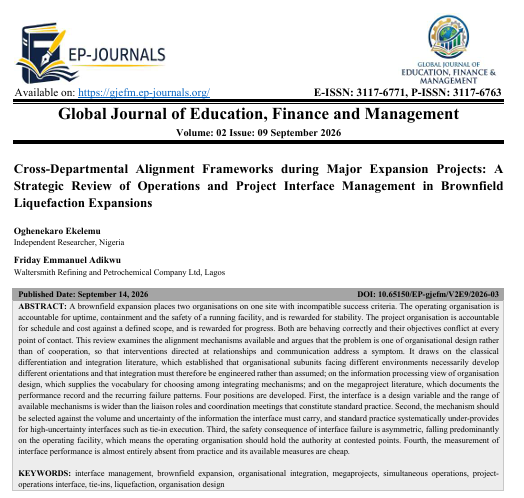
Cross-Departmental Alignment Frameworks during Major Expansion Projects: A Strategic Review of Operations and Project Interface Management in Brownfield Liquefaction Expansions
DOI:
https://doi.org/10.65150/EP-gjefm/V2E9/2026-03Keywords:
interface management, brownfield expansion, organisational integration, megaprojects, simultaneous operations, project-operations interface, tie-ins, liquefaction, organisation designAbstract
A brownfield expansion places two organisations on one site with incompatible success criteria. The operating organisation is accountable for uptime, containment and the safety of a running facility, and is rewarded for stability. The project organisation is accountable for schedule and cost against a defined scope, and is rewarded for progress. Both are behaving correctly and their objectives conflict at every point of contact. This review examines the alignment mechanisms available and argues that the problem is one of organisational design rather than of cooperation, so that interventions directed at relationships and communication address a symptom. It draws on the classical differentiation and integration literature, which established that organisational subunits facing different environments necessarily develop different orientations and that integration must therefore be engineered rather than assumed; on the information processing view of organisation design, which supplies the vocabulary for choosing among integrating mechanisms; and on the megaproject literature, which documents the performance record and the recurring failure patterns. Four positions are developed. First, the interface is a design variable and the range of available mechanisms is wider than the liaison roles and coordination meetings that constitute standard practice. Second, the mechanism should be selected against the volume and uncertainty of the information the interface must carry, and standard practice systematically under-provides for high-uncertainty interfaces such as tie-in execution. Third, the safety consequence of interface failure is asymmetric, falling predominantly on the operating facility, which means the operating organisation should hold the authority at contested points. Fourth, the measurement of interface performance is almost entirely absent from practice and its available measures are cheap.
References
1. Abdulhadi, B. M., & Hamdan, A. M. (2026a). Carbon-driven decision gates: Integrating embodied carbon accounting into construction project lifecycle governance. Research Journal of Pure Science and Technology, 9(5), 48-82.
2. Abdulhadi, B. M., & Hamdan, A. M. (2026c). Sustainability-linked contracting and incentive alignment in integrated project delivery: A conceptual framework. International Journal of Social Sciences and Management Research, 12(6), 466-501.
3. Adebayo, A., Adegbite, M. P., & Ahmed, M. O. (2023). AI augmented threat detection in industrial control systems: A systematic review of machine learning approaches for ICS anomaly detection. International Journal of Engineering and Modern Technology, 9(3), 287-340.
4. Adelanwa, A., Basnet, A., & Anene, U. N. (2023a). Data driven digital transformation models for lifecycle performance management in infrastructure delivery. International Journal of Advanced Multidisciplinary Research and Studies, 3(6),2646-2662.
5. Adenuga, O. M. (2022). Smart grid architectures and energy distribution for high renewable penetration: A comprehensive review of technologies, operations, and deployment pathways. International Journal of Engineering and Modern Technology, 8(5), 125-155.
6. Adeyelu, O. O. (2021). A framework for managing encroachments and unauthorized structures around airport boundaries: Regulatory evidence, enforcement, and corrective action protocols for Nigerian civil aviation. International Journal of Multidisciplinary Research and Growth Evaluation, 2(6), 954-972.
7. Adeyelu, O. O., & Dagodzo, D. (2022). A comparative benchmarking model for aerodrome certification compliance across developing economy civil aviation authorities. International Journal of Multidisciplinary Research and Growth Evaluation, 3(6), 1016-1035.
8. Adikwu, F. E., Ozobu, C. O., Odujobi, O., Onyekwe, F. O., & Nwulu, E. O. (2023). Advances in EHS compliance: A conceptual model for standardizing health, safety, and hygiene programs across multinational corporations. IRE Journals, 7(5), 360-372.
9. Agu, M. U., Akomolafe, O., & Bello, A. (2023a). A comparative review of SOX compliance frameworks in cross-border financial auditing. International Journal of Advanced Multidisciplinary Research and Studies, 3(6), 2297-2306.
10. Agu, M. U., Akomolafe, O., & Bello, A. (2023b). A review of integrated data management systems for enhancing financial forecasting accuracy. International Journal of Advanced Multidisciplinary Research and Studies, 3(6), 2335-2344.
11. Ahiaeke Patrick, M. C., Okonkwo, C. S., Mayo, W., & Okeke, O. T. (2020). A GIS enabled framework for modern ERP procurement processes. International Journal of Multidisciplinary Research and Growth Evaluation, 1(5), 499-508.
12. Ahmed, M. O., Adegbite, M. P., & Adebayo, A. (2021). Zero trust architecture for operational technology in North American critical infrastructure: A framework for implementation and resilience optimization. International Journal of Engineering and Modern Technology, 7(1), 66-113.
13. Ahn, S., Shokri, S., Lee, S., Haas, C. T., & Haas, R. C. G. (2017). Exploratory study on the effectiveness of interface-management practices in dealing with project complexity in large-scale engineering and construction projects. Journal of Management in Engineering, 33(2), 04016039.
14. Akomolafe, O., Agu, M. U., & Bello, A. (2023a). A conceptual model for implementing risk-based auditing in strategic financial management. International Journal of Advanced Multidisciplinary Research and Studies, 3(6), 2274-2286.
15. Akomolafe, O., Agu, M. U., & Bello, A. (2023b). A quantitative conceptual model for assessing compliance risk in emerging economies. International Journal of Advanced Multidisciplinary Research and Studies, 3(6), 2287-2296.
16. Aliliele, C., Mbonu, I. S., Uzoka, E., & Iwuanyanwu, U. (2025b). Advances in data lakehouse governance architectures for enterprise data loss prevention and compliance assurance. Shodhshauryam, International Scientific Refereed Research Journal, 8(4), 171-213.
17. Amayo, E. B., Owulade, O. A., & Isi, L. R. (2024b). Effective project governance in multinational infrastructure projects: A case study from General Electric. Iconic Research and Engineering Journals, 8(5), 1305-1324.
18. Amayo, E. B., Owulade, O. A., & Isi, L. R. (2024c). Strategic project management approaches for successful solar energy deployments in emerging markets: Lessons from West Africa. Iconic Research and Engineering Journals, 7(11), 783-803.
19. Amayo, E. B., Owulade, O. A., & Isi, L. R. (2025a). Diversity and inclusion in global project teams: Impact on delivery success. International Journal of Academic Management Science Research, 9(3), 81-95.
20. Amayo, E. B., Owulade, O. A., & Isi, L. R. (2025c). Risk management and compliance in healthcare project delivery: Lessons from West Africa. Engineering and Technology Journal, 10(3), 4242-4255.
21. Ambali, K. B., Eyetsemitan, R. A., Oyeleye, A. O., & Fadayomi, O. (2021). Lean Six Sigma for small enterprises: A systematic review and Lite-DMAIC adaptation framework for resource-constrained organizations. Iconic Research and Engineering Journals, 5(5), 562-583.
22. Aminu-Ibrahim, A. Y., Ogbete, J. C., & Ambali, K. B. (2024). Governance and accountability models for public private partnerships in healthcare infrastructure development. International Journal of Advanced Multidisciplinary Research and Studies, 4(6), 2943-2960.
23. Aminu-Ibrahim, A. Y., Ogbete, J. C., & Iwuanyanwu, O. C. (2025a). Cost control and financial accountability frameworks for national healthcare construction programs. International Journal of Advanced Multidisciplinary Research and Studies, 5(6), 1970-1990.
24. Ansar, A., Flyvbjerg, B., Budzier, A., & Lunn, D. (2014). Should we build more large dams? The actual costs of hydropower megaproject development. Energy Policy, 69, 43-56.
25. Arumosoye, O. M., & Obriki, O. D. (2018). Development of an integrated heat stress risk conceptual model for industrial operations in extreme environments. Iconic Research and Engineering Journals, 1(12), 141-160.
26. Arumosoye, O. M., & Obriki, O. D. (2019). Systematic review of near-miss and hazard observation data utilization in industrial safety management. Iconic Research and Engineering Journals, 3(2), 981-999.
27. Arumosoye, O. M., & Obriki, O. D. (2021). Organizational learning-based conceptual maturity model for continuous safety performance improvement. International Journal of Multidisciplinary Research and Growth Evaluation, 2(1), 970-980.
28. Arumosoye, O. M., & Obriki, O. D. (2022). Conceptual risk pathway model for lifting and rigging operations in heavy industrial construction. Gyanshauryam, International Scientific Refereed Research Journal, 5(5), 346-369.
29. Arumosoye, O. M., & Obriki, O. D. (2023). Conceptual model for emergency response readiness and capability in energy and process facilities. International Journal of Scientific Research in Computer Science, Engineering and Information Technology, 9(3), 897-917.
30. Arumosoye, O. M., & Obriki, O. D. (2024). Conceptual model of safety leadership influence in large temporary project organizations. International Journal of Advanced Multidisciplinary Research and Studies, 4(6), 3034-3047.
31. Arumosoye, O. M., Obriki, O. D., & Ozobu, C. O. (2026). Systematic review of predictive safety analytics applications in LNG projects with ESG implications. Global Journal of Engineering and Technology Review, 2(2), 61-73.
32. Asiedu, C. S. (2022). Drug interaction risk in antenatal care: A conceptual framework for systematic interaction screening. Shodhshauryam, International Scientific Refereed Research Journal, 5(3), 465-484.
33. Asiedu, C. S., & Asiedu, A. A. (2022). Last-mile drug distribution to underserved communities: A review of barriers and intervention models. Gyanshauryam, International Scientific Refereed Research Journal, 5(6), 439-466.
34. Asiedu, C. S. (2023). Diagnostic integration in infectious disease management: A review of microbiology, virology, and serology workflows. International Journal of Medical Evaluation and Physical Report, 7(4), 173-195.
35. Asiedu, C. S., & Asiedu, A. A. (2023a). Comparative bioavailability of fresh versus dried botanical compounds: A review and cost-effectiveness modelling framework. Research Journal of Pure Science and Technology, 6(3), 226-244.
36. Asiedu, W., & Quainoo, R. (2023a). How far can energy harvesting take us? A systematic review of radio frequency strategies for energy autonomous sensing. Shodhshauryam, International Scientific Refereed Research Journal, 6(1), 448-466.
37. Asiedu, C. S., & Asiedu, A. A. (2023b). Pharmaceutical supply chain inefficiencies and medication affordability in resource-constrained health systems: A narrative review. International Journal of Health and Pharmaceutical Research, 8(4), 192-222.
38. Asiedu, W., & Quainoo, R. (2023b). Toward maintenance free wireless infrastructure: Simulating performance and reliability in large scale intermittently powered IoT networks. Gyanshauryam, International Scientific Refereed Research Journal, 6(1), 489-510.
39. Asiedu, C. S. (2024). Droplet digital PCR for HIV viral reservoir quantification: A review of diagnostic accuracy and clinical utility. International Journal of Medical Evaluation and Physical Report, 8(6), 253-273.
40. Asiedu, W., & Quainoo, R. (2024). Rethinking energy, reliability, and latency trade-offs in green communication for next generation IoT. International Journal of Multidisciplinary Research and Growth Evaluation, 5(6), 1987-1994.
41. Asiedu, C. S., & Asiedu, A. A. (2024a). Equitable access to chronic therapies in hospital pharmacy settings: A conceptual framework for continuity of care. International Journal of Medical Evaluation and Physical Report, 8(6), 274-298.
42. Asiedu, C. S., & Asiedu, A. A. (2024b). Reconceptualizing quality assurance in pharmaceutical manufacturing as a determinant of supply reliability. International Journal of Health and Pharmaceutical Research, 9(5), 148-173.
43. Asiedu, C. S. (2025). A lean process-improvement framework for pharmaceutical inventory and distribution management. International Journal of Health and Pharmaceutical Research, 10(12), 225-252.
44. Asiedu, W., & Quainoo, R. (2025). GleanCast: Epoch-aligned reliable broadcast in batteryless intermittent sensor networks. International Journal of Engineering and Modern Technology, 11(12), 205-218.
45. Asiedu, W., Quainoo, R., & Asiedu, A. (2025). A conceptual framework for characterizing fundamental energy, reliability, and latency trade-offs in green communication paradigms for next-generation IoT. International Journal of Advanced Multidisciplinary Research and Studies, 5(6), 2447-2453.
46. Asiedu, C. S. (2026). Toward a systems-level framework for healthcare access, affordability, and supply chain resilience. International Journal of Health and Pharmaceutical Research, 11(5), 128-156.
47. Asiedu, W., Quainoo, R., & Asiedu, A. (2026). Predictive power management for intermittent IoT devices using lightweight machine learning under uncertain energy harvest. Gulf Journal of Engineering and Technology, 2(4), 108-118.
48. Atta, S., Asomani, E., & Adenuga, O. M. (2018). A systematic review of green corrosion inhibitors from agricultural extracts for mild steel protection in acidic and alkaline media. International Journal of Engineering and Modern Technology, 4(1), 64-97.
49. Atta, S., Tofah, P., Kankam, M. A., & Adenuga, O. M. (2020). A critical review of NDT-based integrity management and corrosion risk assessment strategies for refinery process equipment. International Journal of Engineering and Modern Technology, 6(2), 19-46.
50. Atta, S., Tofah, P., & Adenuga, O. M. (2021). Advances in non-destructive testing methods for weld integrity evaluation in high-capacity power infrastructure. International Journal of Engineering and Modern Technology, 7(1), 20-47.
51. Atta, S., Adjaklo, E., Asomani, E., & Adenuga, O. M. (2022). Advances in welding inspection standards and quality assurance practices in large-scale power generation projects. International Journal of Engineering and Modern Technology, 8(5), 101-124.
52. Atta, S., Kerubo, M. L., Sabisa, N. E., Adu-Gyamfi, D., Appiah, S., & Onyishi, E. (2025). Environmental corrosion and long-term degradation of crystalline silicon solar cells: Mechanisms, climate effects and mitigation strategies. Current Journal of Applied Science and Technology, 44(10), 9-18.
53. Bechky, B. A. (2003). Sharing meaning across occupational communities: The transformation of understanding on a production floor. Organization Science, 14(3), 312-330.
54. Burns, T., & Stalker, G. M. (1961). The management of innovation. Tavistock.
55. Center for Chemical Process Safety. (2007). Guidelines for risk based process safety. Wiley.
56. Dagodzo, D., & Ahiaeke Patrick, M. C. (2021a). A review of GIS applications in utility asset management and infrastructure planning. Iconic Research and Engineering Journals, 5(3), 468-492.
57. Davies, A., Gann, D., & Douglas, T. (2009). Innovation in megaprojects: Systems integration at London Heathrow Terminal 5. California Management Review, 51(2), 101-125.
58. Denicol, J., Davies, A., & Krystallis, I. (2020). What are the causes and cures of poor megaproject performance? A systematic literature review and research agenda. Project Management Journal, 51(3), 328-345.
59. Edivri, J., & Oteri, O. (2024). A conceptual KPI-driven decision and optimization framework for IT service delivery, portfolio performance, and adoption. Gyanshauryam, International Scientific Refereed Research Journal, 7(1), 167-187.
60. Eyetsemitan, R. A., Ambali, K. B., Oyeleye, A. O., & Fadayomi, O. (2020). Multi-stakeholder governance alignment in joint venture operations: A conceptual framework for coordinating business processes in highly regulated environments. Iconic Research and Engineering Journals, 4(4), 418-441.
61. Eyetsemitan, R. A., Oyeleye, A. O., Ambali, K. B., & Fadayomi, O. (2022). Standard operating procedures as strategic assets in small business operations: A systematic review and implementation framework. Gyanshauryam, International Scientific Refereed Research Journal, 5(2), 438-465.
62. Falegan, O. C., & Aniebonam, S. O. (2022). Conceptual framework for lifecycle risk assessment in offshore produced water management. Gyanshauryam, International Scientific Refereed Research Journal, 5(5), 322-345.
63. Falegan, O. C., & Aniebonam, S. O. (2024). Decentralized produced water treatment systems for remote energy assets: A conceptual design framework. International Journal of Scientific Research in Computer Science, Engineering and Information Technology, 10(3), 1133-1151.
64. Flin, R., O’Connor, P., & Crichton, M. (2008). Safety at the sharp end: A guide to non-technical skills. Ashgate.
65. Flyvbjerg, B. (2014). What you should know about megaprojects and why: An overview. Project Management Journal, 45(2), 6-19.
66. Galbraith, J. R. (1973). Designing complex organizations. Addison-Wesley.
67. Galbraith, J. R. (1974). Organization design: An information processing view. Interfaces, 4(3), 28-36.
68. Health and Safety Executive. (2005). Guidance on permit-to-work systems: A guide for the petroleum, chemical and allied industries (HSG250). HSE Books.
69. Hollnagel, E. (2004). Barriers and accident prevention. Ashgate.
70. Hopkins, A. (2012). Disastrous decisions: The human and organisational causes of the Gulf of Mexico blowout. CCH Australia.
71. Ihwughwavwe, S. I., & Usiagu, G. S. (2024). Analyzing effective project management approaches to reduce LNG environmental footprint. International Journal of Scientific Research in Computer Science, Engineering and Information Technology, 10(4), 887-898.
72. Ike, P. N., Ogbuefi, E., Nnabueze, S. B., Olatunde-Thorpe, J., Aifuwa, S. E., Oshoba, T. O., & Akokodaripon, D. (2021). Supplier relationship management strategies fostering innovation, collaboration, and resilience in global supply chain ecosystems. International Journal of Multidisciplinary Evolutionary Research, 2(2), 52-62.
73. Ike, P. N., Aifuwa, S. E., Nnabueze, S. B., Olatunde-Thorpe, J., Ogbuefi, E., Oshoba, T. O., & Akokodaripon, D. (2024). Quantitative risk architecture for public-private partnerships: A multi-layered model for allocating public and private risk. International Journal of Advanced Multidisciplinary Research and Studies, 4(6), 2669-2682.
74. Ike, P. N., Okojie, J. S., Nnabueze, S. B., Idu, J. O. O., Filani, O. M., & Ihwughwavwe, S. I. (2025). Digital twin-driven environmental compliance models for sustainable procurement in oil, gas, and utilities. International Journal of Advanced Multidisciplinary Research and Studies, 5(5), 562-576.
75. Isiekwu, C. P., Oluwo, K., & Dada, T. (2021). A conceptual model for CFO-led strategic finance in joint venture and cross-border partnerships. Iconic Research and Engineering Journals, 4(7), 383-400.
76. Jimoh, H. O., Abolle-Okoyeagu, C. J., Ahmed, M. O., & Lawal, N. O. (2023). Advancing security in IoT-driven critical infrastructure: A focus on smart transportation system. American Journal of Engineering Research, 12(12), 33-46.
77. Kletz, T. (2001). Learning from accidents (3rd ed.). Gulf Professional Publishing.
78. Komi, N. M., & Adamolekun, A. (2022). Hierarchical, decentralized, or hybrid? A systematic review of control architectures for distributed energy resources. International Journal of Engineering and Modern Technology, 8(5), 141-195.
79. Komi, N. M., & Ganiu, O. S. (2023). Edge intelligence for resilient microgrid control: Advances, energy sovereignty, and open challenges. Gyanshauryam, International Scientific Refereed Research Journal, 6(3), 525-586.
80. Komi, N. M., & Adeniji, I. O. (2024a). No single instrument reaches the poor: A systematic review of financing mechanisms for inclusive renewable energy. International Journal of Scientific Research in Computer Science, Engineering and Information Technology, 10(3), 1185-1241.
81. Komi, N. M., & Adeniji, I. O. (2024b). Why energy projects survive or fail: Modeling the causal link between community trust and infrastructure durability. International Journal of Advanced Multidisciplinary Research and Studies, 4(6), 3263-3296.
82. Ladapo, O. O., Dosunmu, A. A., Jooda, D., & Abolaji, T. O. (2023b). An IT service management literature review: Challenges, benefits, opportunities, and implementation practices. International Journal of Advanced Multidisciplinary Research and Studies, 3(6), 2875-2889.
83. Lawrence, P. R., & Lorsch, J. W. (1967). Differentiation and integration in complex organizations. Administrative Science Quarterly, 12(1), 1-47.
84. Lilian, I. N., Liadi, K. O., Yeboah, T. J., & Apelehin, A. A. (2020). Understanding cross-cultural communication: Identity, diversity, and global interaction. Gyanshauryam, International Scientific Refereed Research Journal, 3(4), 153-176.
85. Lilian, I. N., Liadi, K. O., & Yeboah, T. J. (2025a). Intersectionality, language, and identity: Multilingual perspectives on inclusion and social justice. Iconic Research and Engineering Journals, 8(9), 1761-1788.
86. Lundin, R. A., & Söderholm, A. (1995). A theory of the temporary organization. Scandinavian Journal of Management, 11(4), 437-455.
87. Mbonu, I. S., Iwuanyanwu, U., Aliliele, C., & Uzoka, E. (2020b). Advances in infrastructure as code governance for secure terraform based enterprise cloud deployments. International Journal of Multidisciplinary Research and Growth Evaluation, 1(5), 811-828.
88. Merrow, E. W. (2011). Industrial megaprojects: Concepts, strategies, and practices for success. Wiley.
89. Mintzberg, H. (1979). The structuring of organizations. Prentice Hall.
90. Nnabueze, S. B., Ike, P. N., Olatunde-Thorpe, J., Aifuwa, S. E., Oshoba, T. O., Ogbuefi, E., & Akokodaripon, D. (2021). End-to-end visibility frameworks improving transparency, compliance, and traceability across complex global supply chain operations. International Journal of Multidisciplinary Futuristic Development, 2(2), 50-60.
91. Obogo, S. F., Uduokhai, D. O., & Ozobu, C. O. (2019). Systematic review of hazard identification and risk control practices in urban construction projects. Iconic Research and Engineering Journals, 2(12), 666-681.
92. Obogo, S. F., Arumosoye, O. M., & Obriki, O. D. (2020a). Advances in internal QHSE audit systems for industrial engineering operations. Iconic Research and Engineering Journals, 4(4), 399-417.
93. Obogo, S. F., Arumosoye, O. M., & Obriki, O. D. (2020c). Critical review of occupational safety management systems in oil and gas maintenance projects. Shodhshauryam, International Scientific Refereed Research Journal, 3(4), 145-166.
94. Obogo, S. F., Arumosoye, O. M., & Obriki, O. D. (2021). Advances in proactive hazard recognition and near miss reporting systems. International Journal of Multidisciplinary Research and Growth Evaluation, 2(6), 835-846.
95. Obogo, S. F., Obriki, O. D., & Arumosoye, O. M. (2021). Conceptual model for incident prevention in industrial maintenance engineering environments. International Journal of Multidisciplinary Research and Growth Evaluation, 2(6), 847-858.
96. Obogo, S. F., Uduokhai, D. O., & Ozobu, C. O. (2021). Review of contractor safety compliance systems in infrastructure engineering projects. International Journal of Scientific Research in Civil Engineering, 5(4), 76-100.
97. Obogo, S. F., Obriki, O. D., & Arumosoye, O. M. (2022). Conceptual safety governance model for large commercial facility operations. Gyanshauryam, International Scientific Refereed Research Journal, 5(6), 383-410.
98. Obogo, S. F., Nwafor, M. I., & Ozobu, C. O. (2023). Conceptual leadership model for safety culture development in construction and engineering projects. International Journal of Scientific Research in Civil Engineering, 7(6), 121-153.
99. Obogo, S. F., Arumosoye, O. M., & Obriki, O. D. (2024). Review of sustainable environmental practices in occupational safety management systems. International Journal of Scientific Research in Civil Engineering, 8(3), 164-196.
100. Obogo, S. F., Ozobu, C. O., & Nwafor, M. I. (2024). Conceptual environmental safety compliance framework for construction and infrastructure projects. International Journal of Scientific Research in Civil Engineering, 8(3), 132-163.
101. Obogo, S. F., Ozobu, C. O., Sanusi, A. N., & Ajirotutu, R. O. (2025). Conceptual integrated safety management model for multi zone urban infrastructure projects. International Journal of Scientific Research in Civil Engineering, 9(5), 22-55.
102. Obogo, S. F., Ozobu, C. O., Garba, B. M. P., & Adio, S. A. (2026). Predictive safety analytics model for early detection of high-risk construction activities. Global Journal of Engineering and Technology Review, 2(3), 92-109.
103. Obriki, O. D., & Arumosoye, O. M. (2018). Conceptual modeling of data-driven occupational safety risk control in large-scale energy infrastructure projects. Iconic Research and Engineering Journals, 1(7), 169-189.
104. Obriki, O. D., & Arumosoye, O. M. (2019). A conceptual framework linking management safety walkthrough frequency and coverage to safety culture outcomes in mega projects. Iconic Research and Engineering Journals, 2(8), 355-374.
105. Obriki, O. D., & Arumosoye, O. M. (2020). Conceptual framework for human error causation in high-risk construction and industrial activities. International Journal of Multidisciplinary Research and Growth Evaluation, 1(5), 715-727.
106. Obriki, O. D., & Arumosoye, O. M. (2021). Conceptual model for institutionalizing life-preserving safety practices across project-based organizations. International Journal of Multidisciplinary Research and Growth Evaluation, 2(1), 961-969.
107. Obriki, O. D., & Arumosoye, O. M. (2022). Conceptual framework explaining recurrence mechanisms of unsafe behaviors in high-hazard worksites. Shodhshauryam, International Scientific Refereed Research Journal, 5(3), 380-402.
108. Obriki, O. D., Obogo, S. F., & Arumosoye, O. M. (2022b). Review of emergency preparedness and evacuation systems in high density commercial buildings. Gyanshauryam, International Scientific Refereed Research Journal, 5(6), 411-438.
109. Obriki, O. D., & Arumosoye, O. M. (2023). Conceptual framework for proactive hazard identification using digital safety data streams. Gyanshauryam, International Scientific Refereed Research Journal, 6(3), 457-481.
110. Obriki, O. D., Arumosoye, O. M., & Obogo, S. F. (2023). Advances in continuous hazard monitoring systems for workplace safety. International Journal of Advanced Multidisciplinary Research and Studies, 3(6), 2742-2759.
111. Obriki, O. D., Obogo, S. F., & Arumosoye, O. M. (2023). Review of behavioral safety programs for risk reduction in large workforces. International Journal of Advanced Multidisciplinary Research and Studies, 3(6), 2760-2775.
112. Obriki, O. D., & Arumosoye, O. M. (2024b). Systematic review of incident investigation approaches and prevention-oriented learning in industrial operations. Shodhshauryam, International Scientific Refereed Research Journal, 7(4), 239-263.
113. Obriki, O. D., Arumosoye, O. M., & Ozobu, C. O. (2025). Conceptual model linking leading safety signals to sustained injury-free project performance. International Journal of Scientific Research in Humanities and Social Sciences, 2(3), 233-254.
114. Ogbete, J. C., Aminu-Ibrahim, A. Y., & Ambali, K. B. (2021). Risk managed construction strategies for complex and highly regulated healthcare facility developments. International Journal of Scientific Research in Computer Science, Engineering and Information Technology, 7(5), 362-392.
115. Ogbete, J. C., Aminu-Ibrahim, A. Y., & Ambali, K. B. (2023). Lifecycle performance evaluation of purpose built diagnostic laboratories supporting long term healthcare delivery. International Journal of Advanced Multidisciplinary Research and Studies, 3(6), 2605-2621.
116. Ogbete, J. C., & Aminu-Ibrahim, A. Y. (2024). Translating healthcare infrastructure investment into measurable population health and diagnostic outcomes. International Journal of Scientific Research in Humanities and Social Sciences, 1(2), 955-985.
117. Ogbete, J. C., Aminu-Ibrahim, A. Y., & Iwuanyanwu, O. C. (2025a). Digital and BIM enabled coordination methods for delivering complex medical facility projects. International Journal of Advanced Multidisciplinary Research and Studies, 5(6), 1991-2010.
118. Ogunwola, T. A., Owoyemi, T. A., & Iyanda, C. (2026). Cybersecurity and network integration risk management during corporate acquisitions and infrastructure consolidation. Computer Science and IT Research Journal, 7(6), 389-404.
119. Ogunwole, O., Okonkwo, C. S., Agbabiaka, J., Mayo, W., & Okeke, O. T. (2021). Supply chain resilience framework for critical infrastructure and gas processing plants. Shodhshauryam, International Scientific Refereed Research Journal, 4(4), 444-461.
120. Okhuysen, G. A., & Bechky, B. A. (2009). Coordination in organizations: An integrative perspective. Academy of Management Annals, 3(1), 463-502.
121. Okonkwo, C. S., Ogunwole, O., & Okeke, O. T. (2018a). Framework for strategic procurement optimization in oil and gas operations. Iconic Research and Engineering Journals, 1(7), 153-168.
122. Okonkwo, C. S., Ogunwole, O., Okeke, O. T., & Mayo, W. (2019). Conceptual framework for cost reduction through contract negotiation and vendor governance. Iconic Research and Engineering Journals, 2(9), 468-482.
123. Okonkwo, C. S., Agbabiaka, J., Ogunwole, O., Mayo, W., & Okeke, O. T. (2021). Conceptual model for materials readiness and maintenance-driven supply chain performance. International Journal of Multidisciplinary Research and Growth Evaluation, 2(6), 584-594.
124. Okonkwo, C. S., Ogunwole, O., Mayo, W., & Okeke, O. T. (2021). Framework for regulatory-compliant procurement in high-risk energy environments. International Journal of Multidisciplinary Research and Growth Evaluation, 2(6), 595-605.
125. Okonkwo, C. S., Ahiaeke Patrick, M. C., Okeke, O. T., & Mayo, W. (2023). Framework for integrating IT systems engineering with supply chain operations. International Journal of Advanced Multidisciplinary Research and Studies, 3(6), 2580-2589.
126. Okonkwo, C. S., Mayo, W., & Okeke, O. T. (2023). Conceptual model for asset lifecycle management and inventory visibility. International Journal of Scientific Research in Computer Science, Engineering and Information Technology, 10(1), 809-824.
127. Okonkwo, C. S., Agbabiaka, J., Mayo, W., & Okeke, O. T. (2024a). Conceptual framework for digital supply chain governance in energy and infrastructure sectors. Gyanshauryam, International Scientific Refereed Research Journal, 7(4), 335-356.
128. Okonkwo, C. S., Agbabiaka, J., Mayo, W., & Okeke, O. T. (2024c). Model for predictive procurement planning to sustain operational uptime. International Journal of Scientific Research in Humanities and Social Sciences, 1(2), 909-928.
129. Okonkwo, C. S., Agbabiaka, J., Okeke, O. T., & Mayo, W. (2025). Framework for national-scale supply chain optimization through integrated IT and procurement systems. Gulf Journal of Advance Business Research, 3(12), 1610-1625.
130. Onche, V. O., Adegbite, M. P., & Ogbonna, C. S. (2026). Human factors in information security: A capability framework for administrative professionals in the digital workplace. World Journal of Innovation and Modern Technology, 10(5), 154-179.
131. Oteri, O., & Edivri, J. (2024). Applied performance optimization frameworks for managing high-demand enterprise technology programs and system rollouts. Gyanshauryam, International Scientific Refereed Research Journal, 7(1), 188-210.
132. Oteri, O., & Edivri, J. (2026). An operational reliability and service assurance framework for enterprise IT systems supporting large user populations. Gulf Journal of Engineering and Technology, 2(1), 1-19.
133. Oyeleke, A. V., Eze, F. C., & Asiedu, W. (2026). Reliability-centered maintenance strategies for minimizing downtime and maximizing performance in high-density GPU cluster environments. International Journal of Engineering Technology Research and Management, 10(7), 18-38.
134. Quainoo, R., Ogundapo, O., & Asiedu, W. A. (2024). Modeling the impact of impedance mismatch on wireless link performance: A framework for prototype development and system optimization. International Journal of Computer Science and Mathematical Theory, 10(2), 62-116.
135. Quainoo, R., Ogundapo, O., & Asiedu, W. A. (2025a). Predicting throughput degradation in Wi-Fi 6 networks under varying channel conditions: A physical layer performance model. International Journal of Engineering and Modern Technology, 11(12), 205-264.
136. Quainoo, R., Ogundapo, O., & Asiedu, W. A. (2025b). Test automation in wireless hardware engineering: A comprehensive review of scripting frameworks and instrument control strategies. International Journal of Engineering and Modern Technology, 11(10), 405-464.
137. Quainoo, R., & Ogundapo, O. (2026a). A system-level power behavior model for Bluetooth and Wi-Fi coexistence in dual-mode wireless devices. International Journal of Computer Science and Mathematical Theory, 12(2), 298-358.
138. Quainoo, R., & Ogundapo, O. (2026b). Wireless system-on-chip performance in next-generation Internet of Things devices: A systematic review of integrated transceiver testing methodologies. World Journal of Innovation and Modern Technology, 10(5), 76-126.
139. Rasmussen, J. (1997). Risk management in a dynamic society: A modelling problem. Safety Science, 27(2-3), 183-213.
140. Salas, E., Sims, D. E., & Burke, C. S. (2005). Is there a big five in teamwork? Small Group Research, 36(5), 555-599.
141. Star, S. L., & Griesemer, J. R. (1989). Institutional ecology, translations and boundary objects. Social Studies of Science, 19(3), 387-420.
142. Sunday, E. A., & Omoegun, G. O. (2022). Smart fault detection in HVAC systems using sensor-based monitoring. International Journal of Scientific Research in Science, Engineering and Technology, 7(4), 380-403.
143. Thompson, J. D. (1967). Organizations in action: Social science bases of administrative theory. McGraw-Hill.
144. Tonoyan, A., Dada, O., & Ayivi-Donkor, S. S. (2024b). Real-time KPI tracking systems: A review of automated performance monitoring and data-driven decision making. World Journal of Innovation and Modern Technology, 8(6), 247-281.
145. Turner, J. R., & Simister, S. J. (2001). Project contract management and a theory of organization. International Journal of Project Management, 19(8), 457-464.
146. Weick, K. E., & Roberts, K. H. (1993). Collective mind in organizations: Heedful interrelating on flight decks. Administrative Science Quarterly, 38(3), 357-381.
147. Williamson, O. E. (1991). Comparative economic organization: The analysis of discrete structural alternatives. Administrative Science Quarterly, 36(2), 269-296.
148. Winch, G. M. (2001). Governing the project process: A conceptual framework. Construction Management and Economics, 19(8), 799-808.
149. Yeboah, B. K., & Ike, P. N. (2020). Programmatic strategy for renewable energy integration: Lessons from large-scale solar projects. International Journal of Multidisciplinary Research and Growth Evaluation, 1(3), 306-315.
150. Zohar, D. (2002). Modifying supervisory practices to improve subunit safety: A leadership-based intervention model. Journal of Applied Psychology, 87(1), 156-163.
Downloads
Published
Issue
Section
License
Copyright (c) 2026 Oghenekaro Ekelemu , Friday Emmanuel Adikwu (Author)

This work is licensed under a Creative Commons Attribution 4.0 International License.