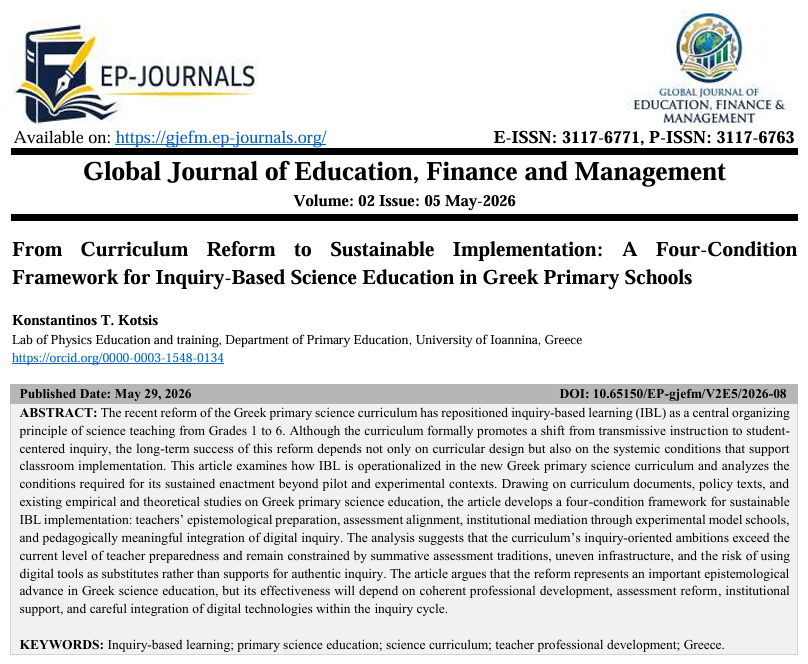
From Curriculum Reform to Sustainable Implementation: A Four-Condition Framework for Inquiry-Based Science Education in Greek Primary Schools
DOI:
https://doi.org/10.65150/EP-gjefm/V2E5/2026-08Keywords:
Inquiry-based learning, primary science education, science curriculum, teacher professional development, Greece.Abstract
The recent reform of the Greek primary science curriculum has repositioned inquiry-based learning (IBL) as a central organizing principle of science teaching from Grades 1 to 6. Although the curriculum formally promotes a shift from transmissive instruction to student-centered inquiry, the long-term success of this reform depends not only on curricular design but also on the systemic conditions that support classroom implementation. This article examines how IBL is operationalized in the new Greek primary science curriculum and analyzes the conditions required for its sustained enactment beyond pilot and experimental contexts. Drawing on curriculum documents, policy texts, and existing empirical and theoretical studies on Greek primary science education, the article develops a four-condition framework for sustainable IBL implementation: teachers’ epistemological preparation, assessment alignment, institutional mediation through experimental model schools, and pedagogically meaningful integration of digital inquiry. The analysis suggests that the curriculum’s inquiry-oriented ambitions exceed the current level of teacher preparedness and remain constrained by summative assessment traditions, uneven infrastructure, and the risk of using digital tools as substitutes rather than supports for authentic inquiry. The article argues that the reform represents an important epistemological advance in Greek science education, but its effectiveness will depend on coherent professional development, assessment reform, institutional support, and careful integration of digital technologies within the inquiry cycle.
References
1) Banchi, H., & Bell, R. (2008). The many levels of inquiry. Science and Children, 46(2), 26–29.
2) Chinn, C. A., Buckland, L. A., & Samarapungavan, A. (2011). Expanding the dimensions of epistemic cognition: Arguments from philosophy and psychology. Educational Psychologist, 46(3), 141–167. https://doi.org/10.1080/00461520.2011.587722
3) Dewey, J. (1938). Experience and education. Macmillan.
4) Duschl, R. A. (2008). Science education in three-part harmony: Balancing conceptual, epistemic, and social learning goals. Review of Research in Education, 32(1), 268–291. https://doi.org/10.3102/0091732X07309371
5) Duschl, R. A., & Grandy, R. (2013). Two views about explicitly teaching nature of science. Science & Education, 22(9), 2109–2139. https://doi.org/10.1007/s11191-012-9539-4
6) Erduran, S., Ozdem, Y., & Park, J.-Y. (2015). Research trends on argumentation in science education: A journal content analysis from 1998–2014. International Journal of STEM Education, 2(1), 5. https://doi.org/10.1186/s40594-015-0020-1
7) European Commission. (2022). Education for digital and green transitions: European education area progress report. Publications Office of the European Union. https://doi.org/10.2766/56895
8) Evangelou, F., & Kotsis, K. T. (2019). Real vs virtual physics experiments: Comparison of learning outcomes among fifth grade primary school pupils. A case on the concept of frictional force. International Journal of Science Education, 41(3), 330–348. https://doi.org/10.1080/09500693.2018.1549760
9) Ford, M. J. (2008). Disciplinary authority and accountability in scientific practice and learning. Science Education, 92(3), 404–423.
https://doi.org/10.1002/sce.20263
10) Furtak, E. M., Seidel, T., Iverson, H., & Briggs, D. C. (2012). Experimental and quasi-experimental studies of inquiry-based science teaching: A meta-analysis. Review of Educational Research, 82(3), 300–329. https://doi.org/10.3102/0034654312457206
11) Gavrilas, L., & Kotsis, K. T. (2025). The evolution of STEM education and the transition to STEAM/STREAM. Aquademia, 9(1), ep25002. https://doi.org/10.29333/aquademia/16313
12) Grant, M. J., & Booth, A. (2009). A typology of reviews: An analysis of 14 review types and associated methodologies. Health Information & Libraries Journal, 26(2), 91–108. https://doi.org/10.1111/j.1471-1842.2009.00848.x
13) Henderson, J. B., MacPherson, A., Osborne, J., & Wild, A. (2015). Beyond construction: Five arguments for the role and value of critique in learning science. International Journal of Science Education, 37(10), 1668–1697. https://doi.org/10.1080/09500693.2015.1043598
14) Hofer, B. K., & Pintrich, P. R. (1997). The development of epistemological theories: Beliefs about knowledge and knowing and their relation to learning. Review of Educational Research, 67(1), 88–140. https://doi.org/10.3102/00346543067001088
15) Ko, M.-L. M., & Krist, C. (2019). Opening up curricula to redistribute epistemic agency: A framework for supporting science teaching. Science Education, 103(4), 979–1010. https://doi.org/10.1002/sce.21511
16) Kotsis, K. T. (2024a). The significance of experiments in inquiry-based science teaching. European Journal of Education and Pedagogy, 5(2), 86–92. https://doi.org/10.24018/ejedu.2024.5.2.815
17) Kotsis, K. T. (2024b). Integrating ChatGPT into the inquiry-based science curriculum for primary education. European Journal of Education and Pedagogy, 5(6), 28–34. https://doi.org/10.24018/ejedu.2024.5.6.891
18) Kotsis, K. T. (2025a). Inquiry-Based Learning in the Latest Greek Primary School Curriculum and the New Challenges in Science Education. European Journal of Contemporary Education and E-Learning, 3(6), 55–71. https://doi.org/10.59324/ejceel.2025.3(6).05
19) Kotsis, K. T. (2025b). Experimental physics teaching in primary education: Progress, barriers, and lessons from a 23-year Greek study. Eurasian Journal of Science and Environmental Education, 5(2), 43–52. https://doi.org/10.30935/ejsee/17430
20) Kotsis, K. T. (2026). Toward an integrated model of science teacher education in Greece. European Journal of Contemporary Education and E-Learning, 4(1), 45–58. https://doi.org/10.59324/ejceel.2026.4(1).04
21) Kotsis, K. T., Gikopoulou, O., Patrinopoulos, M., Kapotis, E., & Kalkanis, G. T. (2023). Designing the new science curricula for primary education in Greece. In S. G. Soulis, M. Liakopoulou, & A. Galani (Eds.), Challenges and concerns in 21st century education (pp. 101–116). Cambridge Scholars Publishing.
22) Kotsis, K. T., Gikopoulou, O., Patrinopoulos, M., Kapotis, E., & Kalkanis, G. T. (2025). The new Greek inquiry-based learning science curriculum for primary education. Journal of Mathematics and Science Teacher, 5(3), em083.
https://doi.org/10.29333/mathsciteacher/16846
23) Kotsis, K. T., & Tsiouri, E. (2024). The important role of the Greek experimental model schools for the new curricula in education. European Journal of Contemporary Education and E-Learning, 2(6), 44–60. https://doi.org/10.59324/ejceel.2024.2(6).03
24) Koulaidis, V., & Dimopoulos, K. (2022). The pedagogic discourse of the Greek school science textbooks of primary and lower secondary level. Pedagogical Trends in the Aegean, 4(1), 3–9. https://doi.org/10.12681/revmata.31054
25) Lazonder, A. W., & Harmsen, R. (2016). Meta-analysis of inquiry-based learning: Effects of guidance. Review of Educational Research, 86(3), 681–718. https://doi.org/10.3102/0034654315627366
26) Loughran, J. (2019). Pedagogical reasoning: The foundation of the professional knowledge of teaching. Teachers and Teaching, 25(5),
523–535. https://doi.org/10.1080/13540602.2019.1633294
27) Mercer, N., & Howe, C. (2012). Explaining the dialogic processes of teaching and learning: The value and potential of sociocultural theory. Learning, Culture and Social Interaction, 1(1), 12–21. https://doi.org/10.1016/j.lcsi.2012.03.001
28) National Research Council. (2012). A framework for K–12 science education: Practices, crosscutting concepts, and core ideas. National Academies Press. https://doi.org/10.17226/13165
29) OECD. (2020). Education policy outlook in Greece (OECD Education Policy Perspectives, No. 17). OECD Publishing. https://doi.org/10.1787/c16b34fa-en
30) Official Government Gazette of the Hellenic Republic. (2023). OGG 3056/B/08-05-2023 [Establishment of the new primary science curriculum]. National Printing Office.
31) Osborne, J. (2010). Arguing to learn in science: The role of collaborative, critical discourse. Science, 328(5977), 463–466.
https://doi.org/10.1126/science.1183944
32) Osborne, J. (2014). Teaching scientific practices: Meeting the challenge of change. Journal of Science Teacher Education, 25(2), 177–
196. https://doi.org/10.1007/s10972-014-9384-1
33) Panagou, D., Stylos, G., & Kotsis, K. T. (2025). Exploring pre-service teachers' perspectives on integrating artificial intelligence in education. Journal of Digital Educational Technology, 5(2), ep2514. https://doi.org/10.30935/jdet/17297
34) Pedaste, M., Mäeots, M., Siiman, L. A., de Jong, T., van Riesen, S. A. N., Kamp, E. T., Manoli, C. C., Zacharia, Z. C., & Tsourlidaki, E. (2015). Phases of inquiry-based learning: Definitions and the inquiry cycle. Educational Research Review, 14, 47–61.
https://doi.org/10.1016/j.edurev.2015.02.003
35) Piaget, J. (1970). Science of education and the psychology of the child. Orion Press.
36) Posner, G. J., Strike, K. A., Hewson, P. W., & Gertzog, W. A. (1982). Accommodation of a scientific conception: Toward a theory of conceptual change. Science Education, 66(2), 211–227. https://doi.org/10.1002/sce.3730660207
37) Sandoval, W. A. (2005). Understanding students' practical epistemologies and their influence on learning through inquiry. Science Education, 89(4), 634–656. https://doi.org/10.1002/sce.20065
38) Strat, T. T. S., Henriksen, E. K., & Jegstad, K. M. (2024). Inquiry-based science education in science teacher education: A systematic review. Studies in Science Education, 60(2), 191–249. https://doi.org/10.1080/03057267.2023.2207148
39) Stroupe, D. (2014). Examining classroom science practice communities: How teachers and students negotiate epistemic agency and learn science-as-practice. Science Education, 98(3), 487–516. https://doi.org/10.1002/sce.21112
40) Stylos, G., Christonasis, A., & Kotsis, K. T. (2023). Pre-service primary teachers' views about scientific inquiry. International Journal of Studies in Education and Science, 4(2), 100–112. https://doi.org/10.46328/ijres.66
41) Stylos, G., Kamtsios, S., & Kotsis, K. T. (2023). Assessment of Greek pre-service primary teachers' efficacy beliefs in physics teaching. Journal of Science Teacher Education, 34(1), 44–62. https://doi.org/10.1080/1046560X.2021.2023959
42) Stylos, G., Siarka, O., & Kotsis, K. T. (2023). Assessing Greek pre-service primary teachers' scientific literacy. European Journal of Science and Mathematics Education, 11(2), 271–282. https://doi.org/10.30935/scimath/12637
43) Tsoumanis, K., Stylos, G., & Kotsis, K. T. (2023). A comparative study between Greek pre-service teachers and primary school students' scientific literacy levels. Science Education International, 34(2), 121–131. https://doi.org/10.33828/sei.v34.i2.6
44) Vosniadou, S. (1994). Capturing and modeling the process of conceptual change. Learning and Instruction, 4(1), 45–69. https://doi.org/10.1016/0959-4752(94)90018-3
45) Vosniadou, S., & Skopeliti, I. (2014). Conceptual change from the framework theory side of the fence. Science & Education, 23(7), 1427–1445. https://doi.org/10.1007/s11191-013-9640-3
46) Vygotsky, L. S. (1978). Mind in society: The development of higher psychological processes. Harvard University Press.
Downloads
Published
Issue
Section
License
Copyright (c) 2026 Konstantinos T. Kotsis (Author)

This work is licensed under a Creative Commons Attribution 4.0 International License.