Catholic Faith Formation as a Means of Strengthening Moral Values and Spirituality Among Youth at Santa Teresia Rungan Manuhing Parish, Gunung Mas Regency
DOI:
https://doi.org/10.65150/EP-gjefm/V2E8/2026-01Keywords:
Catholic Faith Formation, moral values; spirituality, Catholic youth, remote parishAbstract
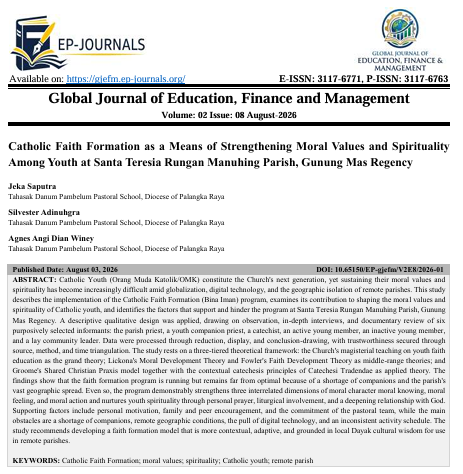
Catholic Youth (Orang Muda Katolik/OMK) constitute the Church's next generation, yet sustaining their moral values and spirituality has become increasingly difficult amid globalization, digital technology, and the geographic isolation of remote parishes. This study describes the implementation of the Catholic Faith Formation (Bina Iman) program, examines its contribution to shaping the moral values and spirituality of Catholic youth, and identifies the factors that support and hinder the program at Santa Teresia Rungan Manuhing Parish, Gunung Mas Regency. A descriptive qualitative design was applied, drawing on observation, in-depth interviews, and documentary review of six purposively selected informants: the parish priest, a youth companion priest, a catechist, an active young member, an inactive young member, and a lay community leader. Data were processed through reduction, display, and conclusion-drawing, with trustworthiness secured through source, method, and time triangulation. The study rests on a three-tiered theoretical framework: the Church's magisterial teaching on youth faith education as the grand theory; Lickona's Moral Development Theory and Fowler's Faith Development Theory as middle-range theories; and Groome's Shared Christian Praxis model together with the contextual catechesis principles of Catechesi Tradendae as applied theory. The findings show that the faith formation program is running but remains far from optimal because of a shortage of companions and the parish's vast geographic spread. Even so, the program demonstrably strengthens three interrelated dimensions of moral character moral knowing, moral feeling, and moral action and nurtures youth spirituality through personal prayer, liturgical involvement, and a deepening relationship with God. Supporting factors include personal motivation, family and peer encouragement, and the commitment of the pastoral team, while the main obstacles are a shortage of companions, remote geographic conditions, the pull of digital technology, and an inconsistent activity schedule. The study recommends developing a faith formation model that is more contextual, adaptive, and grounded in local Dayak cultural wisdom for use in remote parishes.
References
1) Amal, Y., Midun, H., Habur, A. M., Katolik, U., & Santu, I. (2024). Pastoral inovatif dan keterlibatan. 24(1), 37–50.
2) Creswell, J. W. (2014). Research design: Qualitative, quantitative, and mixed methods approaches (4th ed.). SAGE Publications.
3) Denzin, N. K. (1978). The research act: A theoretical introduction to sociological methods. McGraw-Hill.
4) Denzin, N. K., & Lincoln, Y. S. (2011). The SAGE handbook of qualitative research (4th ed.). SAGE Publications.
5) Fowler, J. W. (1981). Stages of faith: The psychology of human development and the quest for meaning. Harper & Row.
6) Groome, T. H. (1980). Christian religious education: Sharing our story and vision. Harper & Row.
7) Second Vatican Council. (1965). Gravissimum Educationis: Declaration on Christian education. Vatican.
8) Lickona, T. (2012). Character matters: Persoalan karakter. Bumi Aksara.
9) Lincoln, Y. S., & Guba, E. G. (1985). Naturalistic inquiry. SAGE Publications.
10) Miles, M. B., Huberman, A. M., & Saldaña, J. (2014). Qualitative data analysis: A methods sourcebook (3rd ed.). SAGE Publications.
11) Pope Francis. (2019). Christus Vivit: Post-synodal apostolic exhortation to young people and to the entire people of God. Vatican.
12) Pranyoto, Y. H. (2024). Pemberdayaan Orang Muda Katolik Paroki Muting, Keuskupan Agung Merauke dalam bidang pastoral-katekese dengan model Shared Christian Praxis. Aplikasia: Jurnal Aplikasi Ilmu-Ilmu Agama, 24(1), 21–36. https://doi.org/10.14421/aplikasia.v24i1.3556
13) Rahayu, A. D. (2023). Transformasi media digital dalam katekese kontekstual: Studi kasus terhadap pengelolaan pelayanan gereja-gereja kontemporer. Jurnal Magistra, 1(4), 19–26. https://doi.org/10.62200/magistra.v1i4.50
14) Santika, M., Adinuhgra, S., & Wirasari, P. M. E. (2019). Bina iman kaum muda sebagai upaya meningkatkan kehidupan menggereja OMK di Stasi Tumbang Kaman. Sepakat: Jurnal Pastoral Kateketik, 5(2), 41–51. https://doi.org/10.58374/sepakat.v5i2.21
15) Sinaga, R. D. (2024). Penghayatan Orang Muda Katolik Asrama Santo Stefanus tentang makna persekutuan dalam kehidupan menggereja. Jurnal Masalah Pastoral, 12(1), 1–17. https://doi.org/10.60011/jumpa.v12i1.162
16) Sitepu, A. G., Lumbanbatu, J., Sinulingga, A. A., & Sihotang, D. O. (2024). Pembinaan iman orang muda katolik di paroki santa perawan maria diangkat ke surga Kabanjahe. Jurnal PKM Setiadharma, 5(1), 70–79.
17) Sugiyono. (2019). Metode penelitian kualitatif: Untuk penelitian yang bersifat eksploratif, enterpretif, interaktif, dan konstruktif. Alfabeta.
18) Sutrisno, A. D. A. (2024). Membangun keseimbangan antara yang rohani dan yang duniawi: Pendekatan holistik dalam pendampingan Orang Muda Katolik. Focus, 5(2), 121–132.
19) Pope John Paul II. (1979). Catechesi Tradendae: Apostolic exhortation on catechesis in our time. Vatican.
Downloads
Published
Issue
Section
License
Copyright (c) 2026 Jeka Saputra , Silvester Adinuhgra , Agnes Angi Dian Winey (Author)

This work is licensed under a Creative Commons Attribution 4.0 International License.