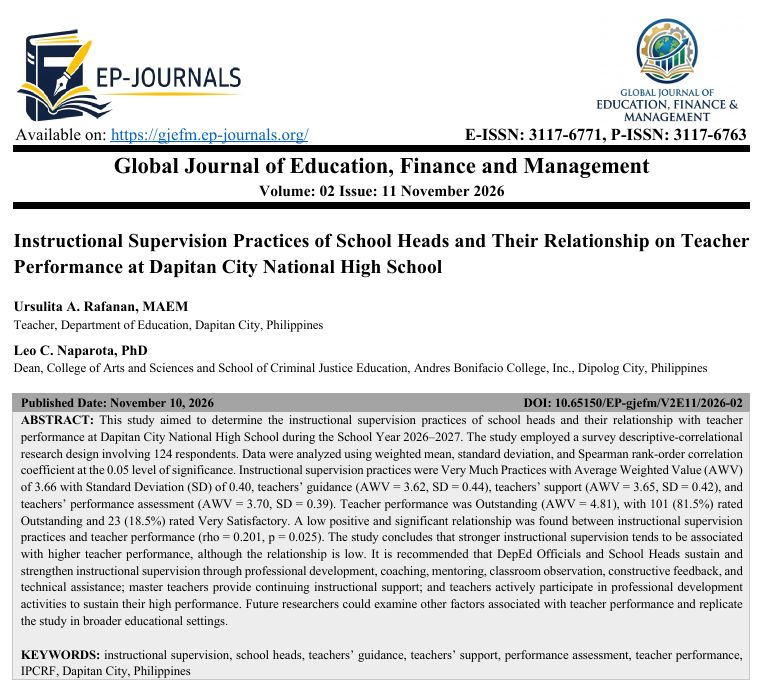
Instructional Supervision Practices of School Heads and Their Relationship on Teacher Performance at Dapitan City National High School
DOI:
https://doi.org/10.65150/EP-gjefm/V2E11/2026-02Keywords:
instructional supervision, school heads, teachers’ guidance, teachers’ support, performance assessment, teacher performance, IPCRF, Dapitan City, PhilippinesAbstract
This study aimed to determine the instructional supervision practices of school heads and their relationship with teacher performance at Dapitan City National High School during the School Year 2026–2027. The study employed a survey descriptive-correlational research design involving 124 respondents. Data were analyzed using weighted mean, standard deviation, and Spearman rank-order correlation coefficient at the 0.05 level of significance. Instructional supervision practices were Very Much Practices with Average Weighted Value (AWV) of 3.66 with Standard Deviation (SD) of 0.40, teachers’ guidance (AWV = 3.62, SD = 0.44), teachers’ support (AWV = 3.65, SD = 0.42), and teachers’ performance assessment (AWV = 3.70, SD = 0.39). Teacher performance was Outstanding (AWV = 4.81), with 101 (81.5%) rated Outstanding and 23 (18.5%) rated Very Satisfactory. A low positive and significant relationship was found between instructional supervision practices and teacher performance (rho = 0.201, p = 0.025). The study concludes that stronger instructional supervision tends to be associated with higher teacher performance, although the relationship is low. It is recommended that DepEd Officials and School Heads sustain and strengthen instructional supervision through professional development, coaching, mentoring, classroom observation, constructive feedback, and technical assistance; master teachers provide continuing instructional support; and teachers actively participate in professional development activities to sustain their high performance. Future researchers could examine other factors associated with teacher performance and replicate the study in broader educational settings.
References
1) Abutanmo, I. R., & Tantiado, R. C. (2023). Motivation and teachers’ performance. International Journal of Research Publications, 125(1), 947–957. https://doi.org/10.47119/IJRP1001251520234945
2) Aiken, L., & Susane, G. (2001). West multiple progression. Sage Publishing, Inc.
3) Aquino, C. J. C., Afalla, B. T., & Fabelico, F. L. (2021). Managing educational institutions: School heads’ leadership practices and teachers’ performance. International Journal of Evaluation and Research in Education, 10(4), 1325–1333.
https://doi.org/10.11591/ijere.v10i4.21518
4) Brandon, J., Hollweck, T., Donlevy, J. K., & Whalen, C. (2018). Teacher supervision and evaluation challenges: Canadian perspectives on overall instructional leadership. Teachers and Teaching, 24(3), 263–280. https://doi.org/10.1080/13540602.2018.1425678
5) Clara, T. B. (2026). Instructional supervision practices and supervisory challenges of school heads as determinants of teacher motivation in Atok District. Journal of Management, and Development Research, 3(2), 32–52.
6) Claud, D., & Dalisay, J. (2024). Demographic profile, school heads’ supervisory practices, and teachers’ performance: Towards corresponding intervention program. Romblon State University Research Journal, 6(2), 72–80. https://doi.org/10.58780/rsurj.v6i2.208
7) Cohen, J., Cohen, P., West, S. G., & Aiken, L. S. (2014). Applied multiple regression/correlation analysis for the behavioral sciences (3rd ed.). Routledge.
8) Creswell, J. W., & Guetterman, T. C. (2019). Educational research: Planning, conducting, and evaluating quantitative and qualitative research (6th ed.).
9) Department of Education. (2017). National adoption and implementation of the Philippine Professional Standards for Teachers (DepEd Order No. 42, s. 2017).
10) Department of Education, Schools Division of Bukidnon. (2023). Utilization of the electronic Individual Performance Commitment and Review Form (e-IPCRF) for teachers and online IPCRF consolidation system for SY 2022–2023 (Division Memorandum No. 298, s. 2023).
11) Department of Education. (2015). Guidelines on the establishment and implementation of the Results-Based Performance Management System (RPMS) in the Department of Education (DepEd Order No. 2, s. 2015).
12) Department of Education. (2017). Mandatory use of lead-safe paints in schools (DepEd Order No. 4, s. 2017).
13) Department of Education. (2023). Participation of teachers in volunteer work and extra curricular activities (DepEd Order No. 8, s.2023).
14) Department of Education. (2025). Amendment to DepEd Order No. 006, s. 2023 (Guidelines on the implementation of the Joint Delivery Voucher Program for Senior High School Technical-Vocational-Livelihood Specializations for School Year 2022–2023) (DepEd Order No. 002, s. 2025).
15) Donaldson, M. L., Mavrogordato, M., Youngs, P., & Dougherty, S. M. (2024). Principals’ priorities, teacher evaluation, and instructional leadership. Educational Researcher, 53(9), 487–495. https://doi.org/10.3102/0013189X241273903
16) Fernandez, M. A., & Selecios, A. (2025). Performance rating of Araling Panlipunan teachers and their teaching styles under the new normal. Psychology and Education: A Multidisciplinary Journal, 32(2), 127–135. https://doi.org/10.5281/zenodo.14858745
17) Fish, J., & Suyat, Z. (2026). Instructional leadership practices of school heads and its relationship to teachers’ Performance Management Evaluation System (PMES) rating. Psychology and Education: A Multidisciplinary Journal, 59(10), 1299–1315.https://doi.org/10.70838/pemj.591010
18) Godes, A. R., & Dioso, E. (2024). School head’s instructional supervisory practices and the performance of the teachers: A correlational study. Psychology and Education: A Multidisciplinary Journal, 23(7), 857–873. https://doi.org/10.5281/zenodo.13310054
19) Gragasin, E. R., Gante, L. I., Jr., Limos-Galay, J. A., & Lazaro, N. J. (2023). The impact of job satisfaction, anxiety, and attitude toward teaching on Individual Performance Commitment and Review Form (IPCRF) rating. International Journal of Research Studies inManagement, 11(12), 1–13. https://doi.org/10.5861/ijrsm.2023.1147
20) He, P., Guo, F., & Abazie, G. A. (2024). School principals’ instructional leadership as a predictor of teacher’s professional development. Asian-Pacific Journal of Second and Foreign Language Education, 9, Article 63. https://doi.org/10.1186/s40862-024-00290-0
21) Lacandazo, M., Saibudin, D. L., & Claveria, V. (2022). Job satisfaction and performance of public secondary school teachers in Bataraza, Palawan. Psychology and Education: A Multidisciplinary Journal, 5(9), 726–731. https://doi.org/10.5281/zenodo.7342180
22) Macayanan, M., & Abalos, A. (2023). Relationship of secondary teachers’ instructional skills, competencies and teaching performance. Wesleyan Scientific Review, 2(2), 37–49. https://doi.org/10.54788/wsr.v2i2.27
23) Mestry, R., & Govindasamy, V. (2021). The perceptions of school management teams and teachers of the principal’s instructional leadership role in managing curriculum changes. Interchange, 52, 545–560. https://doi.org/10.1007/s10780-021-09425-5
24) Muijs, D., Reynolds, D., Sammons, P., Kyriakides, L., Creemers, B. P. M., & Teddlie, C. (2018). Assessing individual lessons using a generic teacher observation instrument: How useful is the International System for Teacher Observation and Feedback? ZDM Mathematics Education, 50, 395–406. https://doi.org/10.1007/s11858-018-0921-9
25) Refugio, C. N., Galleto, P. G., & Torres, R. (2019). Competence landscape of Grade 9 mathematics teachers: Basis for an enhancement program. Cypriot Journal of Educational Sciences, 14(2), 241–256. https://doi.org/10.18844/cjes.v14i2.4125
26) Ruel, E. (2018). 100 questions (and answers) about survey research. SAGE Publications.
27) Saeed, S. B., & Ain, N. ul. (2022). Principal as instructional supervisor: Role of supervisory practices in professional development of APS&CS and FGEIS teachers. UMT Education Review, 5(2), 137–156. https://doi.org/10.32350/uer.52.08
28) Saunders, M. N. K., Lewis, P., & Thornhill, A. (2019). Research methods for business students(8th ed.). Pearson.
29) Tuytens, M., Devos, G., & Vanblaere, B. (2020). An integral perspective on teacher evaluation: A review of empirical studies. Educational Assessment, Evaluation and Accountability, 32, 153–183. https://doi.org/10.1007/s11092-020-09321-z
Downloads
Published
Issue
Section
License
Copyright (c) 2026 Ursulita A. Rafanan, MAEM, Leo C. Naparota, PhD (Author)

This work is licensed under a Creative Commons Attribution 4.0 International License.