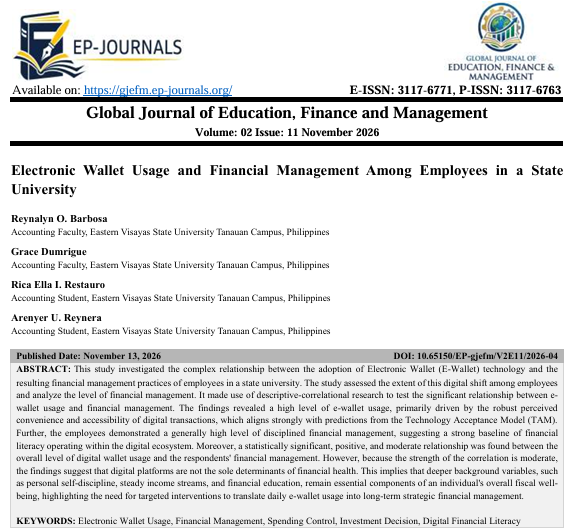
Electronic Wallet Usage and Financial Management Among Employees in a State University
DOI:
https://doi.org/10.65150/EP-gjefm/V2E11/2026-04Keywords:
Electronic Wallet Usage, Financial Management, Spending Control, Investment Decision, Digital Financial LiteracyAbstract
This study investigated the complex relationship between the adoption of Electronic Wallet (E-Wallet) technology and the resulting financial management practices of employees in a state university. The study assessed the extent of this digital shift among employees and analyze the level of financial management. It made use of descriptive-correlational research to test the significant relationship between e-wallet usage and financial management. The findings revealed a high level of e-wallet usage, primarily driven by the robust perceived convenience and accessibility of digital transactions, which aligns strongly with predictions from the Technology Acceptance Model (TAM). Further, the employees demonstrated a generally high level of disciplined financial management, suggesting a strong baseline of financial literacy operating within the digital ecosystem. Moreover, a statistically significant, positive, and moderate relationship was found between the overall level of digital wallet usage and the respondents' financial management. However, because the strength of the correlation is moderate, the findings suggest that digital platforms are not the sole determinants of financial health. This implies that deeper background variables, such as personal self-discipline, steady income streams, and financial education, remain essential components of an individual's overall fiscal well-being, highlighting the need for targeted interventions to translate daily e-wallet usage into long-term strategic financial management.
References
1) Abay-abay, R. J., Intig, M. R., Mohinog, A., & Valdez, C. A. (2023). Impulse buying behavior and pricing preferences of shoppers in Davao City. Business and Organization Studies E-Journal, 1(4), 21-37. https://ieesjournals.com/index.php/bosej/article/view/167
2) Aji, H. M., & Adawiyah, W. R. (2022). How e-wallets encourage excessive spending behavior among young adult consumers?. Journal of Asia Business Studies, 16(6), 868-884. https://doi.org/10.1108/JABS-01-2021-0025
3) Al-Ma'aitah, N., Al-Nahleh, O., & Alsmairat, M. A. (2024). Exploring the impact of electronic procurement on buyer-supplier relationship in the Jordanian pharmaceutical industry: an empirical study. International Journal of Procurement Management, 20(1), 85-105. https://doi.org/10.1504/IJPM.2024.137803
4) Angeles, I. T. (2026). Effects of Bank and Non-Bank Digital Banking on Customer Satisfaction, Financial Awareness, and Financial Inclusion: A Comparative Analysis.
5) Arner, D. W., Buckley, R. P., & Zetzsche, D. A. (2021). Digital Finance and its Regulation. In The Palgrave Handbook of Fintech and Blockchain (pp. 377–407). Palgrave Macmillan, Cham. https://www.nber.org/papers/w22476
6) Arini, N. K., Satia, M. A., & Ristiana, Y. (2024). Exploring the convenience and efficiency of e-wallet use in fast-paced work environments. Jurnal Ekonomi dan Bisnis, 15(1), 45–60.
7) Bangko Sentral ng Pilipinas. (2023). 2023 Report on E-Payments Measurement. Retrieved from
https://www.bsp.gov.ph/PaymentAndSettlement/2023_Report_on_Epayments_Measurement.pdf
8) Bangko Sentral ng Pilipinas. (2024). From surge to stability: Digital payments driving a steady transition, 2024 Status of digital payments in the Philippines. Retrieved from https://www.bsp.gov.ph/PaymentAndSettlement/2024_Report_on_E payments_Measurement.pdf
9) Baveja, G. S., & Verma, A. (2024). Impact of financial literacy on investment decisions and stock market participation using extreme learning machines. arXiv preprint arXiv:2407.03498. https://doi.org/10.48550/arXiv.2407.03498
10) Bian, W., Cong, L. W., & Ji, Y. (2024). The Rise of E-Wallet Super-Apps and Buy-Now-Pay-Later (No. w33178). National Bureau of Economic Research. http://dx.doi.org/10.2139/ssrn.4407023
11) Calderon, A. A. (2025). Digital payments and their role in enhancing financial transactions efficiency. International Journal of Economics and Financial Issues, 15(1), 182. http: www.econjournals.com
12) Chawla, S., & Singh, B. (2021). A study on factors affecting adoption of e-wallet in India. International Journal of Creative Research Thoughts, 9(4), 1668–1682. https://doi.org/10.30574/wjarr.2024.24.3.3965
13) GMA News. (2022, November 7). GCash surpasses 60 million registered users nationwide.
14) Hazar, A., & Babuşcu, Ş. (2023). Financial technologies: Digital payment systems and digital banking. today's dynamics. Journal of Research. Innovation and Technologies, 2(4), 162-178. https://doi.org/10.57017/jorit.v2.2(4).04
15) Jagapur, A. B., & Vinay, V. (2025). The role of real-time transaction monitoring in promoting financial discipline among young professionals. Asian Journal of Management Studies, 16(1), 10–25. https://ijrpr.com/uploads/V6ISSUE6/IJRPR48614.pdf
16) Kaur, G., & Singh, N. (2020). E-wallets: Adoption and challenges in India. International Journal of Management, Technology and Engineering, 10(1), 1076–1082. https://www.nber.org/papers/w22476
17) Komandla, V. (2024). Transforming Financial Interactions: Best Practices for Mobile Banking App Design and Functionality to Boost User Engagement and Satisfaction. Global Research Review in Business and Economics, 10(5), 91-101. https://doi.org/10.56805/grrbe
18) Krejcie, R. V., & Morgan, D. W. (1970). Determining sample size for research activities. Educational and Psychological Measurement, 30(3), 607–610.
19) Kumar, P., Pillai, R., Kumar, N., & Tabash, M. I. (2023). The interplay of skills, digital financial literacy, capability, and autonomy in financial decision making and well-being. Borsa Istanbul Review, 23(1), 169–183. https://doi.org/10.1016/j.bir.2022.09.012
20) Lee, J., & Lee, S. (2021). The effects of perceived risk on e-wallet adoption: Focusing on gender differences. Journal of Theoretical and Applied Electronic Commerce Research, 16(2), 246–261. https://doi.org/10.3390/jtaer16020014
21) Leyesa, M. ., S. De Jesus, F. ., De Jesus, C. ., Gerald A. Quijano, A., & Agustin, N. . (2024). Examining consumers attitude towards E-wallet utilization as a payment method using technology acceptance model: A perspective from young generations in Nueva Ecija, Philippines. Edelweiss Applied Science and Technology, 8(4), 1157–1173. https://doi.org/10.55214/25768484.v8i4.1490
22) Mahato, S., Yadav, R., & Mahato, B. (2025). Impact of E-Wallets on Consumer Spending Behavior: A Mediating Role of Financial Management. Journal of Economics and Management, 5(1), 139-155. https://doi.org/10.3126/jem.v5i1.87119
23) Malaluan, M. J. (2025). E-wallet adoption: shapıng consumer decısıon-makıng towards ımpulse buyıng tendencıes. International Journal of Novel Research and Development. 10 (2).
24) Ozili, P. K. (2018). Impact of digital finance on financial inclusion and stability. Borsa Istanbul Review, 18(4), 329–340. https://doi.org/10.1016/j.bir.2018.10.003
25) Parungao, J. F. (2024). Cybersecurity awareness and practices among e-wallet users: A Philippine context. International Journal of Digital Finance, 14(2), 150–165. https://www.ijams-bbp.net/wp-content/uploads/2024/05/4-IJAMS-APRIL-2024-205-217.pdf
26) Philippine Statistics Authority. (2024). Digital Economy contributes 8.4 percent to the Economy in 2023.
https://psa.gov.ph/content/digital-economy-contributes-84percent-economy-2023Saif, S., Ahmad, M., & Farooq, M. (2022). Factors influencing the adoption of E-wallets in developing countries: The role of trust and perceived risk. Journal of Business Research, 142, 888–898. https://doi.org/10.1016/j.jbusres.2022.01.002
27) Schueffel, P. (2021). Fintech and Blockchain: The next generation of financial services. In The Palgrave Handbook of Fintech and Blockchain (pp. 1-17). Palgrave Macmillan, Cham. https://doi.org/10.1016/j.jbusres.2022.01.002
28) Syafiqah, A.D. & Diana, D. (2024). The Influence of Factors on Students’ Financial Management: SEM Approach. Airlangga Journal of Innovation Management, 5(2), 231-246. https://doi.org/10.20473/ajim.v5i2.57746
29) Wardana, A., Widyastuti, P., & Al-Hakim, R. R. (2022). The influence of ease of use on usage decisions and purchase decisions for e-wallet. International Journal of Social Science Research and Review, 5(6), 180–186. https://www.atlantispress.com/article/125975182.pdf
30) Xiao, J. J., & O'Neill, B. (2018). Propensity to plan, financial capability, and financial satisfaction. International Journal of Consumer Studies, 42(5), 501-512. https://doi.org/10.1111/ijcs.12461
31) Yousef, F. Z. Y. (2024). The impact of e-wallets on consumer spending behavior and financial management. International Journal for Scientific Research. London, 3 (12), 12. https://doi.org/10.59992/IJSR.2024.v3n12p12
Downloads
Published
Issue
Section
License
Copyright (c) 2026 Reynalyn O. Barbosa, Grace Dumrigue, Rica Ella I. Restauro, Arenyer U. Reynera (Author)

This work is licensed under a Creative Commons Attribution 4.0 International License.