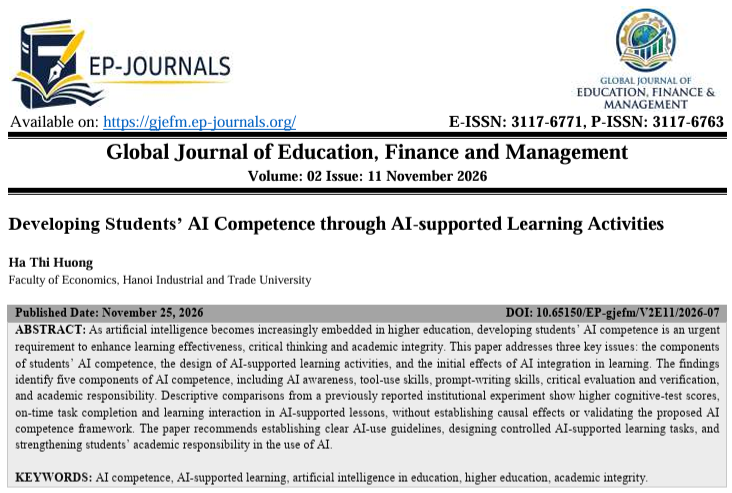
Developing Students’ AI Competence through AI-supported Learning Activities
DOI:
https://doi.org/10.65150/EP-gjefm/V2E11/2026-07Keywords:
AI competence, AI-supported learning, artificial intelligence in education, higher education, academic integrityAbstract
As artificial intelligence becomes increasingly embedded in higher education, developing students’ AI competence is an urgent requirement to enhance learning effectiveness, critical thinking and academic integrity. This paper addresses three key issues: the components of students’ AI competence, the design of AI-supported learning activities, and the initial effects of AI integration in learning. The findings identify five components of AI competence, including AI awareness, tool-use skills, prompt-writing skills, critical evaluation and verification, and academic responsibility. Descriptive comparisons from a previously reported institutional experiment show higher cognitive-test scores, on-time task completion and learning interaction in AI-supported lessons, without establishing causal effects or validating the proposed AI competence framework. The paper recommends establishing clear AI-use guidelines, designing controlled AI-supported learning tasks, and strengthening students’ academic responsibility in the use of AI.
References
1) Holmes, W., Bialik, M., & Fadel, C. (2019). Artificial intelligence in education: Promises and implications for teaching and learning. Center for Curriculum Redesign. https://unesdoc.unesco.org/ark:/48223/pf0000368021
2) Long, D., & Magerko, B. (2020). What is AI literacy? Competencies and design considerations. In Proceedings of the 2020 CHI Conference on Human Factors in Computing Systems (pp. 1–16). Association for Computing Machinery.
https://doi.org/10.1145/3313831.3376727
3) Miao,F., & Cukurova, M. (2024). AI competency framework for teachers. UNESCO. https://unesdoc.unesco.org/ark:/48223/pf0000391104
4) Miao, F., & Holmes, W. (2023). Guidance for generative AI in education and research. UNESCO. https://unesdoc.unesco.org/ark:/48223/pf0000386693
5) Miao, F., Shiohira, K., & Lao, N. (2024). AI competency framework for students. UNESCO. https://unesdoc.unesco.org/ark:/48223/pf0000391105
6) Mishra, P., & Koehler, M. J. (2006). Technological pedagogical content knowledge: A framework for teacher knowledge. Teachers College Record, 108(6), 1017–1054. https://doi.org/10.1111/j.1467-9620.2006.00684.x
7) Tran, T. N. (2026). Research on the application of selected AI tools in teaching at Hanoi Industrial and Trade University [Institutional research project report]. Hanoi Industrial and Trade University.
Downloads
Published
Issue
Section
License
Copyright (c) 2026 Ha Thi Huong (Author)

This work is licensed under a Creative Commons Attribution 4.0 International License.